Table of Contents
- Short Answer: Specify Two Protection Layers, Then Test the Response
- Why a Magnet Does Not Replace a Metal Detector
- Put Protection on the Route That Actually Reaches the VSI
- Select the Magnet for the Belt and Burden, Not Only the Crusher Nameplate
- Define the Detector Trip, Stop, or Diversion Sequence in Writing
- Make Tramp-Metal Protection a Commissioning Acceptance Item
- Common Buying Mistakes That Leave a Gap Before the Rotor
- What to Send for a Protection Proposal
- FAQ
- Can a magnet protect a VSI crusher from all metal?
- Where should a metal detector be installed for a VSI crusher?
- Should the magnet go before or after the metal detector?
- What information is needed to size a suspended magnet?
- What should happen when the detector alarms?
- Can a detector be tested with an empty belt?
- Does a self-cleaning magnet eliminate maintenance work?
- What should be included in the supply contract?
VSI Crusher Tramp Metal Protection: Magnets and Metal Detectors
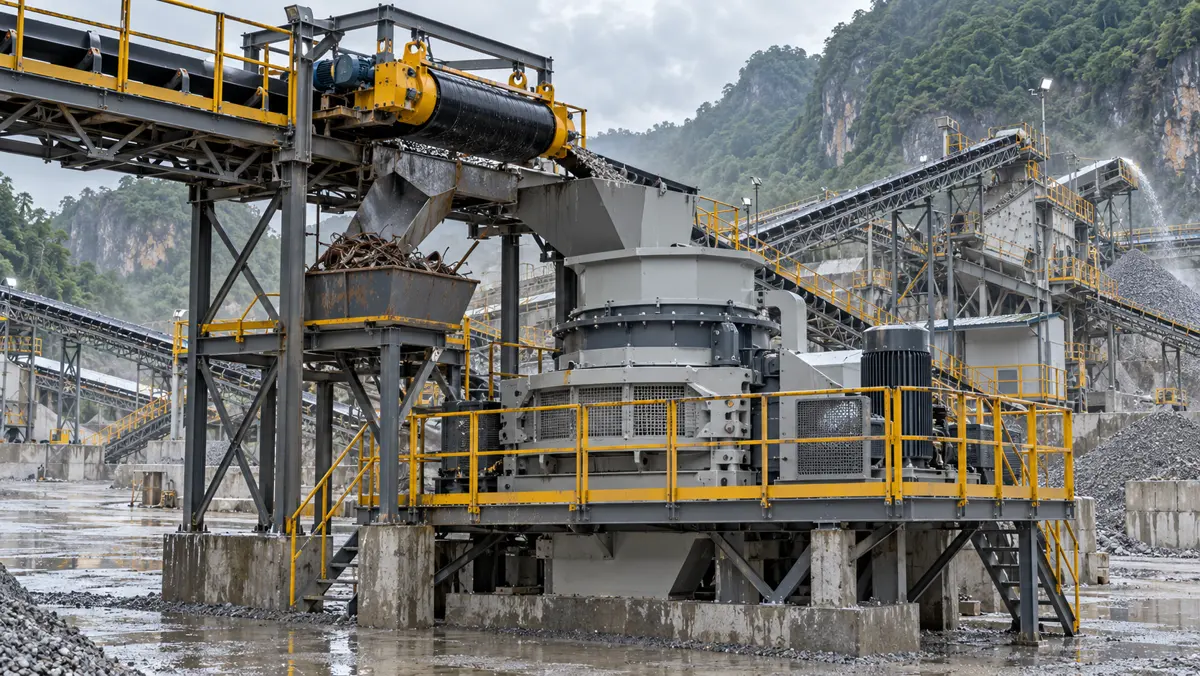
A VSI crusher needs a feed-protection system whenever the material stream could carry excavator teeth, drill steel, bucket pins, screen media, bolts, tools, or other metal into the rotor and chamber. A suspended magnet can remove suitable ferrous pieces before the VSI, but it is not a universal metal-removal guarantee. A metal detector with an agreed stop or diversion response is the separate layer that addresses metal the magnet may not capture. Specify the whole route: feed source, belt width and burden, magnet location and discharge, detector location and sensitivity test, conveyor stop logic, safe clearing method, and restart authorization. Send the raw material, feed size, output size, capacity, site photos, and budget range before choosing the protection scope.
Short Answer: Specify Two Protection Layers, Then Test the Response
For a VSI feed conveyor, use a magnet to remove the ferrous tramp it is designed to capture and a correctly specified detector to identify metal that should stop or divert the feed. Neither device should be accepted as a stand-alone promise that every possible object has been eliminated.
The supplier must size and locate the equipment for the actual belt, burden depth, material, throughput, available headroom, and likely metal hazards. The plant control system also needs a defined response and a safe, supervised method for investigating an alarm. That scope matters as much as the magnet or detector model number.
Why a Magnet Does Not Replace a Metal Detector
Magnets and detectors do different jobs. A suspended or pulley magnet attracts magnetically susceptible ferrous material. A metal detector senses metal in the conveyed stream and can pass an alarm to a control system; its practical result depends on the selected detector, material effect, installation, sensitivity setting, and response arrangement.
| Protection layer | Primary job | Do not assume it will do this | What the RFQ should state |
|---|---|---|---|
| Suspended or pulley magnet | Remove appropriate ferrous tramp before the crusher | Capture every non-ferrous, stainless, alloy, deeply buried, or unusually shaped piece | Belt width, burden, speed, material, suspension height, mounting, cleaning method, and scrap-discharge arrangement |
| Metal detector | Detect metal and initiate the agreed control response | Physically remove the object or make an unsafe clearing operation safe | Conveyor location, test method, alarm, stop/divert logic, interlocks, reset method, and delay |
| Guarded recovery point | Keep removed or detected metal out of the product route and provide a controlled inspection point | Permit people to reach into a moving belt, chute, or crusher | Access platform, guarding, lockout/isolation responsibility, collection bin, lighting, and housekeeping scope |
The exact magnetic response of a part cannot be guessed from its general description. Treat likely contamination sources as an input to selection. In quarry and recycling work, magnetic separation and detection are often used together: the magnet reduces ferrous burden, while the detector provides another barrier for metal that remains in the stream.
Before spending money on protection hardware, first control the feed itself. Oversize, unstable loading, wet clay, and a poorly managed return stream can make a good device look ineffective. Review VSI feed-size control and wet-feed preparation as part of the same feed-system review.
Put Protection on the Route That Actually Reaches the VSI
The best location is the last practical point that protects the VSI from the identified hazard while still giving the magnet and detector a stable, measurable burden and a safe place to act. On a typical plant this is a dedicated feed conveyor before the VSI feed hopper, but the right layout changes when there are several feed sources, a stockpile tunnel, a bypass, a recirculating return, or mobile equipment.
- Which belts can feed the VSI? A magnet on one transfer is ineffective if a return conveyor, bypass chute, loader feed, or maintenance route can introduce unprotected material later.
- Where is the burden controlled? A magnet and detector need predictable material depth and a mechanically stable installation. A piled, surging, or overfilled belt makes selection and test results less meaningful.
- What happens after an alarm? The conveyor stopping distance, feeder delay, downstream run-out, and safe inspection point must be engineered with the controls and conveyor suppliers.
- Where does removed iron go? A self-cleaning magnet needs clearance for its discharge belt and a collection point that will not spill, re-enter the product stream, or create an unsafe cleanup task.
- Can the crew maintain it safely? Include platform access, guards, isolation points, lighting, housekeeping needs, and a documented restart sequence.
Do not place a detector only after the VSI and call that crusher protection. It may be useful for downstream product control, but it cannot prevent the detected item from entering the rotor. Ask the selected supplier for an arrangement drawing that shows the actual belt, trajectories, supports, clearance envelope, and removal route.

Select the Magnet for the Belt and Burden, Not Only the Crusher Nameplate
A VSI model does not determine the magnet size. The magnet supplier needs the feed-belt width, speed, burden depth, material density and gradation, expected metal type and size, suspension height, and space available for mounting and cleaning. Wet material, heavy burden, high speed, and deeply buried metal can change what is realistically removed.
- Suspended permanent magnet: can provide continuous magnetic protection without a magnet power supply, subject to application-specific sizing and installation.
- Suspended electromagnet: can be considered where duty, separation depth, or expected metal calls for the selected supplier’s higher-duty solution; it brings its own power, control, support, and maintenance requirements.
- Self-cleaning versus manual cleaning: self-cleaning equipment may suit a higher or more continuous tramp load, while a manual-cleaning arrangement needs a safe, isolated procedure and a realistic cleaning frequency.
- Cross-belt versus in-line arrangement: space, material trajectory, scrap discharge, belt direction, and separation requirement determine which is appropriate.
Ask for the magnet face-to-belt or face-to-burden reference used in the proposal, not only an overall suspension height. The seller should also identify any non-magnetic idler, head-pulley, splitter, or structural requirements necessary for the chosen arrangement.
Define the Detector Trip, Stop, or Diversion Sequence in Writing
A detector adds value only when its signal leads to a controlled response before the object can reach the protected machine. In many plants that response is a coordinated stop of the feeder and conveyor sequence. Some layouts may use a diversion arrangement, but it must be designed for the actual material flow, guarding, and recovery procedure—not added as a generic sketch.
| Control item | Buyer decision to document |
|---|---|
| Detection point | The protected belt and distance to the VSI feed point, including any sources that can bypass it |
| Alarm response | Audible/visual indication, feeder inhibit, conveyor stop, diversion command, or a defined combination |
| Material tracking | How belt speed, run-out time, and any delay are handled so suspect material can be found safely |
| Reset authority | Who investigates, who confirms the conveyor is clear, and who may reset the protection trip |
| Interlocks and evidence | Safe restart conditions, alarm log, test record, trip-cause record, and corrective-action owner |
Do not choose an aggressive sensitivity setting without a representative test. Natural mineral content, moisture, belt construction, electrical noise, and normal operating conditions can affect detector behaviour. The detector supplier should define the approved test method, representative test pieces, commissioning settings, and limits of the proposed system. If frequent nuisance trips occur, investigate the feed and installation first; bypassing a protection circuit to maintain throughput shifts the risk to the rotor, conveyors, and people.
Make Tramp-Metal Protection a Commissioning Acceptance Item
Treat protection equipment as part of the crushing-circuit acceptance record, not as a separate add-on. At handover, the site should be able to demonstrate the intended material route, removal path, detector response, safe recovery method, and restart control using the approved procedures.
- Verify the installed magnet type, support frame, clearances, collection bin, guards, and cleaning method against the approved drawing.
- Confirm that every material route into the VSI has the intended protection or an explicitly controlled exception.
- Carry out supplier-approved magnet and detector tests with the conveyor at representative operating conditions. Keep people clear of moving equipment.
- Demonstrate feeder response, belt stop or diversion, indication, safe isolation, inspection point, reset, and normal restart.
- Record the test conditions, material burden, detector settings, test article, results, corrective actions, and responsible person.
The site procedure, OEM manual, electrical drawings, and local safety requirements take priority over this buyer checklist. Connect it to the broader VSI commissioning checklist so a protection trip, feed-rate change, product sample, power trend, and return load are not evaluated as unrelated events.

Common Buying Mistakes That Leave a Gap Before the Rotor
- Ordering “one magnet for the crusher.” This does not define belt geometry, burden, expected objects, scrap discharge, mounting, or unprotected bypasses.
- Treating the magnet as a non-ferrous solution. A detector and a safe response plan are still required when the risk includes metal that magnetic separation may not remove.
- Buying the detector without control integration. An alarm with no defined feeder inhibit, stop/divert logic, recovery point, and reset authority does not protect the rotor reliably.
- Ignoring mobile and maintenance feed routes. Loader-fed material, temporary bypasses, or replacement belts can defeat an otherwise good arrangement.
- Leaving cleaning and access out of the proposal. The plant then inherits unsafe manual handling, poor housekeeping, or unplanned downtime.
- Testing only when the belt is empty. Acceptance must reflect representative burden, speed, moisture, and operating sequence according to the selected supplier’s method.
The same discipline helps when the symptom looks unrelated. A sudden change in vibration, motor trend, bearing temperature, screen return, or discharge stability should prompt a controlled inspection rather than an assumption that a single component has failed. See VSI bearing-temperature and lubrication checks, feed-rate control, and closed-circuit VSI screening for related operating boundaries.
What to Send for a Protection Proposal
Send the raw material and likely contamination sources; feed size distribution and maximum top size; target output size and capacity; belt widths, speeds, and approximate burden; layout drawing; site photos of the existing feed route; power and control information; whether the plant is fixed or mobile; and the budget range. Include a photo of common recovered metal if it is safe and available.
With that information, an equipment supplier can define the protection boundary, ask for missing installation data, and explain which items belong in the magnet, detector, structural, electrical, guarding, and commissioning scopes. That is much more useful than a generic promise that a VSI will be “metal protected.”
FAQ
Can a magnet protect a VSI crusher from all metal?
No. A magnet is selected to attract and remove suitable ferrous material under stated belt, burden, and installation conditions. It should not be assumed to capture every type, size, position, or composition of metal. Use a detector and an agreed control response as a separate protection layer.
Where should a metal detector be installed for a VSI crusher?
Install it on a defined conveyor route before the protected VSI, at a point where its alarm can trigger the designed stop or diversion sequence before the suspect object reaches the feed hopper. Confirm all alternate feed and return routes in the layout review.
Should the magnet go before or after the metal detector?
The sequence is application-specific. A magnet is often used upstream to remove ferrous tramp so a detector can focus on metal that remains, but the selected equipment suppliers should confirm spacing, controls, access, and test conditions for the actual conveyor.
What information is needed to size a suspended magnet?
Provide belt width, speed, burden depth, material density and size, expected metal hazards, suspension height, available headroom, duty cycle, and whether the unit will be manual-cleaning or self-cleaning. The crusher capacity alone is not enough.
What should happen when the detector alarms?
The approved control sequence should stop or divert the material before it reaches the protected equipment, identify the alarm, allow safe isolation and inspection, and require an authorized reset. The exact sequence must be engineered for the conveyor and site procedure.
Can a detector be tested with an empty belt?
An empty-belt check may be part of commissioning, but it is not enough to demonstrate performance under real burden and operating conditions. Use the detector supplier’s approved representative test method and record the settings and response.
Does a self-cleaning magnet eliminate maintenance work?
No. It reduces manual removal in suitable applications, but the discharge path, collection area, support, belt condition, guards, and safe inspection procedure still need routine attention.
What should be included in the supply contract?
Include the defined protected routes, magnet and detector equipment, mounting and structural scope, controls and interlocks, cable and power interfaces, guards and access, scrap collection, commissioning tests, documentation, training responsibilities, and exclusions.