Table of Contents
- Short Answer: Treat Cascade Feed as a Controlled Process Split
- What Cascade Feed Changes Inside a VSI
- Do Not Start With a Universal Bypass Ratio
- Match the Cascade Strategy to the Crushing Mode
- A Practical Plant-Test Sequence
- Warning Signs That the Split Is Not Helping
- Specify the Cascade Arrangement in the RFQ and Layout
- Cost and Wear: Look Beyond Instantaneous TPH
- Buyer Checklist Before Asking for a Cascade-Feed Recommendation
- FAQ
- What is cascade feed on a VSI crusher?
- What is the best cascade-feed ratio for a VSI?
- Can cascade feed increase VSI crusher capacity?
- Does more cascade feed reduce wear?
- Should I change rotor speed and cascade feed together?
- Can wet feed be used with a cascade arrangement?
- Does cascade feed work with rock-on-iron VSI crushers?
- What information should I send for a cascade-feed proposal?
- Request a VSI Cascade-Feed Review
VSI Crusher Cascade Feed: How to Set Bypass Ratio for Sand Shape, Capacity, and Wear
A VSI crusher cascade-feed setting should be chosen from the material, required product, rotor arrangement, chamber condition, and screen return load—not copied as a universal percentage. In an adjustable arrangement, part of prepared feed enters the rotor while a controlled stream enters the chamber around it. Changing that split can affect material acceleration, chamber rock bed, product shape, throughput stability, and wear pattern. Start from the supplier’s approved arrangement, establish a measured baseline, and change one variable at a time while checking final grading, particle shape, motor load, vibration, return load, and wear. A supplier needs representative rock, feed-size distribution, target gradation, capacity, and layout before proposing a setting.
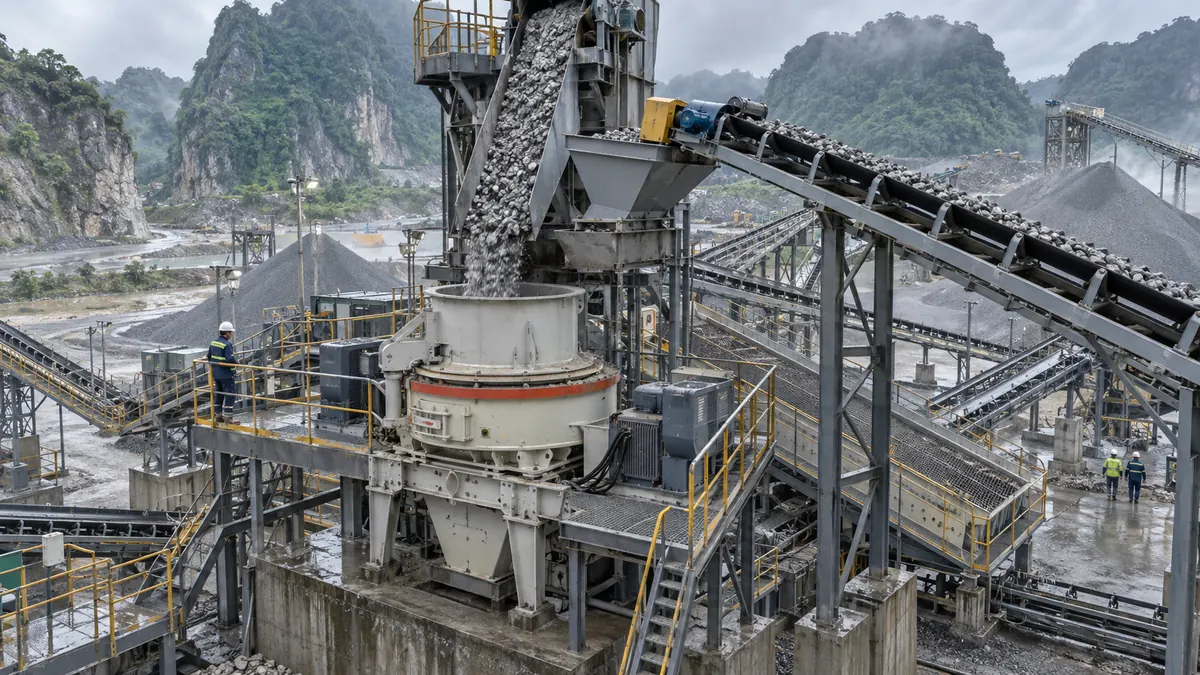
Short Answer: Treat Cascade Feed as a Controlled Process Split
Cascade feed is not simply an extra conveyor above a VSI. On compatible designs, it lets a portion of prepared feed enter the crushing chamber without first passing through the rotor centre. The central feed and cascade stream then interact with the rotor’s accelerated material and the chamber’s rock lining according to the crusher design and operating condition.
It is a tuning variable, not a cure for poor feed preparation. If feed is too coarse, wet, clay-rich, erratic, or outside the permitted gradation, changing the cascade setting can hide the real problem. First confirm VSI feed-size control, stable feeder control, and the intended rotor/chamber arrangement.
What Cascade Feed Changes Inside a VSI
The exact material path varies by manufacturer and rotor configuration, so the equipment manual and supplier commissioning guidance take priority. Direct rotor feed is accelerated through the rotor, while cascade material is introduced to the chamber by a separate route. The balance changes the proportion of material that sees direct rotor acceleration versus interaction with accelerated particles and the chamber rock bed.
| Operating objective | What the cascade setting may influence | What must be checked with it |
|---|---|---|
| Particle shape and surface texture | More or less direct rotor action can change how strongly feed is worked in the chamber | Shape index, flaky/elongated fraction where relevant, sand texture, and final grading |
| Capacity and motor duty | The split can change rotor loading and chamber fill | Motor trend, feed rate, vibration, discharge stability, and screen loading |
| Wear life | A stable rock bed may protect selected chamber surfaces on compatible rock-on-rock arrangements | Rotor-tip, anvil, liner, and distributor wear pattern—not only total hours |
| Fines and gradation | Impact, inter-particle breakage, and return load can shift the fine fraction | 0–5 mm quantity, fineness modulus where applicable, screen efficiency, and recirculating load |
| Plant stability | An uncontrolled split can cause surging or uneven chamber load | Feeder response, chute flow, belt loading, screen overflow, spillage, and dust |
These are directions to investigate, not guaranteed results. Rock strength, abrasiveness, moisture, natural fines, rotor speed, chamber wear, and the product specification can reverse the commercial value of a setting.
Do Not Start With a Universal Bypass Ratio
There is no responsible universal cascade percentage for every VSI. A setting that works with dry, well-graded river stone in a rock-on-rock chamber can be unsuitable for abrasive basalt, high-fines material, a different rotor, or a plant operating with a heavily loaded return conveyor. Some designs do not have the same adjustment range, and some applications should follow a fixed supplier-approved feed route.
- Confirm the permitted adjustment method. Use the OEM’s safe access and adjustment procedure; never modify chutes, gates, guards, or feed routes while equipment is running.
- Measure the starting condition. Record fresh-feed rate, feed gradation, moisture, rotor speed, motor trend, screen configuration, return load, product samples, and wear condition.
- Keep upstream feed stable. Review how to avoid unstable VSI feed rate before testing the split.
- Change one approved variable at a time. Let the plant stabilize, take representative samples, and record the same data after each change.
- Decide against saleable product and total plant duty. Confirm grading, shape, screen return, wear risk, and downstream handling—not just a single power or throughput number.
The target is a repeatable operating window, not the largest possible cascade opening. Record the approved gate position or feeder split, material condition, measured rates, and sample results.
Match the Cascade Strategy to the Crushing Mode
In a rock-on-rock arrangement, the chamber rock bed and material-on-material interaction are central to breakage and surface protection. A cascade stream may help sustain the intended chamber condition when feed is within specification, but it must be evaluated with the actual material and rotor setting. Read rock-on-rock vs. rock-on-iron VSI crushing before treating the cascade route as a stand-alone setting.
In a rock-on-iron or hybrid arrangement, installed wear parts and approved limits have more direct influence on how the chamber absorbs impact. The split still affects flow and load, but it must never compensate for incorrect anvils, worn liners, an unsuitable rotor, or prohibited oversize.
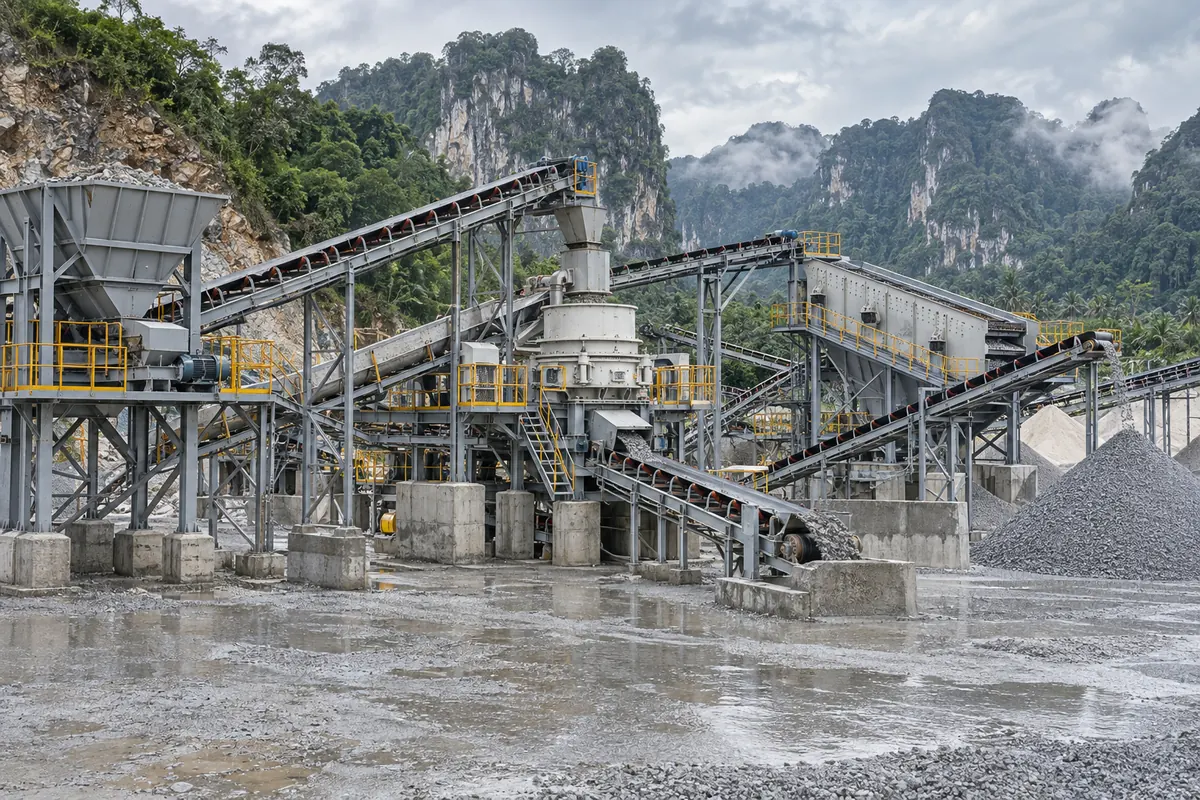
Connect cascade decisions to rotor-speed selection and the current VSI wear-parts condition. Changing rotor speed and cascade split together makes troubleshooting difficult.
A Practical Plant-Test Sequence
Start a trial only after normal material flow and safety conditions are established. Use the same rock source and a representative operating period. If the quarry changes benches or feed moisture changes after rain, record it; those changes may explain more than the gate setting.
| Step | Record | Why it matters |
|---|---|---|
| Baseline | Fresh feed, gradation, moisture, rotor speed, route, motor trend, product samples, screen load, and wear condition | Creates a reference before adjustment |
| Approved split change | Exact controlled change, time, operator, and unchanged feeder/screen settings | Keeps the trial traceable |
| Stabilized observation | Throughput, motor trend, vibration, chute flow, belts, dust, spillage, and screen behavior | Checks the whole circuit remains controlled |
| Product check | Representative sieve result, shape assessment, fines quantity, and saleable-product separation | Tests the buyer requirement, not only crusher operation |
| Wear review | Rotor tips, liners, anvils where fitted, distributor, and chamber build-up | Detects uneconomic or unsafe wear |
In a closed circuit, inspect the screen and return conveyor before assuming the VSI is the constraint. A new grading may change return load even with the same fresh-feed rate. See when a VSI plant needs a screen for the circuit boundary to measure.
Warning Signs That the Split Is Not Helping
Stop and review the process with the supplier when a change is followed by persistent feeder surging, abnormal vibration, unusual noise, material buildup, rapid wear, screen overload, unstable motor behavior, spillage, or an off-spec product. Do not keep changing the cascade route until a symptom disappears.
The source may be unsuitable feed gradation, moisture or clay, worn parts, a blocked chute, a screen limit, or excessive return load. For wet or clay-bearing material, solve drainage, scalping, or washing first; see when a VSI needs pre-screening, drainage, or washing.
Specify the Cascade Arrangement in the RFQ and Layout
- Whether the proposed VSI model and rotor configuration support adjustable cascade feed for the stated material and product target.
- Feed-size distribution, maximum top size, moisture range, natural fines/clay, rock strength, abrasiveness, and representative samples.
- Direct-feed and cascade-feed hardware: chute layout, gate or feeder control, liners, supports, inspection doors, sensors, guards, and service access.
- Fresh-feed capacity, return load, screen deck configuration, output sizes, grading/shape requirement, and measurement method for commissioning.
- Operating envelope, commissioning support, spare wear parts, adjustment limits, interlocks, and data required to compare trials.
This avoids treating a cascade-feed conveyor as an optional accessory when it changes how the crusher, screen, return load, and wear budget must be evaluated.
Cost and Wear: Look Beyond Instantaneous TPH
A setting that appears to reduce rotor duty may still cost more if it produces an unsuitable gradation, pushes extra material around the return loop, overloads a screen, increases another wear zone, or reduces saleable product. A shape-improving setting may be worthwhile if the market pays for a specification the plant can make consistently. Compare saleable tonnes, power trend, screening duty, wear use, labor, downtime, and product quality.

Buyer Checklist Before Asking for a Cascade-Feed Recommendation
- Representative raw-material samples, rock type, abrasiveness, moisture range, clay and natural-fines observations.
- Normal and maximum feed size, full feed-size distribution, upstream crushing and screen arrangement.
- Required output sizes, grading limits, shape expectation, capacity, and final product use.
- VSI make/model, rotor/chamber arrangement, installed wear parts, rotor speed, operating history, and photos of the crusher, chutes, screen, and return conveyor.
- Fresh-feed measurement method, circulating load, screen deck sizes, control range, motor/vibration/dust observations, site photos, commissioning constraints, and budget range.
FAQ
What is cascade feed on a VSI crusher?
On compatible VSI designs, cascade feed is a controlled stream of prepared material that enters the crushing chamber by a route other than the rotor centre. Its path and adjustment range are specific to the machine.
What is the best cascade-feed ratio for a VSI?
There is no universal best ratio. Material, feed condition, machine configuration, product requirement, screen return load, and supplier-approved limits must be evaluated from a measured baseline.
Can cascade feed increase VSI crusher capacity?
It can change rotor loading and chamber flow, but capacity must be checked with motor duty, product grading, screening, return load, vibration, and wear. Higher fresh-feed rate is not useful if the circuit or product becomes unstable.
Does more cascade feed reduce wear?
It may change the chamber rock bed and impact pattern on compatible configurations, but it is not a guaranteed wear reduction. Inspect tips, liners, anvils where fitted, and the distributor.
Should I change rotor speed and cascade feed together?
No. Change one approved variable at a time during a controlled trial so the cause of a result can be identified.
Can wet feed be used with a cascade arrangement?
Only within the supplier’s permitted feed condition. Wet material, clay, or poor drainage can cause buildup and unstable flow, so address scalping, drainage, or washing first.
Does cascade feed work with rock-on-iron VSI crushers?
It depends on the specific machine, rotor, chamber, and installed wear parts. Ask the supplier to confirm the approved arrangement rather than transferring a setting from a rock-on-rock application.
What information should I send for a cascade-feed proposal?
Send raw material and samples, feed-size distribution, moisture/fines, target output, capacity, product use, plant layout, VSI and screen details, wear history, site photos, controls information, and budget range.
Request a VSI Cascade-Feed Review
Send MVSI your raw material details and samples, feed gradation and maximum feed size, required output size and product standard, target capacity, current rotor/chamber and wear information, screen and return-conveyor layout, site photos, operating observations, available controls, commissioning constraints, and budget range. We can help define a VSI crushing proposal that connects cascade-feed hardware and settings to the material, final product, wear plan, and whole-plant duty.