Table of Contents
- The Short Answer: Stop Dust at the Source Before It Reaches the Yard
- Where Dust Escapes in a VSI Sand Plant
- Treat Containment and Collection as One Air System
- Choose Dry Collection, Water, or a Combined Approach by Process Risk
- Design the Material Flow to Avoid Creating Dust
- Housekeeping Is a Safety and Reliability Requirement
- What to Put in a Dust-Control Request for Quotation
- Cost Factors and Common Buyer Mistakes
- Buying a collector without a capture layout
- Adding water without checking product requirements
- Ignoring return load and screen behavior
- Designing for operation but not maintenance
- FAQ
- Where does most dust come from around a VSI crusher?
- Can water sprays solve VSI crusher dust problems?
- Does a VSI crusher need a dust collector?
- How do I stop dust escaping from a crusher transfer chute?
- Why is dust worse when the VSI feed rate changes?
- What information is needed to size a crusher dust-control system?
- Can dust collected from a VSI plant be reused in the sand product?
- What maintenance keeps a crusher dust-control system working?
- Request a VSI Dust-Control Review
VSI Crusher Dust Control: How to Manage Airflow, Fines, and Housekeeping
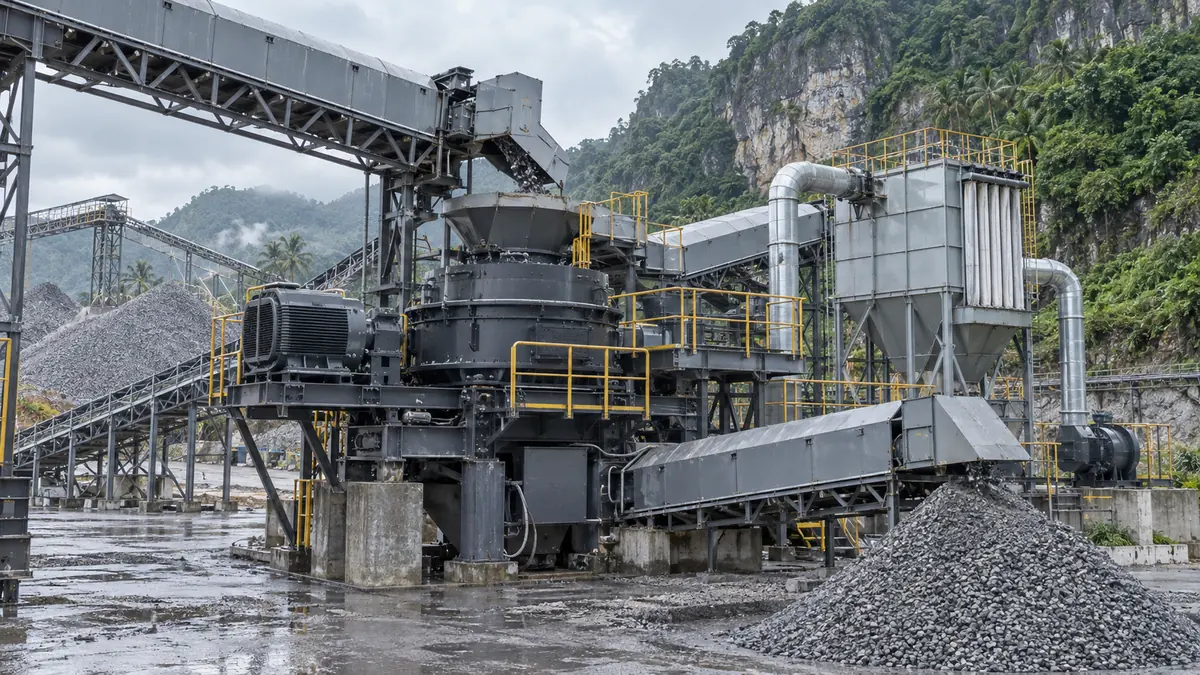
Effective VSI crusher dust control starts with containing dust at the points where material falls, accelerates, separates, or leaves the machine—not with adding water or a dust collector after the plant is already dirty. For a manufactured-sand circuit, check the feed hopper, crusher feed chute, rotor enclosure, discharge chute, transfer points, screen, return conveyor, and stockpile conveyor as one connected airflow system. The right package depends on rock moisture and fines, throughput, enclosure layout, wind exposure, available water, electrical supply, discharge-air rules, and maintenance access. Buyers should ask for a defined dust-control scope with ducting, hoods, sealing, fan duty, filters, drainage, controls, and safe cleaning access rather than accepting a vague promise of “low dust.”
The Short Answer: Stop Dust at the Source Before It Reaches the Yard
VSI dust is usually a combination of airborne fine particles released at a transfer point and air displaced by moving material, conveyors, screens, and the crusher itself. The most dependable approach is to reduce uncontrolled openings, keep chutes properly loaded, seal predictable leakage paths, and capture the remaining dusty air with a deliberately designed enclosure and collection system. Water can help at selected transfer points or stockpiles, but it is not automatically compatible with every final-sand specification or every wet-feed condition.
Start with the process. An erratic feeder, oversize feed, overloaded screen, or unstable return load creates more impact, spillage, and escaping air than a balanced circuit. Stabilize feed size and rate first; our guides to VSI feed-size control and avoiding unstable VSI feed rate explain the upstream conditions that make dust control easier to design and maintain.
Where Dust Escapes in a VSI Sand Plant
Do not specify a collector only from the crusher name or nominal capacity. Walk the material path and identify where dust is generated, where air can escape, and where access is needed for maintenance.
| Plant location | Why dust escapes there | Control priority |
|---|---|---|
| Feed hopper and feeder discharge | Falling stone displaces air; surging feed can push dusty air out through open sides | Use sized skirts, an enclosure with inspection access, and a stable material loading pattern |
| VSI feed chute and crusher top | Material accelerates into the machine and leakage can occur around joints, access covers, or open gaps | Seal joints and covers, keep chute geometry compatible with feed, and provide capture points where required |
| Crusher discharge and transfer chute | Fast material, internal air movement, and a falling stream can entrain fines | Contain the stream, avoid open drop zones, use flexible seals, and capture air from the enclosure |
| Screen and screen discharge | Separation exposes dry fines and screen motion can pump air through openings | Enclose practical sections, control air balance, and keep inspection access workable |
| Return and final-product conveyors | Multiple transfers and wind exposure can re-release fines after the crusher | Cover or enclose critical transfers, limit free fall, and review stockpile discharge separately |
The strongest enclosure can still perform poorly if the material path is wrong. When a chute plugs, spills, or has a wide uncontrolled drop, operators often leave doors open to keep the plant running. The quotation should therefore include chute inspection, liner-change access, cleanout provisions, and a practical way to observe the material stream.
Treat Containment and Collection as One Air System
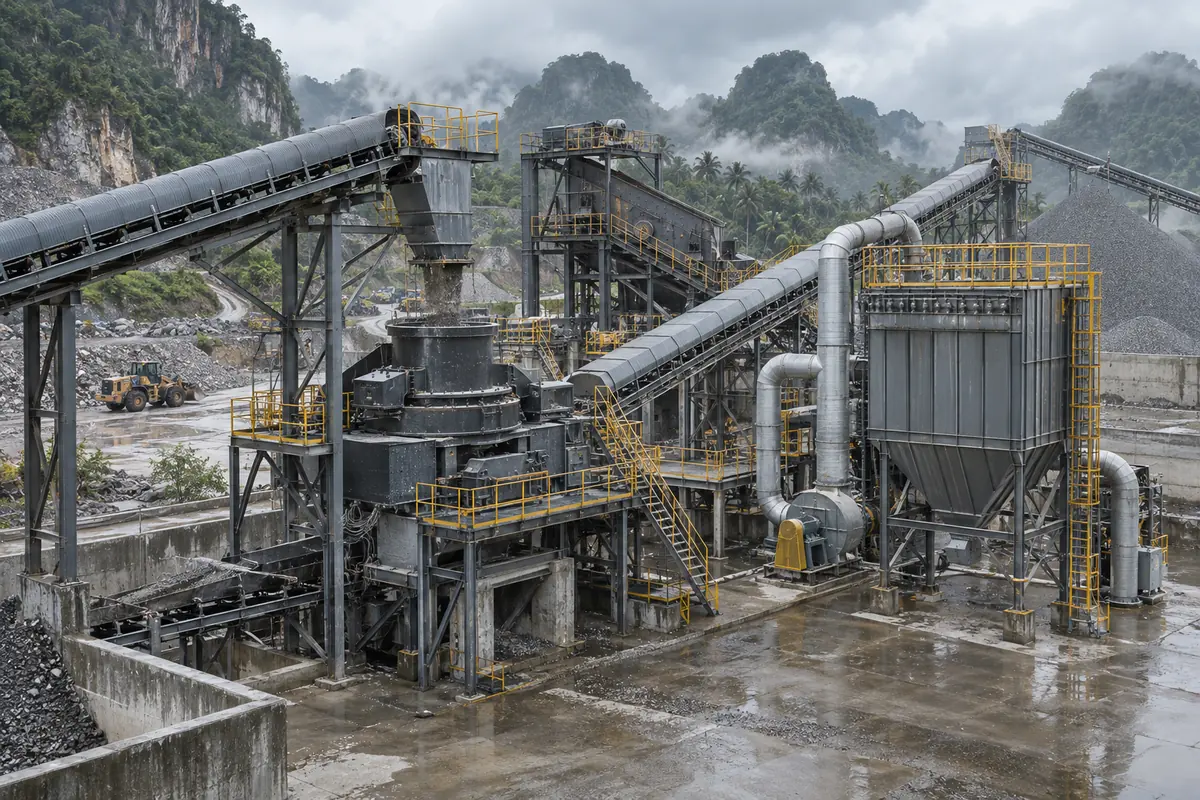
| Scope item | What to define | Buyer question |
|---|---|---|
| Enclosures and covers | Crusher, chute, screen, and conveyor areas enclosed; panel construction; doors; viewing points | Which openings remain for access, and how are they sealed in normal operation? |
| Hoods and ductwork | Capture location, branch layout, supports, cleanout access, abrasion allowance, and weather exposure | Is air volume calculated by capture point, including duct losses and maintenance? |
| Fan and collector | Filter type, fan duty, discharge, controls, dust disposal route, and service access | What operating condition and material-fines basis are used to select them? |
| Transfer-point sealing | Skirts, flexible seals, liner interfaces, belt tracking allowance, and replacement access | How will seals remain effective without rubbing the belt or blocking maintenance? |
| Water or suppression points | Water quality, pressure, nozzle location, drainage, moisture impact, and automation | Is water permitted by the product specification, and where will added moisture go? |
| Housekeeping and monitoring | Cleaning method, accumulation zones, filter/fan status feedback, and safe access | Which signals identify a restricted filter or failed fan before dust is visible? |
Airflow must be based on the actual layout, not copied from another plant. The supplier or dust-control specialist needs the number of capture points, enclosure volumes and openings, material drop locations, operating combinations, duct runs, site elevation and climate, and any local emission requirement. Ask how the system behaves when one screen deck, return conveyor, or product conveyor is temporarily stopped.
Choose Dry Collection, Water, or a Combined Approach by Process Risk
Dry collection is often useful where finished aggregate or manufactured sand must stay dry and capture points can be enclosed. Its performance depends on intact ducting, seals, filter maintenance, and a realistic plan for handling collected material. Water suppression can reduce visible dust at selected points, but it changes the material condition. If water is proposed, define its quality, flow control, drainage route, spray location, and the maximum acceptable product moisture with the process team.
For wet or clay-bearing feed, see when to pre-screen, drain, or wash material before a VSI. A combined arrangement may be appropriate: contain and extract dust at the crusher and enclosed transfers, then use controlled water only at an exposed discharge or stockpile if the product allows it.
Design the Material Flow to Avoid Creating Dust
- Control the feed. A consistent, centered feed reduces impact, leakage, and unnecessary air movement. Confirm feeder control range and feed-size distribution.
- Avoid open drops. Use contained chutes and an appropriate loading direction rather than letting material free-fall across a wide conveyor or floor area.
- Separate fresh feed from return load. In a closed circuit, the VSI can see more than fresh-feed tonnage. Read when a VSI plant needs a screen when defining the circuit boundary.
- Provide wear allowance without leaks. Liners, curtains, seals, and duct elbows wear. Make replacement predictable rather than relying on improvised repairs.
- Keep the product path clean. Fine dust on frames can be re-entrained by wind or vibration. Review covers, skirt boards, return-belt cleaning, and final stockpile discharge.
The specification should record raw material, moisture range, natural fines, feed size, target output size, capacity, and operating hours rather than describing the project only as a “sand plant.”
Housekeeping Is a Safety and Reliability Requirement
Dust that is not captured settles on structures, walkways, cable trays, motors, guards, platforms, and stairs. Use the site safety procedure and equipment manual for isolation, access, and cleaning method; do not blow deposited dust into the air or clean around running equipment.

A practical housekeeping plan identifies accumulation areas, permitted cleaning tools and frequency, dust-disposal destination, drainage management, and safe access. It should define who checks seals, doors, duct supports, filter differential pressure, fan status, and water nozzles. Small leaks and restrictions can then be corrected before the entire plant becomes visibly dusty.
What to Put in a Dust-Control Request for Quotation
- A layout showing crusher, chutes, screens, conveyors, hoods, ducting, fan, collector, discharge point, and any water-spray locations.
- Material data: rock type, moisture, natural fines/clay, feed size, output size, target capacity, saleable grades, and operating hours.
- Supplied enclosures, seals, ductwork, fan, collector, controls, supports, access platforms, liners, installation supervision, and commissioning.
- Wind, climate, water availability/quality, power, drainage, site elevation, and local emission or workplace-dust requirements.
- Filter service, spare seals and liners, dust-disposal route, cleaning tools, alarms/interlocks, warranty boundaries, and maintenance-access drawings.
This turns “please add dust control” into comparable technical offers and exposes scope gaps early—for example, a collector without ducting, a hood without workable sealing, or water sprays without a moisture and drainage decision.
Cost Factors and Common Buyer Mistakes
The lowest-priced option may exclude the unglamorous parts that determine whether a system works: sealed inspection doors, duct supports, abrasion liners, fan controls, access platforms, electrical isolation, filter replacement space, dust-bin handling, drainage, and commissioning time. Review recurring costs too: filter elements, wear liners, seals, fan power, water, cleaning labor, and production loss caused by poor maintenance.
Buying a collector without a capture layout
A collector cannot remove dust escaping from an open chute elsewhere in the plant. Ask for hoods, enclosures, duct runs, and airflow assumptions, not just a collector model.
Adding water without checking product requirements
Water can be useful, but it may increase product moisture, create mud, or worsen wet-feed problems. Confirm material and downstream consequences first.
Ignoring return load and screen behavior
Dust may seem to come from the VSI while the actual release is a screen, return transfer, or product conveyor outside the original layout basis.
Designing for operation but not maintenance
If filters, seals, liners, cleanout doors, and access platforms are hard to reach, performance will decline. Include service space and routine inspection in the purchase specification.
FAQ
Where does most dust come from around a VSI crusher?
It commonly escapes from feed/discharge chutes, crusher openings, screen areas, transfer points, return conveyors, and stockpile discharge points. The priority depends on fines, moisture, enclosure condition, airflow, and circuit layout.
Can water sprays solve VSI crusher dust problems?
They can help at selected points, but product-moisture limits, drainage, water quality, and wet-feed behavior must be checked. Containment and airflow control remain important.
Does a VSI crusher need a dust collector?
Many dry manufactured-sand circuits benefit from contained capture and dry collection, but the required scope depends on material, layout, local rules, and product specification.
How do I stop dust escaping from a crusher transfer chute?
Stabilize the material stream, reduce uncontrolled openings, then review chute geometry, seals, inspection doors, capture hood location, and the controlled air path.
Why is dust worse when the VSI feed rate changes?
Feed surges change material impact, chute loading, air displacement, screen load, and return circulation. Stabilizing feeder and screen conditions often improves dust behavior.
What information is needed to size a crusher dust-control system?
Provide layout, material type, moisture/fines, feed size, output size, capacity, capture points, utilities, wind conditions, drainage constraints, and local requirements.
Can dust collected from a VSI plant be reused in the sand product?
Only after checking product grading, cleanliness, moisture, and applicable specification. Reuse must be a controlled process decision.
What maintenance keeps a crusher dust-control system working?
Inspect seals, skirts, doors, ducts, supports, fan status, filter restriction, dust-disposal route, water nozzles if used, and buildup at chutes/conveyors. Follow equipment instructions and site safety procedures.
Request a VSI Dust-Control Review
Send MVSI your raw material details, moisture and fines observations, normal and maximum feed size, required output size, target capacity, plant layout or site photos, current dust locations, available water and power, local dust-control requirements, operating hours, and budget range. We can help define a VSI crushing and dust-control scope that matches the material flow, access needs, and final-product requirement.