Table of Contents
- What Is the Main Difference?
- Quick Selection Table
- How a Track-Mounted Mobile Crusher Works on Site
- Pros of Track-Mounted Mobile Crushers
- Cons of Track-Mounted Mobile Crushers
- How a Tire-Mounted Mobile Crusher Works on Site
- Pros of Tire-Mounted Mobile Crushers
- Cons of Tire-Mounted Mobile Crushers
- Terrain and Site Access
- Transport, Permits, and Relocation Frequency
- Capacity and Crushing Circuit
- Cost Comparison
- Which Projects Fit Track-Mounted Mobile Crushers?
- Which Projects Fit Tire-Mounted Mobile Crushers?
- Common Buyer Mistakes
- What to Send Before Asking for a Quote
- Conclusion
- FAQ
- Is a track-mounted mobile crusher better than a tire-mounted mobile crusher?
- What is a tire-mounted mobile crusher used for?
- Which mobile crusher is better for rough quarry ground?
- Which mobile crusher is easier to transport on highways?
- Does chassis type affect crusher capacity?
- Is a track-mounted mobile crusher worth the higher cost?
- Can tire-mounted mobile crushers process granite and basalt?
- What information should I provide before requesting a quotation?
Track-Mounted vs Tire-Mounted Mobile Crusher: Pros and Cons
A track-mounted mobile crusher is usually better when the plant must move often inside a quarry, follow a working face, operate on rough ground, or reduce internal truck haulage. A tire-mounted mobile crusher is usually better when the project has road access, longer highway transport, prepared pads, and less frequent relocation between sites. The right choice depends on terrain, transport distance, feed size, output sizes, capacity, setup time, power supply, permit limits, maintenance access, and total cost per ton. Buyers should compare the complete mobile crushing and screening flow, not only the chassis type.
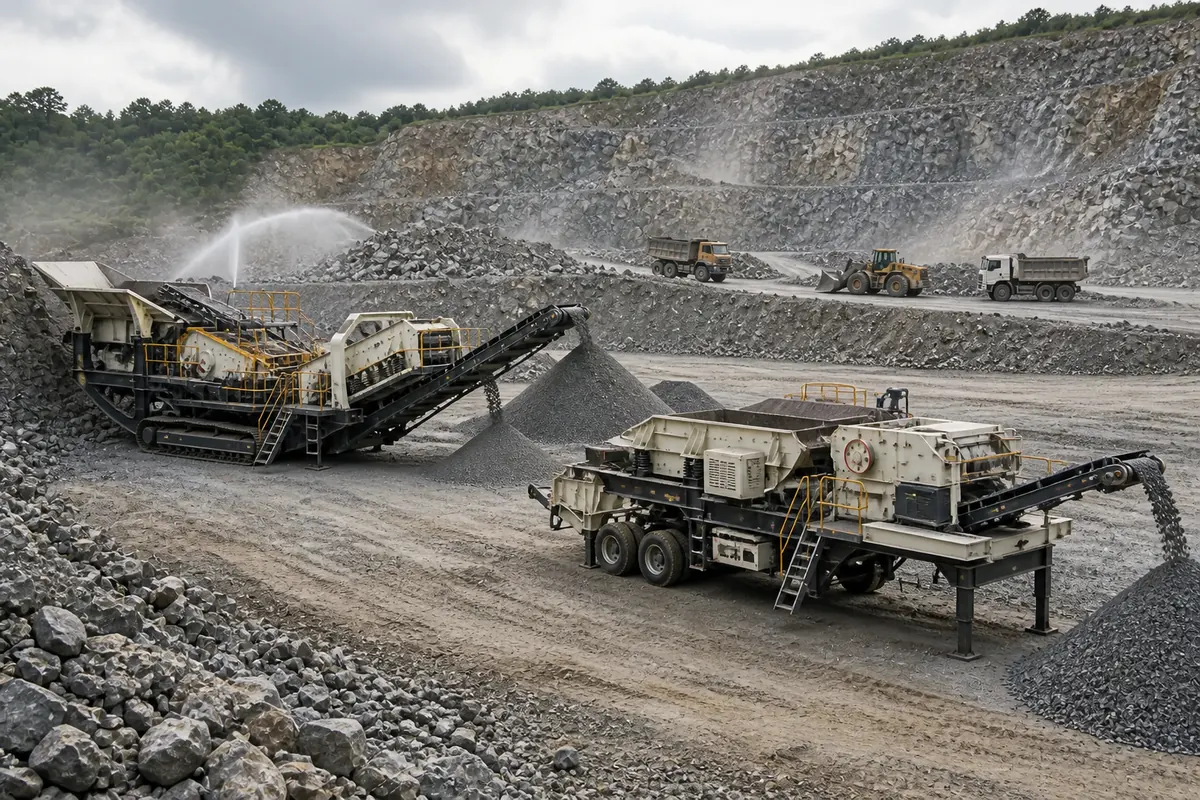
What Is the Main Difference?
Track-mounted mobile crushers, also called crawler mobile crushers, use crawler tracks to move around the job site. They can reposition near the quarry face, mining bench, demolition pile, or temporary stockpile without needing a separate tractor. This makes them useful when the crushing position changes often.
Tire-mounted mobile crushers, also called wheel-mounted mobile crushers or trailer mobile crushers, are mounted on tires and support legs. They are usually moved by truck tractor between project sites or within prepared areas. They can be practical for road contractors, aggregate suppliers, and buyers who need mobile equipment but still rely on road transport.
If you are still comparing mobile plant modules, start with the Mobile Crushing Plant Buying Guide for Quarry and Mining Projects. If the key question is crusher type, also read Mobile Jaw Crusher vs Mobile Impact Crusher: Which One Should You Choose?.
Quick Selection Table
| Project Condition | Better Starting Choice | Why It Matters |
|---|---|---|
| Frequent movement inside quarry | Track-mounted mobile crusher | Moves under its own power and follows the working face. |
| Long highway transport between sites | Tire-mounted mobile crusher | Easier to tow when road rules and permits allow. |
| Rough ground or uneven benches | Track-mounted mobile crusher | Crawler tracks distribute weight better on rough surfaces. |
| Prepared road-accessible project pad | Tire-mounted mobile crusher | Stabilizing legs and tire chassis can work efficiently on firm ground. |
| Short-term road aggregate contract | Tire-mounted or track-mounted | Choose by transport distance, setup time, and local road limits. |
| Open-pit mining primary crushing | Track-mounted mobile crusher | Better suited to in-pit movement and reduced haul distance. |
| Budget-sensitive fixed-location work | Tire-mounted mobile crusher | May reduce chassis cost if relocation is not frequent. |
This table is only a starting point. The final configuration still depends on raw material, feed size, required output size, target capacity, screen demand, power system, and service access.
How a Track-Mounted Mobile Crusher Works on Site
A track-mounted mobile crusher combines the crusher, feeder, conveyors, power system, hydraulic system, and crawler chassis into one movable unit. It can usually crawl short distances around the site after the operator prepares the path and checks ground safety.
Common track-mounted modules include:
- Track-mounted jaw crusher for primary crushing.
- Track-mounted cone crusher for hard rock secondary crushing.
- Track-mounted impact crusher for limestone or recycling.
- Track-mounted screen plant for final sizing.
- Track-mounted VSI crusher for shaping and manufactured sand.
The main value of a crawler mobile crusher is site flexibility. In a quarry, it can be moved closer to blasted rock. In an open-pit mine, it can help reduce the haul distance from loading point to crusher. In recycling, it can move around large demolition stockpiles.
Pros of Track-Mounted Mobile Crushers
Track-mounted machines are strong when mobility inside the site is the real business advantage.
Key advantages include:
- Better movement on rough quarry floors and uneven working faces.
- Faster repositioning when the feed source changes.
- Less dependence on tractors or external towing equipment for short moves.
- Strong fit for open-pit mining, quarry face crushing, and demolition recycling.
- Lower internal haulage distance when the crusher can move near the feed.
- Good flexibility for phased projects with changing stockpile locations.
For hard rock, a track-mounted jaw crusher can be paired with a mobile cone crusher and mobile screen. For granite applications, see Mobile Crusher Plant for Granite: Jaw, Cone, VSI, and Screen Combination.
Cons of Track-Mounted Mobile Crushers
The same crawler system that gives site mobility also adds cost, weight, and maintenance items. Buyers should not choose track-mounted equipment only because it looks more advanced.
Possible limitations include:
- Higher purchase price than many tire-mounted alternatives.
- Heavier machine weight, which may complicate long-distance transport.
- More hydraulic and undercarriage maintenance.
- Track pads, rollers, idlers, and drive parts need inspection.
- Road transport usually requires a low-bed trailer and permit planning.
- Not always necessary when the plant will stay on one prepared pad.
If the project only relocates once every several months and has good road access, tire-mounted equipment may provide the needed mobility with lower chassis complexity.
How a Tire-Mounted Mobile Crusher Works on Site
A tire-mounted mobile crusher is installed on a wheeled chassis with support legs, conveyors, and plant modules. It normally needs a tractor or truck for movement. Once the plant reaches the site, operators level the unit, deploy support legs, connect conveyors or screens, and start production.
Tire-mounted plants can include jaw crusher, impact crusher, cone crusher, VSI crusher, screen, feeder, and conveyors. Some systems are single-machine mobile crushers, while others are complete wheel-mounted crushing and screening lines.
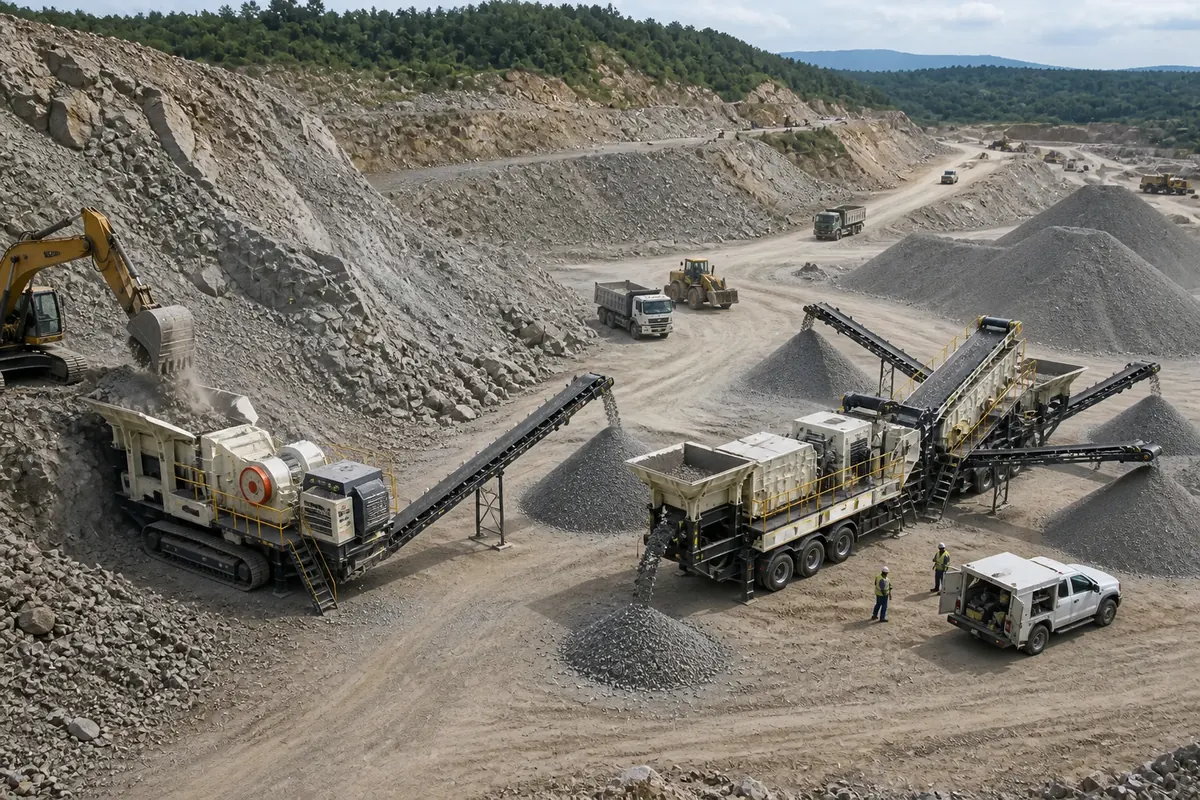
Pros of Tire-Mounted Mobile Crushers
Tire-mounted mobile crushers are practical when the project moves between road-accessible sites or when the crushing area is already prepared.
Key advantages include:
- Often easier for highway transport than crawler-mounted equipment.
- Good fit for road construction contractors and aggregate supply projects.
- May have lower purchase cost than a similar track-mounted plant.
- Support legs provide stable operation on prepared ground.
- Good for semi-mobile quarry plants that relocate occasionally.
- Can be configured as a complete wheel-mounted crushing and screening line.
For contractors producing road aggregate, compare the capacity logic in 200 TPH Mobile Crusher Plant for Road Construction Aggregates and 100 TPH Mobile Crushing Plant: Configuration, Cost, and Applications.
Cons of Tire-Mounted Mobile Crushers
Tire-mounted equipment is mobile, but it is not always suitable for rough quarry movement. The site still needs a stable access road, enough turning space, and safe ground bearing.
Possible limitations include:
- Usually needs external towing equipment for relocation.
- Less suitable for rough, muddy, steep, or unstable quarry floors.
- Setup can require more leveling and support-leg adjustment.
- Movement near the working face may be limited.
- Road transport still depends on width, height, axle load, and local permits.
- Internal haulage may remain high if the plant cannot move close to the feed.
If the plant will work in wet clay, steep benches, or changing quarry faces, crawler mobility may be worth the extra investment.
Terrain and Site Access
Terrain is one of the clearest decision factors. Track-mounted machines are usually better on rough ground, compacted quarry floors, and temporary working benches. They can reposition more easily when the blasted rock pile changes.
Tire-mounted plants prefer prepared pads, haul roads, firm ground, and enough turning space for tractor movement. They can work well in quarries and road projects, but the site must be planned before delivery.
Check these site access points before buying:
- Width and slope of access roads.
- Ground bearing capacity under crusher and support legs.
- Turning radius for trailers and service trucks.
- Space for feed loader, excavator, stockpiles, and finished trucks.
- Drainage, mud risk, and rainy-season access.
- Distance from working face to crusher feed hopper.
In many projects, the best answer is not only track or tire. It is a layout decision that combines the chassis, conveyor length, loader route, and stockpile position.
Transport, Permits, and Relocation Frequency
Long-distance movement changes the economics. A crawler machine can move inside the site, but it usually still needs a low-bed trailer for highway transport. A tire-mounted plant can often be more convenient for road movement, but the actual answer depends on local transport rules.
Before ordering, confirm:
- Overall transport length, width, height, and weight.
- Whether the equipment fits container, flat rack, or low-bed transport.
- Road permit requirements and escort requirements.
- Lifting points and loading method.
- Time needed to fold conveyors and prepare for transport.
- Frequency of relocation during the project.
If the plant moves every few days inside one quarry, track-mounted equipment may save time. If the plant moves between road-accessible projects several times per year, tire-mounted equipment can be easier to manage.
Capacity and Crushing Circuit
Chassis type does not decide crushing capacity by itself. A track-mounted jaw crusher and a tire-mounted jaw crusher can both be undersized or well matched depending on the crusher model, feeder size, screen area, closed-side setting, and material.
Capacity should be calculated from the full circuit:
- Raw material hardness and abrasiveness.
- Maximum feed size and feed grading.
- Crusher chamber, motor power, and discharge setting.
- Screen deck number and screen area.
- Return conveyor and recirculating load.
- Required output sizes and saleable product split.
- Loader, excavator, truck, and stockpile logistics.
For manufactured sand or final aggregate shaping, a mobile VSI may be needed after jaw and cone crushing. See Is a Mobile VSI Crusher Better Than a Stationary Sand Making Plant? if the final product includes 0-5 mm sand or cubical aggregate.
Cost Comparison
The cheapest machine price is not always the lowest cost per ton. Track-mounted plants may cost more at purchase but save money when they reduce internal haulage or speed up relocation. Tire-mounted plants may cost less and transport more easily, but can lose value if the site needs frequent rough-ground movement.
Compare these cost factors:
- Crusher model and wear parts.
- Chassis type, hydraulic system, tracks, tires, and support legs.
- Screen, conveyors, return circuit, and dust control.
- Fuel, generator, or electric power.
- Transport, permits, lifting, and local movement.
- Installation, commissioning, spare parts, and operator training.
- Downtime cost during relocation and maintenance.
- Loader and truck haulage distance inside the site.
For broader budget planning, see Stone Crusher Plant Cost: What Determines the Final Price?. For complete plant layout thinking, see Complete Stone Crusher Plant Setup: Equipment, Layout, and Cost.
Which Projects Fit Track-Mounted Mobile Crushers?
Track-mounted mobile crushers are usually a strong fit for:
- Quarry face crushing where the working face changes.
- Open-pit mining primary crushing.
- Hard rock aggregate with changing feed locations.
- Demolition recycling with large stockpiles spread across the site.
- Remote sites where building a fixed foundation is not practical.
- Projects where reducing internal haulage creates measurable savings.
A crawler mobile jaw crusher can be the first stage, followed by a mobile cone crusher, mobile screen, or mobile VSI depending on final products.
Which Projects Fit Tire-Mounted Mobile Crushers?
Tire-mounted mobile crushers are usually a strong fit for:
- Road construction aggregate projects.
- Contractors moving between road-accessible job sites.
- Semi-mobile quarry plants that relocate occasionally.
- Prepared crushing pads near stockpiles.
- Projects where highway transport convenience matters.
- Buyers who need mobile flexibility but do not need frequent quarry-face movement.
This layout can be especially practical for limestone, road base, and medium-capacity aggregate projects where the site is organized before the plant arrives.
Common Buyer Mistakes
One mistake is choosing a track-mounted crusher only because it seems more modern. If the site is stable and road-accessible, the extra crawler cost may not create enough value.
Another mistake is choosing tire-mounted equipment for a quarry where the crusher must move close to the working face every week. The plant may be cheaper at purchase, but towing, leveling, and haulage can increase operating cost.
Buyers also compare chassis type while ignoring crusher duty. A tire-mounted cone crusher may be better than a track-mounted impact crusher for hard abrasive granite. A track-mounted impact crusher may be better than a tire-mounted jaw crusher for concrete recycling. Material and product target still come first.
What to Send Before Asking for a Quote
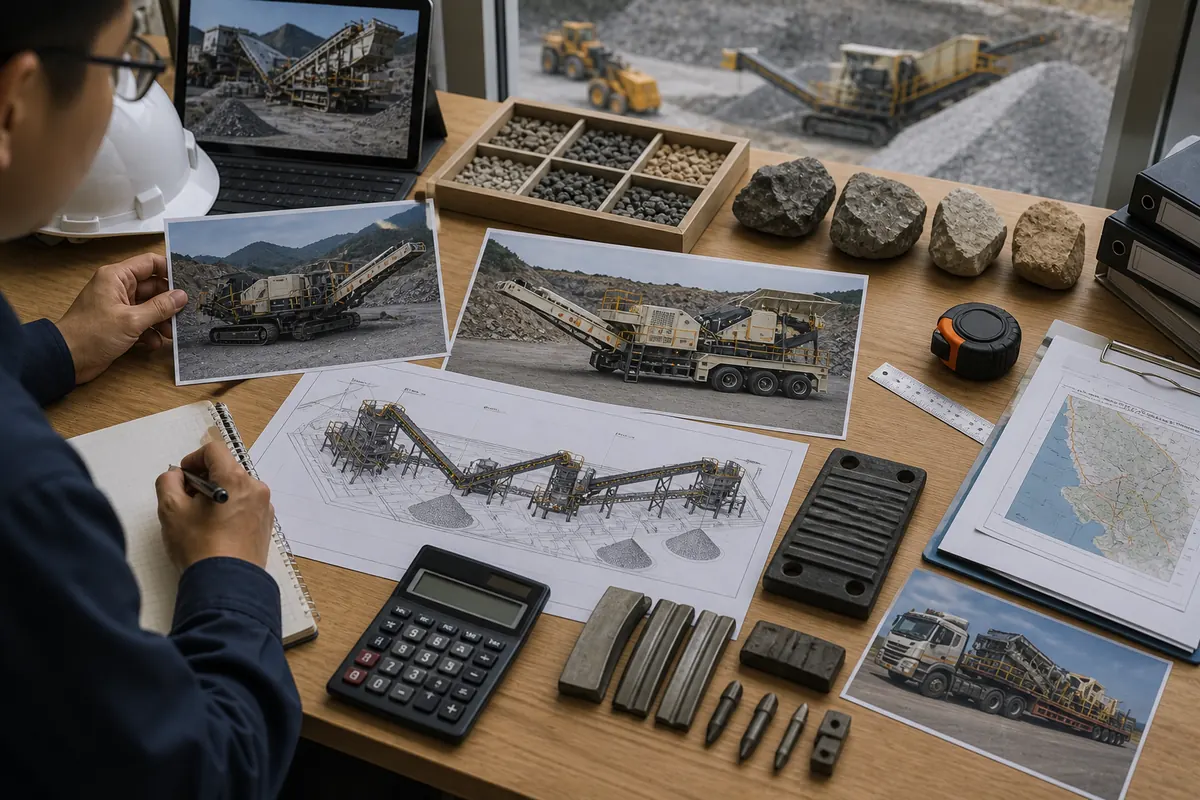
To get a practical mobile crusher quotation, send the supplier enough information to compare track-mounted and tire-mounted options correctly.
Prepare these details:
- Raw material name, photos, hardness, abrasiveness, moisture, and clay content.
- Maximum feed size and typical feed size distribution.
- Required output sizes, such as 0-5 mm, 5-10 mm, 10-20 mm, or road base.
- Target capacity in tons per hour and working hours per day.
- Site photos showing quarry face, access roads, working pad, slopes, and stockpile area.
- Relocation frequency inside the site and between project sites.
- Road transport limits, permit constraints, lifting plan, and available towing equipment.
- Power supply, fuel plan, dust control needs, budget range, and delivery schedule.
With these details, MVSI can compare crawler and tire-mounted chassis options, then recommend a mobile jaw crusher, cone crusher, impact crusher, VSI crusher, screen, and conveyor layout that fits the project.
Conclusion
Track-mounted mobile crushers are best when site movement, rough terrain, quarry-face access, and reduced internal haulage are important. Tire-mounted mobile crushers are best when road transport, prepared pads, occasional relocation, and lower chassis complexity are more important. The best buying decision should combine chassis type with raw material, feed size, output size, capacity, screen demand, power supply, transport limits, maintenance access, and total cost per ton.
If you are comparing track-mounted and tire-mounted mobile crusher options, send MVSI your raw material, feed size, output size, capacity, site photos, relocation plan, transport limits, and budget range. We can help review the application and prepare a practical mobile crushing and screening configuration.
FAQ
Is a track-mounted mobile crusher better than a tire-mounted mobile crusher?
It is better when the plant must move frequently inside a quarry, operate on rough terrain, or follow the working face. A tire-mounted crusher can be better for road-accessible projects and less frequent relocation.
What is a tire-mounted mobile crusher used for?
A tire-mounted mobile crusher is used for quarry aggregate, road construction aggregate, limestone crushing, recycling, and semi-mobile production where the plant can work on prepared ground and move by road when needed.
Which mobile crusher is better for rough quarry ground?
A track-mounted mobile crusher is usually better for rough quarry ground because the crawler chassis distributes weight and can reposition without a towing tractor for short site movements.
Which mobile crusher is easier to transport on highways?
A tire-mounted mobile crusher is often easier for highway transport, but the final answer depends on local road rules, width, height, weight, axle load, and permit requirements.
Does chassis type affect crusher capacity?
Chassis type does not determine capacity by itself. Real capacity depends on crusher model, feeder size, material hardness, feed size, screen area, return load, power, and required output sizes.
Is a track-mounted mobile crusher worth the higher cost?
It can be worth the higher cost if frequent relocation, shorter haul distance, or rough-ground movement saves enough operating time and truck cost. If the plant stays on one pad, tire-mounted equipment may be enough.
Can tire-mounted mobile crushers process granite and basalt?
Yes, if the crusher type and circuit are correct. For hard abrasive rock, a tire-mounted jaw crusher plus cone crusher and screen can work, but wear cost and plant layout must be checked carefully.
What information should I provide before requesting a quotation?
Provide raw material, feed size, output size, capacity, site photos, relocation frequency, transport limits, power condition, dust control needs, budget range, and delivery timeline.