Table of Contents
- Quick Answer: Which One Should You Choose?
- What Is a Mobile VSI Crusher Plant?
- What Is a Stationary Sand Making Plant?
- Main Differences Between Mobile VSI and Stationary VSI
- Capacity Comparison
- Cost and ROI Comparison
- Product Quality and Grading Control
- Site Conditions and Installation
- Maintenance and Operation
- Recommended Use Cases
- Choose Mobile VSI for These Projects
- Choose Stationary VSI for These Projects
- Common Buyer Mistakes
- What Information Should You Send for Plant Selection?
- Conclusion
- FAQ
- Is a mobile VSI crusher better than a stationary sand making plant?
- Can a mobile VSI crusher make manufactured sand?
- Which option has lower cost per ton?
- Is mobile VSI suitable for granite and basalt?
- Which plant is easier to install?
- Which plant is better for 300 TPH sand production?
- Does stationary VSI produce better sand quality?
- What information should I provide before asking for a quotation?
A mobile VSI crusher is usually better when the project needs fast installation, frequent relocation, temporary aggregate production, or on-site sand shaping close to the quarry face. A stationary sand making plant is usually better when the buyer needs higher capacity, long-term operation, stable grading control, larger stockpiles, lower cost per ton, and more flexible multi-product screening. The best choice depends on feed size, required output, project duration, site layout, power supply, transport rules, civil foundation, and how often the plant must move.
This guide compares mobile VSI crusher plants and stationary VSI sand making plants for quarry owners, road contractors, aggregate producers, and EPC buyers.
Quick Answer: Which One Should You Choose?
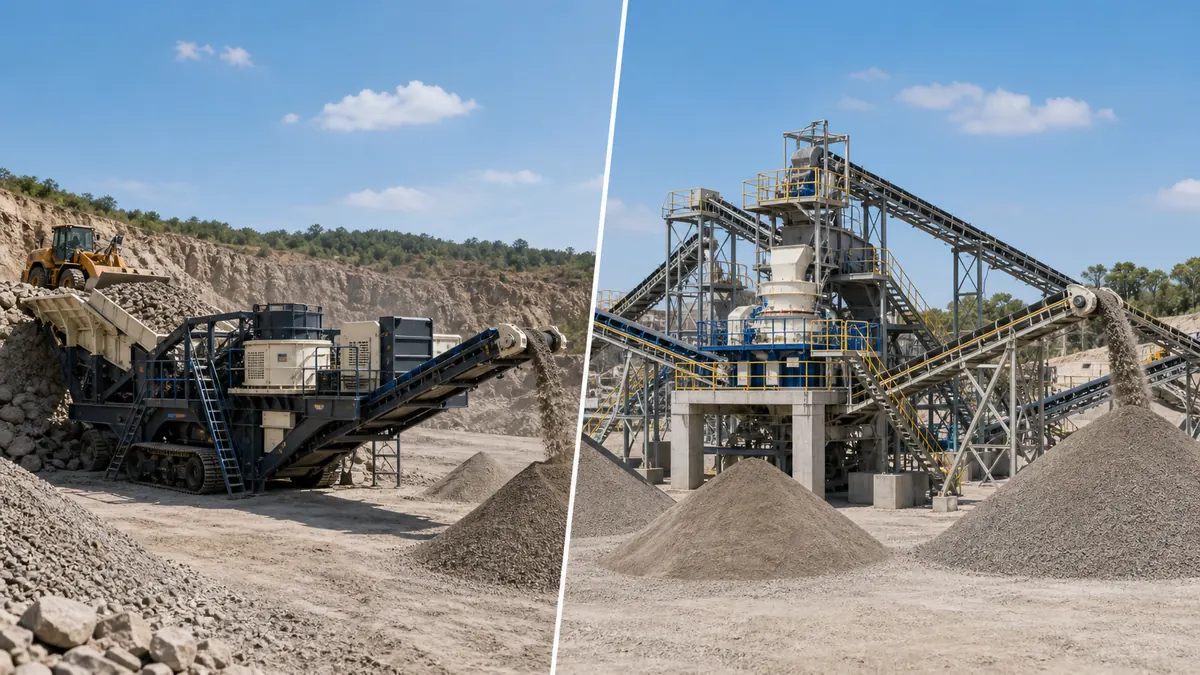
Choose a mobile VSI crusher if the project moves between sites, installation time must be short, civil foundation work is difficult, the project is temporary, the plant must work near changing quarry faces, or the capacity requirement is moderate.
Choose a stationary sand making plant if the quarry will operate for many years, high capacity and stable output are required, multiple final product sizes are needed, there is enough land for conveyors and stockpiles, fixed power is available, and lower long-term cost per ton is more important than fast relocation.
What Is a Mobile VSI Crusher Plant?
A mobile VSI crusher plant combines a vertical shaft impact crusher with a mobile chassis, conveyors, electrical system, and sometimes a screen or return conveyor. It can be track-mounted or tire-mounted depending on the design.
Mobile VSI plants are often used for manufactured sand production near the quarry face, road construction aggregate, temporary crushing contracts, concrete and asphalt aggregate shaping, remote project sites, and recycling or reshaping applications.
The main advantage is flexibility. The machine can be moved, installed faster, and used where fixed foundations are not practical.
What Is a Stationary Sand Making Plant?
A stationary sand making plant is a fixed crushing and screening system. It usually includes feeder, jaw crusher, cone crusher or impact crusher, VSI crusher, vibrating screen, return conveyor, product conveyors, dust control, sand washing or air classification, and final stockpiles.
Stationary VSI plants are often used for long-term quarry production, high-capacity manufactured sand, concrete sand with strict grading control, asphalt aggregate, multi-size aggregate production, and plants that need washing, classification, or large stockpiles.
Main Differences Between Mobile VSI and Stationary VSI

| Factor | Mobile VSI Crusher Plant | Stationary Sand Making Plant |
|---|---|---|
| Mobility | High | Low |
| Installation time | Short | Longer |
| Civil foundation | Limited or light | More foundation work |
| Capacity range | Small to medium, sometimes large | Medium to very large |
| Layout flexibility | Limited by mobile frame | Highly flexible |
| Screening options | Limited to mobile design | More screen decks and return circuits |
| Cost per ton | Higher in long-term high-volume work | Often lower for long-term production |
| Best use | Temporary, mobile, fast setup | Long-term, stable, high-volume production |
Capacity Comparison
Mobile VSI plants are convenient, but the frame, conveyor length, screen size, and transport rules can limit capacity. Stationary plants can use larger screens, longer conveyors, bigger bins, and more flexible recirculation circuits.
If the target is 50-150 TPH and the project moves often, mobile VSI may be attractive. If the target is 200-500 TPH and the quarry is long-term, a stationary plant is often easier to optimize.
For capacity planning, read VSI Crusher Capacity Guide: 50 TPH to 500 TPH Sand Production.
Cost and ROI Comparison
Mobile VSI plants can reduce early site work. They may save time on foundation, installation, relocation, and temporary project setup. However, the purchase price per ton of capacity may be higher, and maintenance space can be more compact.
Stationary plants usually need more early investment in foundation, conveyors, electrical work, installation, and site preparation. But for long-term production, they may offer lower cost per ton because they can be optimized for capacity, screening efficiency, stockpile handling, and maintenance.
Product Quality and Grading Control
Both mobile and stationary VSI crushers can produce good manufactured sand. The difference is usually not the VSI crushing principle, but the surrounding process control.
Stationary plants normally have more space for larger multi-deck screens, better closed-circuit return control, sand washing or air classification, more product stockpiles, dust control equipment, and separate conveyors for each product size.
For cubical shape improvement, see How to Improve Cubical Shape in Manufactured Sand with a VSI Crusher.
Site Conditions and Installation

Before choosing mobile or stationary VSI, check whether the site is permanent or temporary, how often the plant will move, whether there is space for conveyors and stockpiles, whether grid power is available, whether diesel or generator operation is acceptable, whether road permits are needed, whether foundation work is easy, and how strict the final sand specification is.
If land and power are limited, a mobile VSI may solve practical site problems. If the site is stable and spacious, a stationary plant usually gives more process control.
Maintenance and Operation
| Maintenance Point | Mobile VSI | Stationary VSI |
|---|---|---|
| Access space | More compact | Easier to design around service needs |
| Wear parts replacement | Practical but space-limited | Usually easier with platforms and lifting tools |
| Conveyor service | Foldable or compact conveyors | Longer conveyors but easier access |
| Electrical system | Integrated mobile controls | Fixed control room and power distribution |
| Spare parts storage | Usually separate support vehicle or container | Easier to build site storage |
For troubleshooting, read Common VSI Crusher Problems and How to Fix Them.
Recommended Use Cases
Choose Mobile VSI for These Projects
- Road construction projects that move along the route
- Temporary aggregate supply
- Contract crushing
- Remote quarry sites
- Projects with limited foundation work
- Medium-capacity sand shaping
- Fast startup before a permanent plant is built
Choose Stationary VSI for These Projects
- Long-term quarry production
- High-capacity manufactured sand
- Concrete sand with strict grading control
- Multi-size aggregate production
- Plants with washing or air classification
- Sites with stable grid power
- Operations focused on lowest long-term cost per ton
Common Buyer Mistakes
- Choosing mobile only because it looks convenient
- Choosing stationary only because it seems cheaper per ton
- Ignoring final sand output and only comparing feed capacity
- Forgetting screen and return conveyor capacity
- Underestimating transport rules for mobile equipment
- Not checking power supply before choosing the plant type
- Planning too little stockpile space
- Ignoring wear parts and maintenance access
- Buying before confirming feed size and product specification
What Information Should You Send for Plant Selection?
To recommend mobile VSI or stationary VSI, send raw material name and photos, maximum feed size, required final product sizes, required capacity, project duration, relocation needs, site photos or layout drawing, available land area, power supply condition, road transport limits, washing or air classification needs, budget range, and delivery timeline.
Conclusion
A mobile VSI crusher is better when mobility, fast setup, and temporary production are more important than maximum process flexibility. A stationary sand making plant is better when the quarry needs long-term high-capacity production, stable grading control, larger stockpiles, easier maintenance access, and lower cost per ton.
If you are comparing mobile VSI and stationary VSI options, send your raw material, feed size, output size, capacity, site photos, relocation needs, power condition, and budget range. MVSI can help design a practical sand making solution for your project.
FAQ
Is a mobile VSI crusher better than a stationary sand making plant?
It is better for mobile, temporary, or fast-start projects. A stationary plant is usually better for long-term high-capacity production and stronger product grading control.
Can a mobile VSI crusher make manufactured sand?
Yes. A mobile VSI crusher can make manufactured sand when feed size, rotor speed, screen return, and product grading are controlled properly.
Which option has lower cost per ton?
For long-term high-volume production, a stationary plant often has lower cost per ton. For temporary or frequently moved projects, mobile VSI may create better overall ROI.
Is mobile VSI suitable for granite and basalt?
Yes, but the machine must be selected for hard rock, with suitable wear parts, controlled feed size, and enough power and screening capacity.
Which plant is easier to install?
A mobile VSI plant is usually easier and faster to install because it needs less foundation work. A stationary plant takes longer but gives more layout flexibility.
Which plant is better for 300 TPH sand production?
For stable 300 TPH production, a stationary plant is often easier to optimize. A mobile solution may still work if the model, screen, conveyors, and return circuit are large enough.
Does stationary VSI produce better sand quality?
Not automatically. Sand quality depends on feed control, VSI settings, screening, recirculation, and powder control. Stationary plants usually provide more room for these systems.
What information should I provide before asking for a quotation?
Send raw material, feed size, output size, capacity, site photos, project duration, relocation needs, power condition, and budget range.