Table of Contents
- What Is a Mobile Crushing Plant?
- When Is a Mobile Crushing Plant a Good Choice?
- Main Types of Mobile Crushers
- Mobile Jaw Crusher
- Mobile Cone Crusher
- Mobile Impact Crusher
- Mobile VSI Crusher
- Mobile Screen Plant
- How to Choose the Right Mobile Crushing Configuration
- Capacity Planning
- Crawler-Mounted vs Tire-Mounted Mobile Plant
- Power Supply and Fuel
- Cost and ROI Factors
- Common Buyer Mistakes
- What Information Should You Send Before Asking for a Quotation?
- Conclusion
- FAQ
- How do I choose a mobile crushing plant?
- What equipment is needed for a mobile crushing plant?
- Is mobile crushing better than stationary crushing?
- Which mobile crusher is best for hard rock?
- Can a mobile crusher make manufactured sand?
- What capacity mobile crushing plant do I need?
- Is crawler-mounted or tire-mounted mobile crusher better?
- What information should I provide before asking for a quote?
A mobile crushing plant should be chosen according to raw material, maximum feed size, required output sizes, target capacity, mobility needs, power supply, site layout, final aggregate quality, and operating cost per ton. For quarry and mining projects, the most common mobile configurations include mobile jaw crusher for primary crushing, mobile cone crusher for hard rock secondary crushing, mobile impact crusher for limestone or recycling, mobile VSI crusher for shaping and sand making, and mobile screen plant for final sizing. The right plant is not the largest machine; it is the configuration that matches the material and business target.
This guide helps quarry owners, mining operators, road contractors, and aggregate producers compare mobile crushing plant options before requesting a quotation.
What Is a Mobile Crushing Plant?
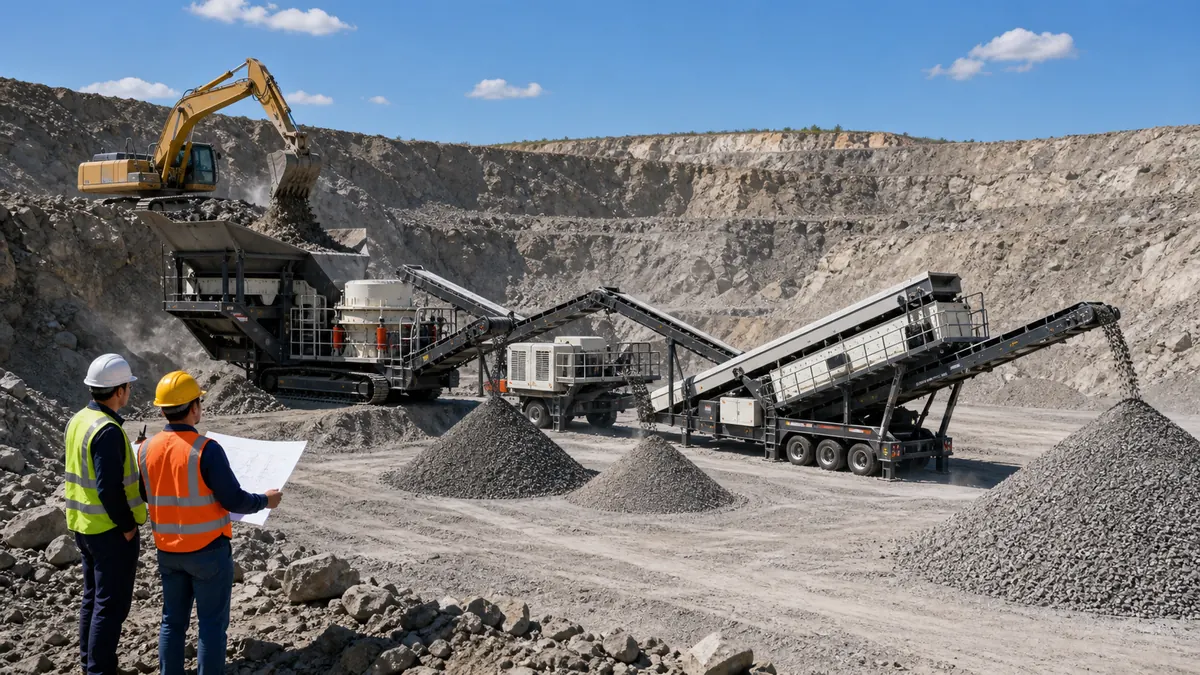
A mobile crushing plant is a movable crushing and screening system installed on a crawler or tire-mounted chassis. It can be moved within a quarry, relocated between project sites, or used as a temporary production line before a fixed plant is built.
Typical modules include mobile jaw crusher, cone crusher, impact crusher, VSI crusher, screen plant, feeder, return conveyors, product conveyors, and diesel, generator, or electric power system.
When Is a Mobile Crushing Plant a Good Choice?
A mobile crushing plant is a good choice when the project needs fast installation, flexible relocation, lower civil foundation work, or production close to the quarry face. It is often used for road projects, open-pit mining, contract crushing, temporary aggregate supply, and remote sites.
For a permanent high-capacity quarry with stable land, grid power, and large stockpiles, a stationary plant may still be more economical.
Main Types of Mobile Crushers

Mobile Jaw Crusher
A mobile jaw crusher is mainly used for primary crushing. It handles large feed sizes and reduces raw rock before secondary crushing. It is suitable for granite, basalt, river stone, iron ore, hard rock quarry, and mining primary crushing.
Mobile Cone Crusher
A mobile cone crusher is used for secondary or tertiary crushing of hard and abrasive rock. It produces controlled aggregate sizes and works well after a jaw crusher.
Mobile Impact Crusher
A mobile impact crusher is suitable for limestone, soft to medium-hard rock, and construction waste recycling. It can produce good shape, but wear cost may increase with very abrasive rock.
Mobile VSI Crusher
A mobile VSI crusher is used for final shaping and manufactured sand. It is often installed after jaw and cone crushing when the buyer needs better particle shape or 0-5 mm sand.
For mobile vs stationary VSI comparison, read Is a Mobile VSI Crusher Better Than a Stationary Sand Making Plant?.
Mobile Screen Plant
A mobile screen plant separates final products by size. It can work after a mobile crusher or as part of a closed circuit. Do not ignore screen capacity, because a large mobile crusher with a small screen may still produce low final output.
How to Choose the Right Mobile Crushing Configuration
| Project Condition | Recommended Mobile Configuration |
|---|---|
| Large hard rock feed | Mobile jaw crusher plus mobile cone crusher |
| Hard rock aggregate with multiple sizes | Mobile jaw, mobile cone, and mobile screen |
| Limestone aggregate | Mobile impact crusher plus mobile screen |
| Concrete recycling | Mobile impact crusher with magnetic separator and screen |
| Manufactured sand | Mobile jaw or cone before mobile VSI and screen |
| Final aggregate shaping | Mobile VSI after cone crusher |
| Mining primary crushing | Heavy-duty mobile jaw crusher |
Capacity Planning
Mobile crushing plant capacity depends on feed size, material hardness, crusher type, screen efficiency, conveyor capacity, moisture, and final product size. Before choosing capacity, define raw feed size, final sizes, required tons per hour, number of product sizes, closed circuit needs, shift hours, and stockpile space.
Crawler-Mounted vs Tire-Mounted Mobile Plant
| Factor | Crawler-Mounted Plant | Tire-Mounted Plant |
|---|---|---|
| Movement inside quarry | Very good | Moderate |
| Long-distance road transport | Usually needs trailer | Often easier |
| Setup time | Short | Short to medium |
| Terrain adaptability | Strong | Depends on road condition |
| Common use | Quarry face, open-pit mining | Road projects, contract crushing |
Power Supply and Fuel
Mobile crushing plants may use diesel-hydraulic power, diesel-electric power, generator sets, or external grid electricity. Check local voltage, grid availability, diesel cost, generator capacity, cable routing, environmental rules, noise control, and maintenance skill level.
Cost and ROI Factors

Mobile crushing plant cost depends on crusher type, capacity, engine or motor power, chassis type, screen and conveyor configuration, automation level, wear parts package, shipping distance, installation support, spare parts, and service.
ROI depends on how much value mobility creates. If moving the plant closer to material reduces haul truck cost, mobile crushing can be very attractive. If the plant stays in one place for many years, a stationary plant may have lower long-term cost per ton.
Common Buyer Mistakes
- Choosing by price only
- Ignoring feed size
- Ignoring final product sizes
- Buying one crusher when a screen is also needed
- Choosing impact crusher for highly abrasive rock without checking wear cost
- Ignoring transport width, weight, and local road rules
- Forgetting power supply requirements
- Underestimating stockpile space
- Not planning spare parts
- Comparing different quotation scopes
What Information Should You Send Before Asking for a Quotation?
To recommend a suitable mobile crushing plant, send raw material name and photos, hardness and abrasiveness if known, maximum feed size, required output sizes, required capacity, project location and site photos, relocation needs, road transport limits, power supply condition, moisture and clay content, washing or dust control needs, budget range, and delivery timeline.
Conclusion
A mobile crushing plant is a practical choice for quarry and mining projects that need mobility, fast installation, flexible site use, and reduced internal haulage. The best plant depends on raw material, feed size, final product, capacity, site layout, power supply, transport rules, and operating cost target.
If you are planning a mobile crushing project, send your raw material, feed size, output size, capacity, site photos, relocation needs, power condition, and budget range. MVSI can help compare configurations and prepare a practical mobile crushing plant quotation.
FAQ
How do I choose a mobile crushing plant?
Choose by raw material, feed size, output size, capacity, mobility needs, site layout, power supply, final product quality, and operating cost per ton.
What equipment is needed for a mobile crushing plant?
A mobile plant may include mobile jaw crusher, cone crusher, impact crusher, VSI crusher, mobile screen, feeder, return conveyor, product conveyors, and power system.
Is mobile crushing better than stationary crushing?
Mobile crushing is better for relocation, temporary projects, fast setup, and reducing haul distance. Stationary crushing is often better for long-term high-capacity production.
Which mobile crusher is best for hard rock?
For hard rock such as granite and basalt, mobile jaw crusher plus mobile cone crusher is commonly used. A mobile VSI may be added for final shaping or manufactured sand.
Can a mobile crusher make manufactured sand?
Yes. A mobile VSI crusher with proper screening and return circuit can produce manufactured sand when feed size and product grading are controlled.
What capacity mobile crushing plant do I need?
Capacity depends on final product demand, feed size, material hardness, crusher type, screen size, and operating hours. Define final saleable output, not only feed capacity.
Is crawler-mounted or tire-mounted mobile crusher better?
Crawler-mounted plants are better for moving inside quarry or mining sites. Tire-mounted plants can be better for contractors moving between road-accessible project sites.
What information should I provide before asking for a quote?
Send raw material, feed size, output size, capacity, site photos, relocation needs, road transport limits, power condition, moisture, budget range, and timeline.