Table of Contents
- Information Gain: Compare the Released Scope, Not the Jaw Size
- Release One Feed-and-Product Record Before Requesting Prices
- Put the Whole Primary-Crushing Material Path in Each Quote
- Compare the Jaw Crusher Technical Basis Before Comparing Commercial Totals
- Make Civil, Electrical and Installation Boundaries Explicit
- Build a Like-for-Like Commercial Comparison Sheet
- Put Commissioning and Acceptance Into the Order, Not an Email Thread
- Buyer Checklist for a Hard-Rock Jaw Crusher Quote
- Frequently Asked Questions
- What should I compare first in jaw crusher quotations?
- Is the largest jaw opening always the safer choice for a hard-rock quarry?
- Why can two jaw crusher capacity figures be different for a similar model?
- Should a feeder and grizzly be included with a jaw crusher quotation?
- What civil information does a jaw crusher supplier need?
- How should commissioning be defined in the purchase order?
- Send the Same Quarry Record to Every Bidder
How to Compare Jaw Crusher Quotations for a Hard-Rock Quarry
A hard-rock quarry buyer should compare jaw crusher quotations only after issuing one written basis for the same rock, feed range, required downstream product and site scope. A larger jaw opening, a higher stated capacity or a lower machine price does not by itself make one proposal better. The decisive question is whether each quotation covers the same physical job: receiving blasted rock, controlling feed, handling oversize and fines, crushing, conveying, civil and electrical interfaces, guarding, commissioning and acceptance. If those boundaries differ, treat the offers as alternative scopes—not comparable prices—and close the gaps before awarding an order.
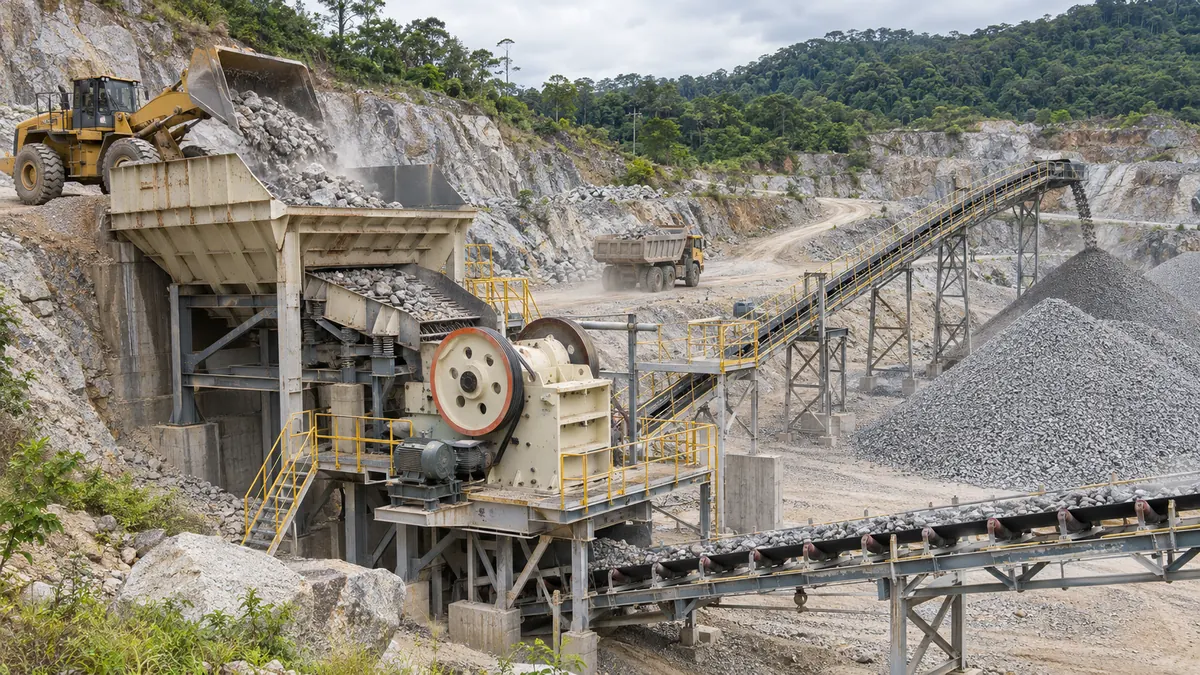
Information Gain: Compare the Released Scope, Not the Jaw Size
Most jaw crusher quotation guides focus on a feed opening, motor rating, nominal capacity or price. Those details matter, but they do not establish that two offers will solve the same quarry problem.
The useful comparison boundary is the released material path from the quarry face to the agreed primary-crushed product handover. A jaw can be correctly sized on paper and still become the disputed part of a project if the feed is too variable, fines blind the grizzly, oversize has no route, a conveyor is excluded, a foundation assumption is unstated, or no party owns the first-product acceptance check. This article makes those interfaces part of the quotation record.
Release One Feed-and-Product Record Before Requesting Prices
Comparable proposals start with comparable input. Ask every bidder to use the same record and mark what is measured, estimated, assumed or excluded. Do not turn an early quarry photo or a single rock sample into a guaranteed capacity basis.
| Record to release | What the quarry team should state | Why it changes the quotation |
|---|---|---|
| Material description | Rock type, observed variability, weathered zones, abrasive or clay-bearing material, and representative photos or samples | It sets the evidence boundary for jaw selection, wear discussion and any need for feed preparation; it does not guarantee results without testing or site confirmation |
| Feed condition | Typical and maximum rock dimensions, fines content, moisture, contamination, blast pattern and stockpile condition | A nominal jaw opening is not a complete receiving specification; the feeder, grizzly, hopper and oversize route need the same basis |
| Operating duty | Target capacity basis, working hours, surge arrangement, loader or truck cycle and whether the stated rate is instantaneous or average | It prevents an unqualified capacity number from being compared with a different duty or feed condition |
| Downstream requirement | Required primary-crushed top size, discharge path, secondary-crusher or screen interface, and product-stockpile plan | The jaw setting, conveyor duty and downstream transfer cannot be compared separately from the process that follows |
| Site interfaces | Site layout, elevation, access, foundation data, available power, water or dust interface, control location and local design constraints | It assigns civil, electrical, transport, installation and environmental responsibilities that may sit outside the machine price |
| Acceptance route | First test material, inspection or sampling method, required records, who can adjust settings and who accepts the handover | It makes start-up a defined technical control point instead of an informal promise |
For a broader process view, see the jaw-and-cone circuit guide for hard-rock quarry projects. That page discusses when the primary jaw is part of a wider circuit; this page explains how to keep the purchase scopes comparable.
Put the Whole Primary-Crushing Material Path in Each Quote
A jaw crusher quotation should name the physical path before and after the machine. The required equipment changes with rock and site conditions, but every bidder should explicitly say what is included, sized by others, optional or excluded.
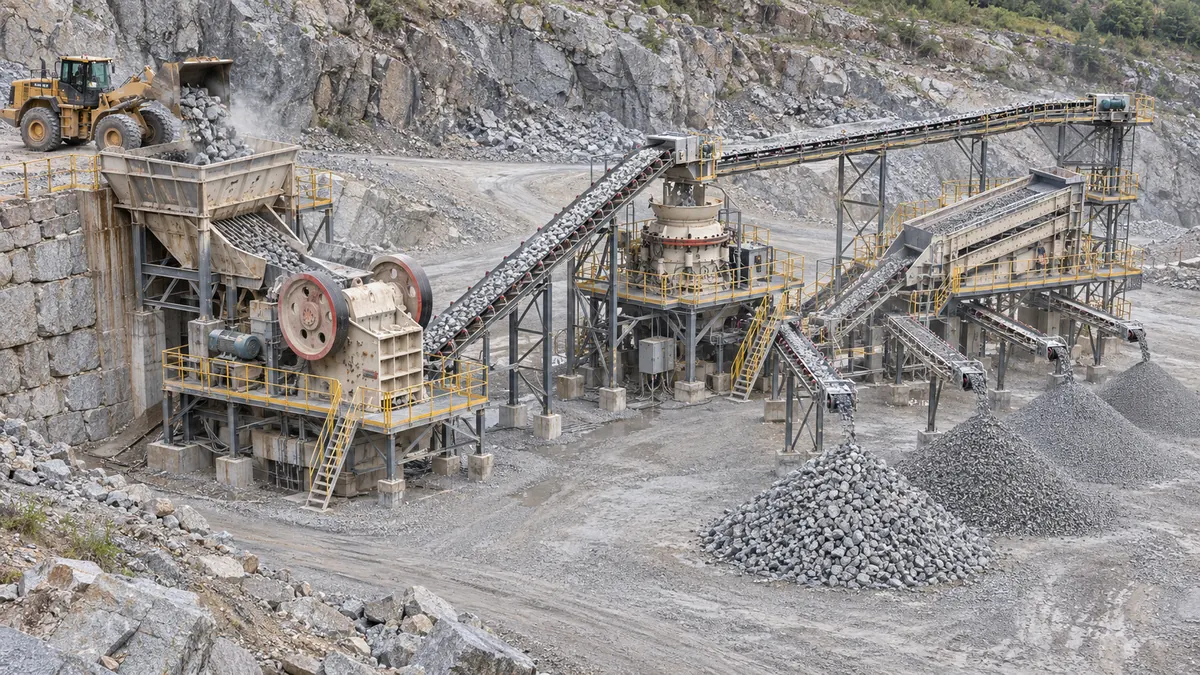
| Process stage | Scope question to use in every proposal |
|---|---|
| Receiving hopper and feed | What rock size, surge, loader or truck interface, hopper lining, access and safe clearing method are assumed? |
| Grizzly or scalping | Is a grizzly included; what happens to fines or bypass material; and is the bypass route specified rather than implied? |
| Jaw crusher | Which exact model, feed opening, setting range, drive, lubrication, wear configuration, access and guards are supplied? |
| Discharge and transfer | Who supplies the chute, belt scale or metal detection if required, transfer points, liners, dust interfaces and receiving conveyor? |
| Oversize and blockage route | What is the permitted oversize, who breaks or removes it, and how is a blockage safely isolated and cleared? |
| Downstream handover | What top size and flow condition does the secondary crusher, screen, surge pile or conveyor receive, and who owns that interface? |
The quarry feeder, crusher, screen and conveyor selection guide can help a buyer map the equipment chain. It does not replace a project-specific layout, material assessment or safety review.
Compare the Jaw Crusher Technical Basis Before Comparing Commercial Totals
The jaw model is important, but it should be compared as a set of connected assumptions. Ask suppliers to complete the same technical schedule and to distinguish guaranteed, expected, design and provisional values. A proposal that leaves conditions unstated is not automatically conservative or competitive.
| Technical line | What to compare | Common comparison risk |
|---|---|---|
| Feed opening and permitted feed | Stated opening, feed orientation, maximum piece assumption and allowed variability | Comparing opening dimensions without knowing the actual rock geometry or feed presentation |
| Capacity basis | Feed gradation, setting, material condition, duty cycle, target top size and whether capacity is a range or a site result | Treating a catalogue headline as an unconditional hourly output |
| Crusher adjustment and protection | Setting adjustment, overload or uncrushable-material response, isolation needs and access for inspection | Assuming a protection feature removes the need for feed control or safe operating procedures |
| Wear and maintenance | Included wear parts, expected inspection points, liner change access, lifting provisions, lubrication and spares boundary | Comparing an initial machine price while one scope omits early-operation spares or access equipment |
| Drive and controls | Motor supply, starting method, panel boundary, control logic, instrumentation, cable interfaces and site voltage assumptions | Counting controls twice or leaving power and interlocks between suppliers |
| Structure and access | Base frame, platforms, stairs, guards, chutes and maintenance clearances | Discovering after delivery that the machine fit is not the complete safe installation |
For a material-focused discussion, the crusher selection guide for hard ore and abrasive rock sets out the conditional role of hardness, abrasiveness and feed condition. It does not prove suitability for a particular quarry without the buyer’s actual material record.
Make Civil, Electrical and Installation Boundaries Explicit
Primary-crusher budgets often become misleading when equipment supply is compared with a partially defined installation. A responsible proposal can exclude civil or electrical work, but the exclusion must identify the design inputs, handover point and responsible party.
| Interface | Questions to resolve before award |
|---|---|
| Foundations and structure | Who supplies load data, embedded items, base frames, drawings, grout, steelwork, installation tolerances and final sign-off? |
| Power and controls | Where is the electrical point of supply, who supplies cables, starters, control cabinets, earthing, interlocks and commissioning labour? |
| Transport and lifting | Which components are shipped, what site access and crane capacity are assumed, and who owns unloading, lifting plans and assembly? |
| Dust and drainage | What dust suppression, extraction, water, drainage, containment and housekeeping interfaces are included or excluded? |
| Safety and access | Which guards, walkways, platforms, isolation points, emergency stops and local compliance responsibilities belong to each party? |
| Downstream tie-in | Who measures and builds the chute, conveyor transfer or surge arrangement between the jaw and downstream equipment? |
The jaw crusher foundation and installation scope guide is a useful pre-award checklist for this boundary. It should be read with the actual site layout and responsible engineer’s requirements, not treated as a construction drawing.
Build a Like-for-Like Commercial Comparison Sheet
Do not begin with a single total. Put every bidder on one scope sheet, then mark each line as included, optional, buyer-supplied, subcontracted, excluded or to be confirmed. A more expensive total can be the more complete scope; a lower total can simply move cost and risk into an unpriced interface.
| Comparison line | Evidence to request |
|---|---|
| Supply list | Itemised equipment list, exact model references, quantities, supplied accessories and exclusions |
| Design basis | Released feed record, operating duty, target top size, layout assumptions and each provisional item |
| Commercial boundary | Incoterm or delivery point, packing, transport basis, taxes or local charges if applicable, installation boundary and validity period |
| Commissioning | What pre-start support, site supervision, test procedure, training, settings support and handover documents are included |
| Spares and service | Included start-up spares, recommended holding list, wear scope, service-response assumptions and the contact route—not an unsupported response promise |
| Change control | How a changed rock condition, feed size, layout, power supply or delivery interface changes technical scope, price and programme |
| Acceptance | First-material procedure, safety and readiness checks, agreed records, outstanding-items list and acceptance party |
Use the cone crusher quotation checklist for a granite quarry as a related example of how scope logic continues into later crushing stages. The equipment differs, but the principle is the same: commercial comparisons need a common technical basis.
Put Commissioning and Acceptance Into the Order, Not an Email Thread
Commissioning should test the assumptions released for the quotation, not manufacture a promise of fixed output. Before release of the order, name the test material, site-ready conditions, personnel, inspection records, adjustment authority and what happens if the confirmed feed differs from the quoted basis.
| Start-up control point | Decision to record |
|---|---|
| Site-ready review | Foundation, power, guarding, access, lifting completion, control interfaces, dust or drainage arrangement and safe work area |
| First material | Which rock stream is used, who confirms it represents the released basis, and how unexpected oversize, fines or contamination are handled |
| Initial setting review | Who may change the jaw setting or feed rate, what downstream constraint must be protected, and how the change is logged |
| Product handover | Required discharge condition, conveyor or secondary-stage interface, stockpile route and any inspection method |
| Documentation | Manuals, drawings, supplied-item list, training record, safety documentation, outstanding works and support contact route |
Buyer Checklist for a Hard-Rock Jaw Crusher Quote
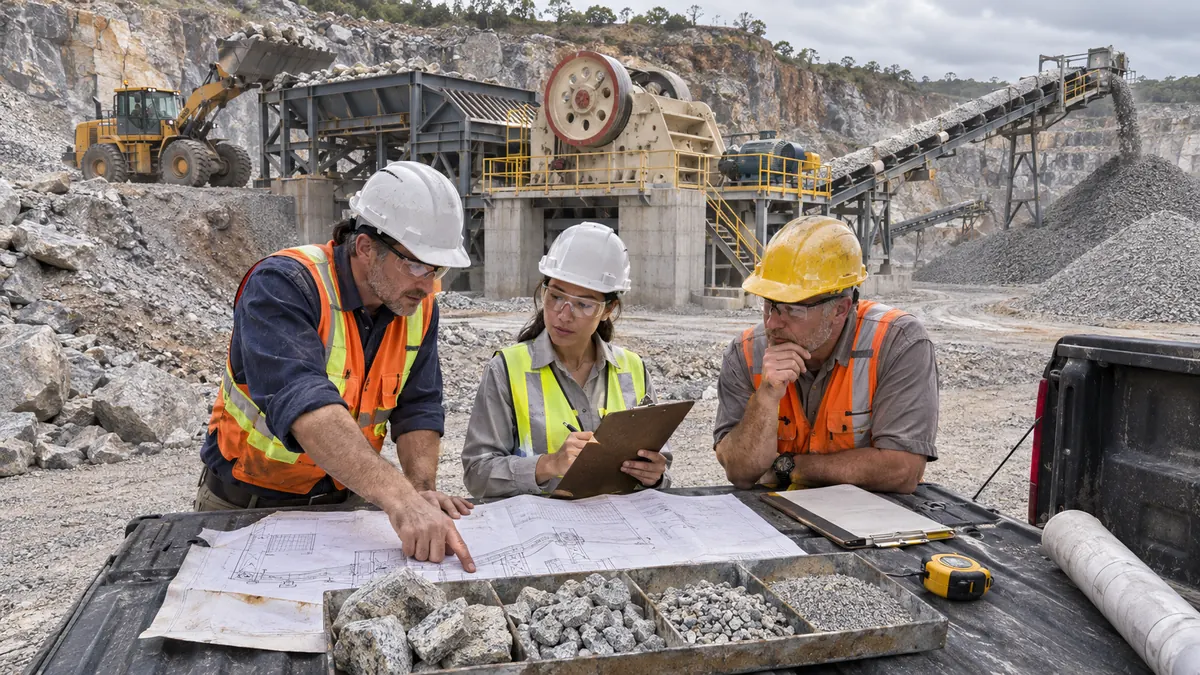
- Release representative raw material information, rock photos or samples, typical and maximum feed size, fines, moisture, weathered material and known variability.
- Give each bidder the same required output condition, capacity basis, working hours, downstream process interface, site layout, elevation and access constraints.
- Require a line-by-line scope for hopper, feeder or grizzly, jaw crusher, conveyors, chutes, steelwork, platforms, guards, dust interface, controls and installation supervision.
- Separate machine supply from civil work, electrical work, transport, lifting, erection, operator labour, water, dust control, local approvals and any downstream equipment.
- Ask which figures and inclusions are confirmed, conditional, provisional, optional or excluded; do not normalise missing information into an assumed inclusion.
- Define the commissioning material, site-ready list, first-product review, training, documentation, handover record and change-control route before issuing an order.
Frequently Asked Questions
What should I compare first in jaw crusher quotations?
Compare the released feed-and-scope basis first: actual rock condition, feed range, required discharge condition, operating duty, physical material path and site interfaces. Then compare the exact jaw model, accessories, commercial terms and total price against that same record.
Is the largest jaw opening always the safer choice for a hard-rock quarry?
No. The jaw opening must be evaluated with feed geometry, feed control, target top size, duty, downstream equipment and site layout. An oversized or poorly integrated primary stage can still create avoidable cost, uneven flow or transfer problems.
Why can two jaw crusher capacity figures be different for a similar model?
Capacity depends on the assumptions behind it, including feed gradation and condition, crusher setting, material characteristics, operating duty and required discharge. Ask each supplier to state those assumptions rather than treating different headline figures as directly comparable.
Should a feeder and grizzly be included with a jaw crusher quotation?
They should be considered whenever the quarry feed needs controlled presentation, fines removal or surge handling. Whether they are included depends on the released feed record and process design, but their scope should be explicit so the jaw is not quoted as an isolated machine.
What civil information does a jaw crusher supplier need?
The project team should provide site layout, foundation or support assumptions, elevation, access, drainage, power location and local design constraints. The proposal should state the supplied load data, drawings, handover points and work excluded from the equipment package.
How should commissioning be defined in the purchase order?
Define the site-ready conditions, representative first material, people responsible, permitted adjustments, records to be issued, initial product handover and process for a material or site condition that differs from the released basis. This creates a review point; it is not an unconditional performance guarantee.
Send the Same Quarry Record to Every Bidder
To compare a hard-rock jaw crusher quotation fairly, send each supplier your raw material description or representative samples, feed size range, required output size or downstream target, required capacity and working hours, site photos and layout constraints, plus your budget range. Include the foundation, power, access and commissioning boundaries you already know. MVSI can then prepare a proposal scope around the stated assumptions rather than implying that a catalogue jaw size alone is a complete quarry solution.