Table of Contents
- Start with one released equipment and site basis
- Separate foundation design from equipment supply
- Map the installation interfaces before equipment arrives
- Make access, isolation, and maintenance part of the purchase decision
- Use a pre-commissioning release gate
- Common scope mistakes to avoid
- Frequently Asked Questions
- Does a jaw crusher supplier design the concrete foundation?
- What information is needed before a jaw crusher foundation is built?
- Should anchor bolts be supplied with the jaw crusher?
- Who is responsible for the feeder and discharge conveyor interfaces?
- What should be checked before first energization?
- Can a preliminary foundation drawing be used for construction?
- What support scope should be included in a jaw crusher installation quotation?
- Request a Jaw Crusher Installation Scope Review
What Should a Buyer Verify in a Jaw Crusher Foundation and Installation Scope?
A buyer should release a jaw crusher order only after the foundation and installation scope turns the selected machine into a shared, checkable set of interfaces. Confirm who supplies the crusher loads, foundation and anchor requirements, survey levels, base-frame items, feeder and discharge connections, power and control termination, drainage, guards, access platforms, lifting provisions, documents, erection supervision, and the handover test. A foundation drawing alone is not the whole answer: the final arrangement must match the selected jaw crusher, feeder, conveyor, local ground conditions, site rules, and maintenance method. Compare supplier offers against one responsibility register, then close every assumption before civil work or equipment delivery begins.

Start with one released equipment and site basis
A jaw crusher foundation should be built from the selected equipment’s current installation data and a site-specific civil review, not from a brochure outline or an earlier machine size. The buyer needs one controlled package that identifies the machine version, base arrangement, feeder, discharge route, operating duty, layout, and every interface that can change the concrete or steelwork.
The US EPA’s crushed-stone processing description is useful general context because it treats crushing, screening, material handling, and storage as connected operations. It does not provide a foundation design or validate a particular plant layout.
| Item to freeze before civil work | What to request | Why it matters |
|---|---|---|
| Equipment identity | Current manufacturer drawing, model/version, base-frame or skid arrangement, installed accessories, and revision status | A generic envelope can miss a changed base, drive, guard, or support point. |
| Process duty | Raw material, maximum and normal feed size, expected fines or moisture observations, capacity basis, and feeder arrangement | Feed preparation and duty influence the surrounding hopper, feeder, chute, and access layout. |
| Layout and elevations | General arrangement, crusher centreline, discharge elevation, feeder and conveyor transitions, maintenance clearances, and survey datum | Finds a clash with a conveyor, wall, drain, cable route, or lifting path before concrete is placed. |
| Civil inputs | Current supplier loads where provided, anchor pattern, base requirements, dynamic or operating notes, and interface limits | Civil responsibility needs actual equipment data and local engineering judgment. |
| Site conditions | Geotechnical information, groundwater or drainage observations, rainfall, access route, lift plan assumptions, power source, and local rules | The same jaw crusher can need a different installation response at a different site. |
| Change control | Named document owner, approval route, revision log, and a rule for changes after foundations begin | Prevents an informal drawing update from becoming an unpriced site rework. |
Before comparing civil allowances, trace the material route with the quarry feeder, crusher, screen, and conveyor guide and use the crushing plant flow-sheet guide to identify feed, discharge, screening, and stockpile interfaces.
Separate foundation design from equipment supply
The equipment supplier and the buyer’s civil team may both contribute to a safe installation, but their deliverables are not automatically the same. The quotation should say who gives equipment-side inputs and who is responsible for project-specific foundation design, local codes, ground review, construction, survey, and final as-built checks. Do not infer that a drawing labelled “foundation” transfers all civil responsibility.
| Interface | Buyer question | Evidence or release record |
|---|---|---|
| Loads and restraints | Which current equipment loads, support locations, operating notes, and restrictions are supplied? Which assumptions remain for the civil engineer? | Dated equipment data, stated scope boundary, and an approved revision list. |
| Concrete and reinforcement | Who designs the foundation, reinforcement, embedded items, and any soil improvement for the actual ground? | Local civil design package and construction responsibility. |
| Anchor bolts and base frame | Who supplies the anchor pattern, template, bolts, grout specification if applicable, base frame, and tightening or alignment procedure? | Controlled anchor drawing, bill of supply, and installation instruction. |
| Levels and alignment | Which party establishes survey datum, base level, equipment position, and final alignment record? | Survey plan, tolerances from current equipment documents, and signed check record. |
| Drainage and housekeeping | Who designs run-off, drains, wash-down or dust-water interfaces, containment, and access around the foundation? | Site layout and drainage responsibility map. |
| Modifications | What happens if field dimensions, the selected machine, or conveyor elevations change? | Written change process with design and cost owner. |
The jaw-and-cone circuit guide for hard-rock quarries can help define the jaw crusher’s process role. It cannot replace the machine-specific foundation package or a qualified local review.
Map the installation interfaces before equipment arrives
Installation risk often sits between packages: a jaw crusher can be delivered while the feeder opening, discharge chute, cable route, crane access, or maintenance platform belongs to no one. Put every mechanical, electrical, controls, civil, and safety transition in one register and identify whether it is supplied, site-provided, or still open.
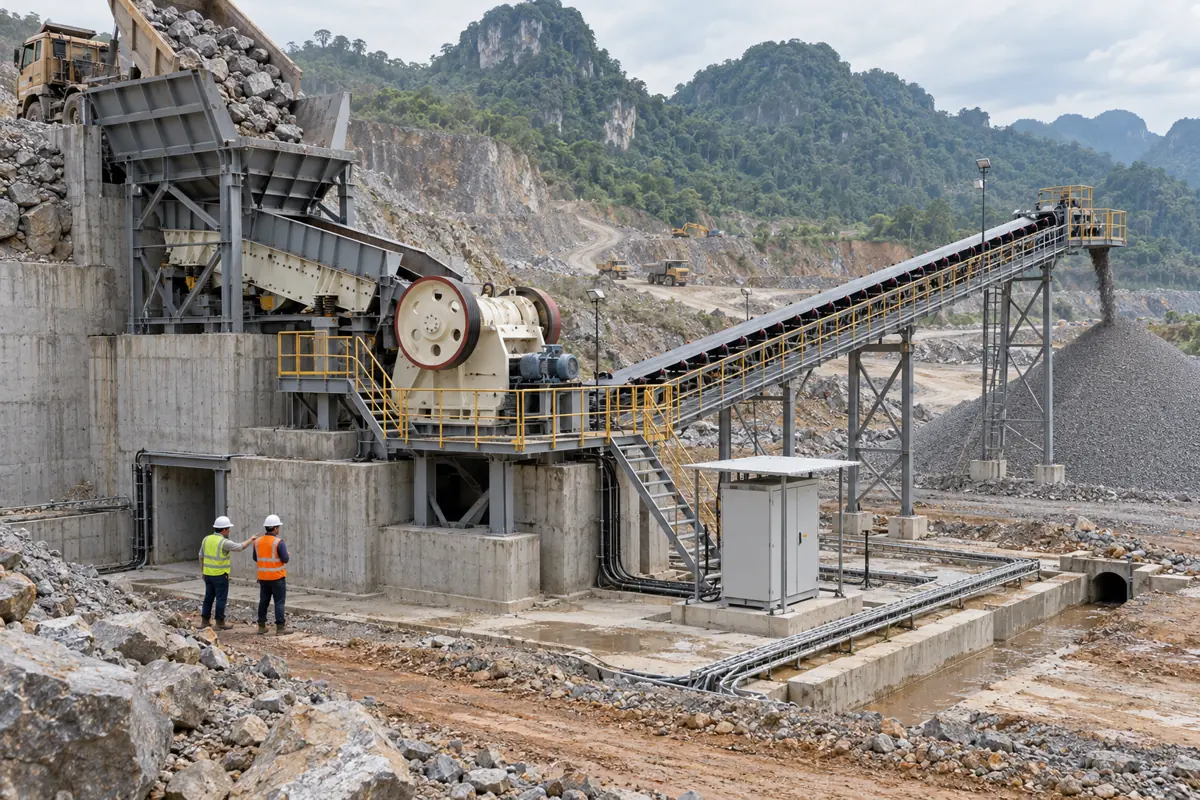
| Installation boundary | Questions to settle before mobilization |
|---|---|
| Receiving and feeder | Who supplies or builds the hopper, feeder supports, liners, grizzly or scalping provision, isolation components, and feed-control instruments? Does the opening match the released layout? |
| Crusher and discharge | Who supplies the base frame, transition chute, supports, liners, guards, and discharge conveyor interface? Is sufficient clearance retained for inspection and replacement work? |
| Electrical power | What is included for motors, starter or drive, local isolators, MCC or panel boundary, cable tray, field cabling, earthing, and test responsibility? |
| Controls and interlocks | Which instruments, emergency stops, permissives, alarms, communication points, and upstream/downstream interlocks are supplied or site-integrated? |
| Access and lifting | Who supplies stairs, platforms, handrails, working clearances, lifting beams or crane assumptions, and any maintenance tooling? |
| Water, dust, and drainage | Who owns dust-control connections, wash-down if used, runoff paths, pumping, spill containment, and housekeeping around the equipment? |
| Installation support | Is the scope equipment supply only, remote support, site supervision, or a defined commissioning attendance? Record travel, labour, tools, consumables, and exclusions explicitly. |
Use the stone crusher plant cost guide to separate equipment from installed-project costs. A lower equipment-only number is not comparable with an offer that includes more interfaces, site work, or handover support.
Make access, isolation, and maintenance part of the purchase decision
Access and isolation provisions are installation requirements, not finishing details. The layout should show how people approach routine inspection points, remove or install wear components where relevant, clean spillage, and isolate energy sources under the site’s procedures. Where a task requires a crane, hoist, lifting accessory, platform, or temporary removal of surrounding items, make that assumption visible before order release.
OSHA’s hazardous-energy standard applies in the United States and is not worldwide legal advice. Its general procurement lesson is useful everywhere: servicing is safer and easier to plan when isolation points, guarding, access, and responsible parties are identified in advance rather than left to a field workaround.
| Maintenance or safety topic | What the buyer should verify |
|---|---|
| Inspection access | Safe, practical access to the feeder, jaw area, drive, discharge, lubrication points where present, and conveyor transitions under local site rules. |
| Isolation boundary | Location and ownership of electrical isolation, lockout/tagout procedures where applicable, emergency stops, stored-energy controls, and handover documents. |
| Guarding boundary | Supplied and site-provided guards, handrails, covers, gates, and responsibility for any field-made interface guards. |
| Lifting plan | Component weights from current documents, proposed lift route, headroom, temporary works, crane or hoist assumptions, tools, and lift responsibility. |
| Spares and tools | Initial spare parts, special tools if offered, machine-specific identification, storage requirements, and the owner of early inspection tasks. |
| Handover information | Current manuals, drawings, parts data, electrical/control information within scope, certificates or records where contractually required, and the open-items list. |
The new-versus-used crusher guide offers a related buying principle: condition evidence and missing-work scope should be visible before price comparison. For a new installation, use the same discipline to expose site interfaces and handover gaps.
Use a pre-commissioning release gate
Civil completion is not the same as an installed, safe-to-test crushing circuit. Before energization or material introduction, the buyer, installation party, and equipment representative where contractually included should work from a written release list. The list does not certify a plant by itself; it records that required documents, interfaces, and unresolved items are visible to the people who own them.

- Confirm that the current machine, base-frame, feeder, conveyor, and layout revisions match the delivered equipment and approved site arrangement.
- Verify that civil work, anchor pattern, levels, grout or fixing steps where specified, drainage, access routes, and surrounding clearances have been checked by the responsible parties.
- Trace the feeder-to-jaw and jaw-to-conveyor interfaces: supports, chutes, guards, liners, sensors, electrical terminations, control signals, and dust or water connections need an owner.
- Confirm that access, platforms, handrails, isolation provisions, lifting assumptions, initial tools or spares, documents, and training or support scope are aligned with the local work method.
- Record open items, restrictions, test prerequisites, witnesses, evidence to be collected, and the route for correcting a deviation before treating the plant as ready for a material test.
The cone-circuit commissioning checklist is a useful comparison for the later commissioning stage. Its gate-based approach can be adapted, but the final release method must follow the actual equipment, contract, and site requirements.
Common scope mistakes to avoid
The frequent mistake is starting a foundation from a preliminary layout and discovering later that the final feeder, base frame, cable route, or discharge conveyor has moved. Another is comparing a machine-only quote with a broader installation package without separating civil, electrical, controls, access, lifting, and commissioning responsibilities.
Avoid treating a generic drawing, a nominal crusher capacity, or a verbal promise of assistance as a complete installation scope. The correct boundaries depend on the final equipment documents, raw material and feed duty, site layout, local engineering, utilities, delivery terms, and the written contract. Record what is known, what is assumed, and what must be resolved before site work begins.
Frequently Asked Questions
Does a jaw crusher supplier design the concrete foundation?
The answer depends on the written scope. A supplier may provide equipment-side information such as base arrangement, loads, anchor pattern, or installation guidance, while the buyer’s civil team remains responsible for site-specific foundation design, ground conditions, local requirements, and construction. Make the split explicit in the offer and drawings.
What information is needed before a jaw crusher foundation is built?
Use the current equipment and layout package, including the selected crusher and base arrangement, feeder and conveyor interfaces, elevations, manufacturer-provided installation data, site survey, geotechnical and drainage information, electrical route, maintenance access, lifting plan, and local civil review requirements.
Should anchor bolts be supplied with the jaw crusher?
Do not assume. Ask who supplies the bolts, template, base frame, grout or fixing materials where specified, torque or alignment instructions, and verification record. The answer must match the current equipment drawing and the project’s civil design.
Who is responsible for the feeder and discharge conveyor interfaces?
Assign every interface in writing. The quotation and installation register should state who supplies or builds hopper and feeder supports, chutes, conveyors, guards, electrical connections, instruments, controls, steelwork, and site installation work. A jaw crusher purchase order does not automatically include adjacent equipment.
What should be checked before first energization?
Check the released equipment revisions, structural and civil completion records, required access and guards, electrical and controls terminations, emergency and isolation provisions under site rules, lubrication or ancillary systems where applicable, open items, and the written test or handover plan. Use current supplier documents and local procedures.
Can a preliminary foundation drawing be used for construction?
Only if the responsible parties formally release it for that purpose and confirm it matches the selected equipment and site conditions. Preliminary layouts are useful for planning but may change as machine, feeder, conveyor, access, or civil inputs are finalized.
What support scope should be included in a jaw crusher installation quotation?
Ask for the actual scope: drawings and manuals, equipment-side installation guidance, remote support if offered, site supervision or commissioning attendance if offered, labour and travel boundaries, tools or consumables, training, test prerequisites, exclusions, and the escalation route. Do not assume local attendance or response time without a written commitment.
Request a Jaw Crusher Installation Scope Review
Send MVSI your raw material, feed size, output size, capacity, site photos, and budget range. Include the current flow sheet, equipment list, site layout or elevations, civil and geotechnical information available, power details, lifting/access constraints, project stage, and the supply boundary you want quoted. A review can identify the information still needed before a jaw crusher foundation and installation scope is ready for release.