Table of Contents
- Quick decision facts for screen-media selection
- When is wire a reasonable choice, and when should polyurethane be evaluated?
- Why does the same aperture not mean the same screening area?
- Can polyurethane replace wire on the proposed mobile screen?
- What should a comparable media quotation include?
- Frequently asked questions
- Is polyurethane always better than woven wire for abrasive aggregate?
- Does a 10 mm aperture guarantee a 10 mm finished product?
- Does lower open area mean an equal percentage loss in capacity?
- Can polyurethane panels be fitted without changing the deck?
- Should every part of a deck use the same media?
- What is needed to compare wire and polyurethane quotations?
- Choose from verified fit and accepted production
- Sources and technical references
Wire or Polyurethane Media for a Mobile Aggregate Screen?
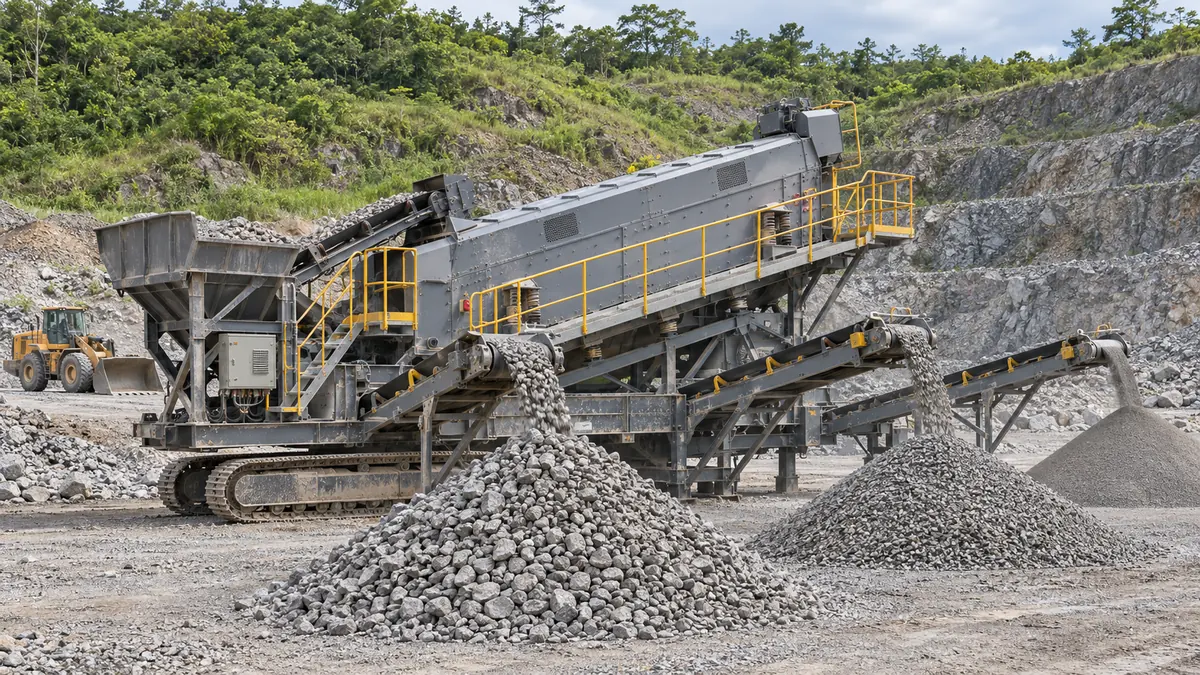
Choose woven wire when its open area and replacement arrangement suit the required aggregate separation. Consider polyurethane when abrasion, wet feed or repeated plugging makes a different media design worth evaluating. Neither material wins on wear life alone: the screen must still deliver accepted products, and the proposed media must fit its deck. Compare the exact aperture, installed screening area, operating blockage, changeout time and product results on the same feed basis. Before ordering a mobile screen, require a media drawing and an agreed output assessment rather than accepting a material name as a performance guarantee.
By MVSI Company. Published 2026-11-10.
Quick decision facts for screen-media selection
Treat wire and polyurethane as candidate designs for a defined screening duty. Compare their actual construction and operating results; a nominal aperture or material label cannot settle the purchase.
| Decision factor | Woven wire candidate | Polyurethane candidate |
|---|---|---|
| Typical reason to evaluate | Open area for sizing duty and the existing replacement arrangement | Wear or plugging problems, including suitable wet or abrasive duties |
| Opening definition | Clear aperture, shape, wire diameter and weave | Clear aperture, shape, panel thickness and moulded profile |
| Area to compare | Clean geometric open area, then installed exclusions and operating blockage | The same definitions, using the exact panel drawing rather than a generic material percentage |
| Fit to establish | Panel dimensions, hook/tension arrangement and support condition | Tensioned or modular construction, attachment details and approved deck compatibility |
| Acceptance basis | Specified product grading and accepted tonnes over a common elapsed period | The same feed, product limits, moisture basis and elapsed measurement period |
When is wire a reasonable choice, and when should polyurethane be evaluated?
Wire is a reasonable starting candidate where its opening area supports the separation and existing wear is manageable. Evaluate polyurethane where wear or plugging creates a recurring problem, provided the proposed construction can meet the product duty.
McLanahan’s screen-media guide describes the trade-off between open area and media life, including polyurethane for suitable wet and abrasive applications. This is application guidance, not a universal life multiplier or a prediction for a particular mobile screen.
Define the problem before requesting a different material. Ask whether the current issue is broken wires, enlarged openings, blocked apertures, frequent changeouts or off-specification stockpiles. Keep the worn sample and identify its position on the deck. Haver & Boecker Niagara’s selection guidance uses material characteristics, deck zones and discarded-media observations to inform that assessment.
Do not approve an all-polyurethane deck simply because a longer life is forecast. Equally, do not reject it solely because its clean open-area percentage is lower. A proposed change is unsuitable for purchase approval when the supplier cannot establish the mounting fit, relevant feed conditions and product acceptance basis. Severe clay adhesion or an unsuitable separation process needs a wider review; the wet, clay-bearing mobile-screen guide addresses that different decision.
Why does the same aperture not mean the same screening area?
Aperture is the clear opening; open area is the proportion of surface occupied by openings. Two media proposals with the same aperture can have different solid material between those openings and different usable installed areas.
For a simple repeating square wire grid, the geometric open-area fraction is (clear aperture / pitch) squared. Pitch equals clear aperture plus wire diameter. This is geometry for an ideal clean grid, excluding edges and supports; it is not a screen-capacity formula.
Illustrative calculation, not a product specification: assume a 10 mm clear square aperture. With 2 mm wire, the ideal open area is (10 / 12) squared, or about 69.4%. With 3 mm wire, it is (10 / 13) squared, or about 59.2%. Both have a nominal 10 mm aperture. These assumed dimensions demonstrate why opening size alone is an incomplete quotation description; they establish no wear life or throughput.
For a polyurethane proposal, request the manufacturer’s opening pattern and calculation basis. Do not insert panel thickness into the wire formula: moulded ribs, borders and aperture profiles require the actual design. Ask both bidders whether their stated percentage covers the active pattern, a complete panel or the installed deck. Then identify areas excluded by supports, clamps, overlaps or blank sections using the same boundary.
Metso’s discussion of rubber-media open area highlights clogging and structural exclusions as reasons nominal area alone does not predict production. Its example concerns rubber, not a measured polyurethane conversion. The useful purchasing principle is to assess the installed, operating screen rather than convert an area difference directly into a capacity difference.
Can polyurethane replace wire on the proposed mobile screen?
Only approve the substitution after the exact media construction and attachment have been checked for the proposed deck. Polyurethane is not synonymous with a modular panel: tensioned polyurethane products also exist.
Metso’s tension-system range documents tensioned wire, rubber and polyurethane constructions. That establishes the distinction between material and mounting method; it does not confirm compatibility with an MVSI screen or make another OEM’s media an included option.
MVSI’s Mobile screens page describes a mobile vibrating-screen family for aggregate, quarry, mining and recycling duties. Use it as the product-family starting point, then obtain written confirmation of the exact screen, deck and media offered. The page is not evidence that any particular polyurethane conversion, mounting kit or spare-panel package is included or available.
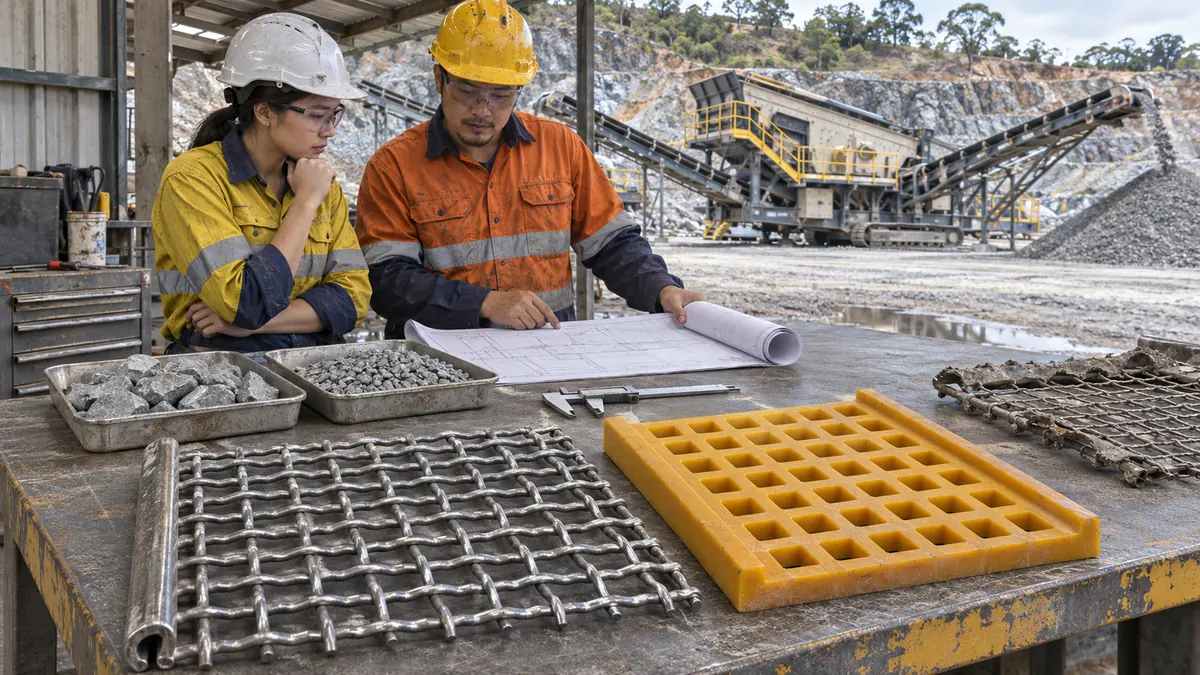
For a new machine, request the media schedule as part of the screen quotation. For replacement on an existing machine, add the machine identity, deck position, measured panel dimensions and mounting drawings. Do not treat matching width and length as complete proof of fit. If deck size or product-stream count remains undecided, settle those inputs with the screen size and deck selection guide before finalizing the media order.
What should a comparable media quotation include?
Require each offer to describe a complete installed option on the same duty basis. Mark unverified life and output figures as estimates and agree how a trial or operating record would support them.
| Quotation item | Required comparison record |
|---|---|
| Duty and product | Representative feed grading, maximum lump size, moisture range, abrasion information and specified product tests |
| Media definition | Material, aperture dimensions/shape, wire diameter or panel profile, deck position and dimensioned layout |
| Installed scope | Attachments, support changes if required, approved compatibility, installation responsibility and first spare set |
| Performance evidence | Feed/product samples, accepted output in t/h, operating blockage and all settings recorded for the same measurement period |
| Ownership cost | Quoted media and hardware, freight, agreed installation labour, replacement frequency evidence and cleaning/changeout downtime |
Use a common comparison period and divide the consistently scoped cost by tonnes meeting the agreed product specification. Report cleaning and changeout time separately so they remain visible. Do not use incoming feed tonnes as the denominator for one option and accepted product tonnes for the other. Avoid counting the same downtime both as a separate cost and as a second lost-production charge without explaining the accounting.
Illustrative decision scenario: a quarry is considering a wire deck and a polyurethane alternative for the same product cut. The polyurethane offer forecasts longer life but provides no matched product results; the wire offer gives only a clean open-area percentage. Neither submission yet supports a lifecycle-cost winner. Request a common duty assessment or an agreed trial, with the same product limits and comparable feed conditions. Treat unverified life and output figures as assumptions until comparable evidence is available.
If screen carryover is already limiting a closed circuit, record the returning stream as well as finished products. The cone-versus-screen upgrade guide explains the wider investment diagnosis. A media comparison alone does not justify buying a larger crusher.
Frequently asked questions
Settle the opening, fit and product-assessment questions together before ordering. These answers apply to selecting the media option, rather than prescribing a universal screen rating.
Is polyurethane always better than woven wire for abrasive aggregate?
No. It is worth evaluating for a suitable abrasive duty, but the exact design must also meet the separation and mounting requirements. Longer forecast life alone does not establish lower cost per accepted tonne.
Does a 10 mm aperture guarantee a 10 mm finished product?
No. It defines a nominal opening, not the complete product grading. Agree the required product tests and assess representative output from the proposed screen and operating conditions.
Does lower open area mean an equal percentage loss in capacity?
No. Clean geometric open area is only one comparison input. Installed exclusions, blockage and the complete screening duty must be assessed; an area percentage is not a throughput conversion.
Can polyurethane panels be fitted without changing the deck?
That requires confirmation for the exact machine and media construction. Request attachment drawings, support requirements and written compatibility approval. Do not assume all polyurethane media use the same mounting system.
Should every part of a deck use the same media?
Not necessarily. Review the observed wear and separation duty by deck zone. Any proposed combination needs a compatible layout and a product assessment; a mixed arrangement is not automatically an available machine option.
What is needed to compare wire and polyurethane quotations?
Provide feed grading and moisture, product requirements, screen and deck identity, mounting drawings and current wear or blockage records. Ask both suppliers to define included hardware, output evidence and costs on the same measurement basis.
Choose from verified fit and accepted production
Keep wire as the reference option when it meets the duty economically. Specify polyurethane only when the exact compatible design and supporting assessment justify the change. If either fit or product evidence is missing, settle that gap before placing the order.
For a screen configuration review, contact MVSI through its listed WhatsApp or email route. Send raw material, maximum and typical feed size, required output size, capacity in t/h, project country, site photos and budget range. Add feed grading and moisture, the product specification, deck and mounting drawings, current media details, and wear or blockage records. Identify any unknown inputs so the quotation can state how they will be resolved.
Sources and technical references
These sources support product-family identification and general screening principles. Other OEM guidance does not establish MVSI options, wear life, supply scope or service commitments. Retrieved 2026-11-10.
- MVSI Mobile screens, linked above: published mobile-screen family and applications; exact media scope requires written confirmation.
- McLanahan, How to Choose the Right Type of Screen Media for Your Aggregate Plant, linked above: general open-area and media-life trade-offs.
- Haver & Boecker Niagara, Four Tips to Select Effective Screen Media for Your Operation, linked above: material inputs, deck zones and wear observations.
- Metso, Does rubber screening media reduce capacity?, linked above: limitations of nominal open area as a capacity predictor.
- Metso Screening media tension systems, linked above: distinction between media material and tensioned construction.