Table of Contents
- What facts decide between a larger jaw and pre-breaking?
- Why can rock bridge even when the opening looks large enough?
- When does a larger mobile jaw deserve a quotation?
- When is separate pre-breaking the stronger option?
- How should buyers compare complete shift output and cost?
- An illustrative decision with two different feed patterns
- Frequently asked questions
- Does the feed opening equal the maximum rock size?
- Will a larger mobile jaw eliminate bridging?
- Is there a universal oversize percentage for choosing a breaker?
- Can one excavator feed the jaw crusher and pre-break rock?
- Does an MVSI mobile jaw quotation automatically include a rock breaker?
- What evidence should decide between the two routes?
- Select the route that can deliver accepted feed throughout the shift
- Sources and technical references
Bigger Mobile Jaw Crusher or Rock Breaker for Oversize Feed?
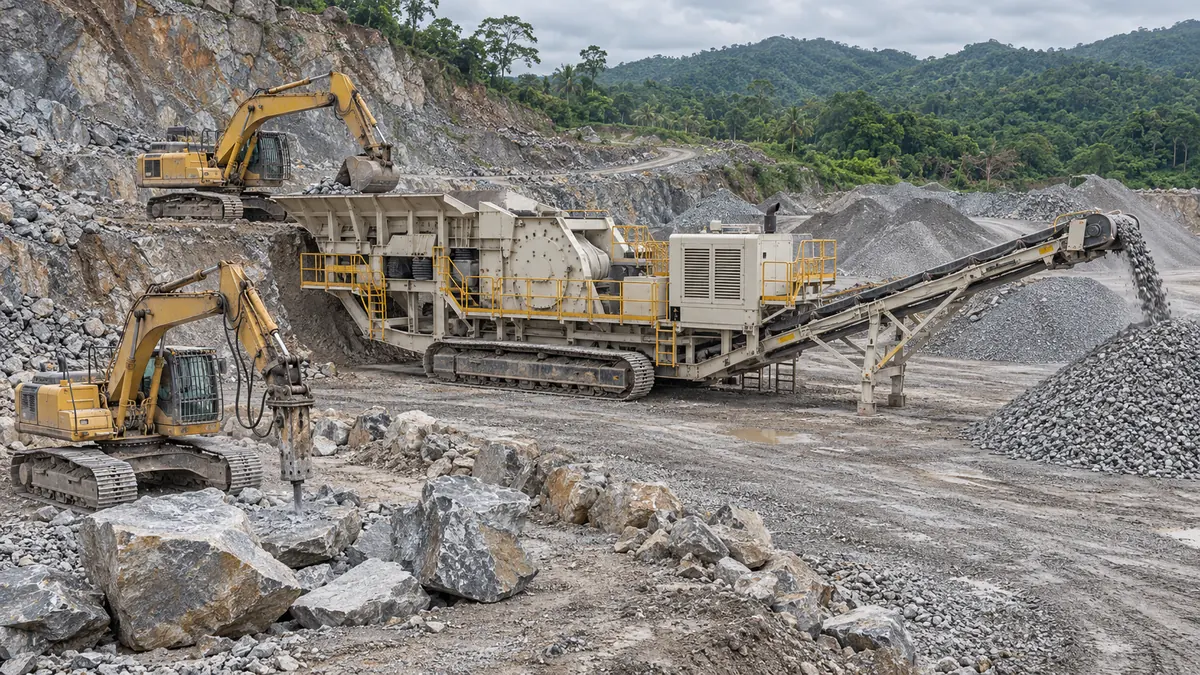
Compare a larger mobile jaw crusher when oversize rock is a recurring part of the normal feed and preparing it separately would restrict production. Consider pre-breaking when occasional large pieces can be isolated and reduced without starving the crusher. Neither choice follows from the largest rock alone: slab shape, feed presentation, jaw geometry and the time available for preparation also matter. Obtain written feed acceptance for the offered crusher and compare complete shift output, including sorting, breaking, loading and interruptions. A larger inlet does not eliminate every bridging risk, and a breaker is not free production capacity.
What facts decide between a larger jaw and pre-breaking?
The decisive inputs are how often difficult pieces arrive and whether the proposed preparation method can keep accepted feed available. Use the same material, output requirement and shift boundary for both options.
| Decision fact | What to establish | Purchase implication |
|---|---|---|
| Accepted feed geometry | Length, width and thickness in mm; slabby shape; supplier-approved top size for the exact jaw and inlet | An inlet dimension alone is not a promise that every matching stone will pass |
| Oversize occurrence | Recorded frequency and, where measurable, mass share across representative feed campaigns | Recurring oversize needs a sustained preparation route or a different primary arrangement |
| Reference size rule | McLanahan publishes an 80% feed-opening rule of thumb; the actual supplier acceptance still governs | Use as an initial screening reference, not an MVSI model rating or permission for slabby rock |
| Preparation resource | Available excavator, attachment, operator, work area and accepted-feed stock | A shared loading excavator may not be available for both duties simultaneously |
| Production basis | Required accepted output in t/h and tonnes per agreed shift, including preparation interruptions | Compare the complete feed-to-product duty rather than crushing-only peak output |
The numerical reference above comes from McLanahan’s jaw-feeding guidance. It does not specify a universal limit for another supplier’s jaw, hopper or liner profile. No project feed dimensions, capacity or breaker production rate are assumed here.
Why can rock bridge even when the opening looks large enough?
A single oversize piece can obstruct the inlet, but several smaller pieces can also interlock and interrupt flow. Slabby rock and the way the feeder presents it therefore need separate attention from the nominal maximum size.
Metso’s guidance on jaw-crusher performance describes both single-piece and multiple-piece bridging. Its examples support checking feed shape and presentation; they do not establish a production loss or an improvement percentage for an MVSI machine.
Ask for the offered jaw’s inlet drawing, the proposed fixed and moving jaw profiles, and the feeder-to-chamber transition. Metso’s jaw-profile guidance notes that liner thickness affects the available opening and that lamellar material matters to selection. Those are reasons to verify the actual supplied arrangement rather than order from a catalogue opening alone.
- Record three dimensions of representative difficult pieces, supported by photos with a visible scale and a description of their source.
- Separate the usual feed distribution from rare maximum pieces and recurring flat slabs; do not describe all three with one top-size number.
- Ask which piece shapes and presentation conditions the written acceptance excludes, and whether representative material review or a trial is needed.
- Do not treat a change in closed-side setting (CSS), the jaw discharge setting, as proof that a larger feed piece is acceptable.
When does a larger mobile jaw deserve a quotation?
A larger jaw deserves comparison when the normal feed repeatedly exceeds the smaller machine’s documented acceptance and the site cannot prepare enough compliant material. It still needs a matched feeder, discharge and downstream circuit.
For this enquiry, use the MVSI mobile primary jaw crusher family as the relevant product route. Its page describes mobile primary jaw crushing for quarry applications. Confirm the exact model, inlet, liners and offered scope in a current proposal; the page does not verify an optional hydraulic breaker or a project-specific performance guarantee.
A larger machine may be unsuitable if transport limits, working space or downstream equipment rule it out. It may also be unnecessary where the ordinary feed already suits a smaller jaw and the few exceptional pieces have a reliable preparation route. Define these limits before treating the larger inlet as the better purchase.
Check the whole line using the feeder, crusher, screen and conveyor selection guide. A jaw’s accepted feed and its required discharge are different questions; the hard-rock jaw-and-cone circuit guide helps define the next-stage handover.
When is separate pre-breaking the stronger option?
Pre-breaking is worth comparing when oversize is intermittent, can be separated from ordinary feed, and can be prepared with resources that do not undermine the required shift output. Confirm the preparation duty and carrier compatibility with the responsible equipment supplier.
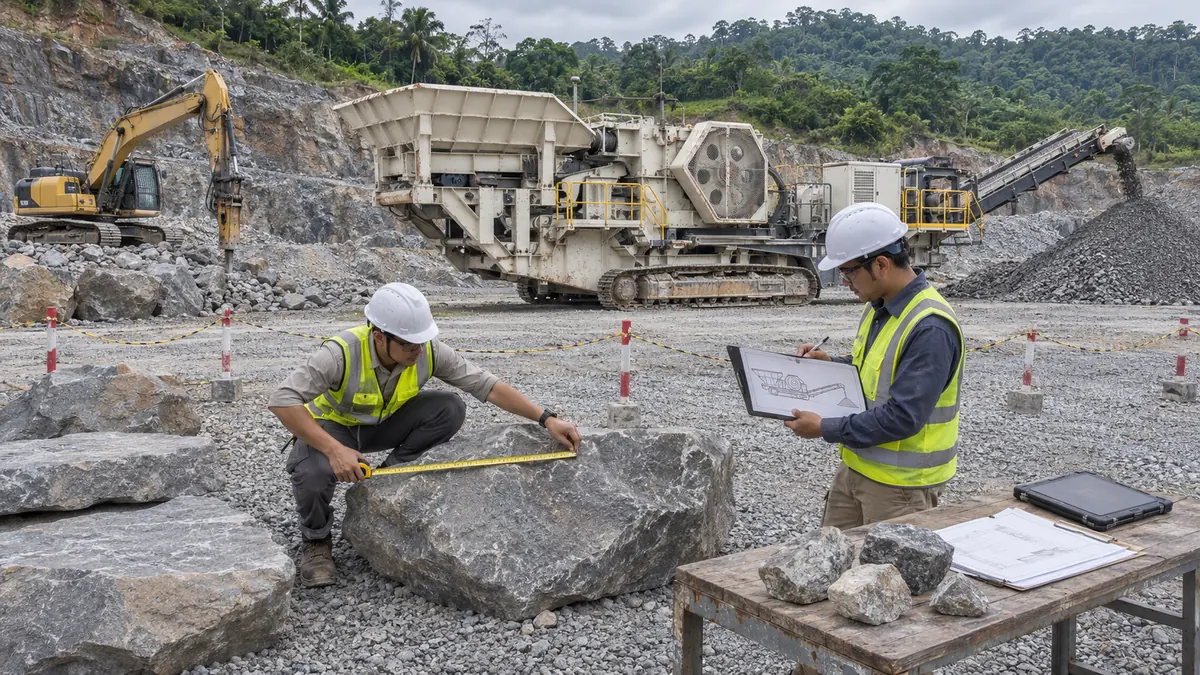
Include sorting, moving oversize to the preparation area, breaking, returning accepted material and any attachment-change time in the comparison. If one excavator must both feed the crusher and operate the breaker, map those duties on a common shift schedule. Do not add their separate hourly ratings as though both activities occur at once.
This route is unsuitable when oversize accumulates faster than the agreed preparation process can handle, when no suitable segregated work area is available, or when feed preparation repeatedly leaves the crusher waiting. A standby attachment without an available carrier and operator does not establish a working preparation system.
How should buyers compare complete shift output and cost?
Compare tonnes of accepted product over the same defined shift and product specification, with preparation and waiting included. Ask each bidder to distinguish a forecast, a material-trial result and a contractual acceptance commitment.
| Scope to compare | Larger mobile jaw route | Smaller jaw plus pre-breaking route |
|---|---|---|
| Feed acceptance | Written size/shape limits and inlet/liner arrangement | Same jaw evidence plus required prepared-feed size/shape |
| Equipment and handling | Crusher, feeder, discharge, transport and setup scope | Crusher plus compatible carrier/attachment, sorting, handling and preparation area |
| Time basis | Common shift; planned feeding and interruption assumptions | Same shift; preparation, attachment changes, loading and any shared-resource conflicts |
| Cost boundary | Quoted equipment and project-specific operating/transport inputs | Same categories plus preparation resources and extra handling |
| Acceptance record | Agreed material, product, measurement point and test period | Same record, explicitly including the preparation stage |
A useful comparison measure is total cost within that agreed boundary divided by accepted product tonnes over the same period. Obtain the missing inputs from comparable quotations or site records. Without them, an hourly breaker rate, a catalogue jaw capacity or a lower machine price cannot establish the cheaper route.
Keep the procurement schedule consistent with the jaw-crusher quotation comparison checklist. Identify who supplies each interface and what is excluded, rather than assuming that carrier, attachment, site preparation or commissioning is included.
An illustrative decision with two different feed patterns
Two quarries with the same largest observed rock can need different purchase routes because the frequency and shape of difficult pieces differ. The following is a hypothetical comparison, not an MVSI project or a performance forecast.
In Scenario A, most feed is within the proposed jaw’s written acceptance and exceptional blocks can be separated before the crusher is fed. The buyer would investigate pre-breaking, verify the preparation resource and include its handling cost. In Scenario B, large flat slabs recur throughout the normal feed and the same excavator is expected to prepare them and keep loading. The buyer would compare a larger or differently configured primary jaw against a properly resourced preparation route, rather than accepting a small-jaw quotation that omits the time conflict.
Neither scenario proves that one route wins. The release decision is whether the supplier-supported inlet and the complete preparation schedule can meet the same agreed duty. No invented dimensions, production rate or quotation range are needed to make that distinction.
Frequently asked questions
Use the questions below to check the feed-acceptance and preparation assumptions in a quotation. The answers refer to natural quarry rock; reinforced demolition material needs its own contamination and handling assessment.
Does the feed opening equal the maximum rock size?
No. Obtain the permitted feed dimensions and shape conditions for the exact jaw, liner profile and feeding arrangement. A nominal inlet dimension is not an acceptance guarantee for every rock that appears to fit.
Will a larger mobile jaw eliminate bridging?
No. A larger inlet may address a documented size constraint, but several stones can interlock and slabby feed can still interrupt entry. Check the complete inlet geometry, jaw profile and feed presentation.
Is there a universal oversize percentage for choosing a breaker?
No universal purchasing threshold is established here. Record oversize frequency, mass share where measurable, shape and preparation time, then compare the two routes against the same required shift output.
Can one excavator feed the jaw crusher and pre-break rock?
It may do both at different times if the approved arrangement and shift schedule support that plan. Include switching, handling and preparation time, and verify whether enough accepted feed remains available while the excavator is breaking.
Does an MVSI mobile jaw quotation automatically include a rock breaker?
Do not assume that it does. The linked mobile primary jaw page identifies the crusher family, but breaker availability, carrier compatibility, supply responsibility and included scope require separate written confirmation.
What evidence should decide between the two routes?
Use representative three-dimensional feed records, oversize recurrence, written crusher acceptance and a complete preparation schedule. Compare quotations or trials on the same material, product specification and shift-output basis before releasing the order.
Select the route that can deliver accepted feed throughout the shift
Prefer the larger-jaw comparison when oversize is routine and a smaller jaw would depend on an unworkable preparation schedule. Prefer the pre-breaking comparison when the exceptional fraction can be managed with confirmed resources and the smaller jaw accepts the resulting feed. Release neither order until feed acceptance and preparation responsibility are written down.
To discuss the mobile jaw scope, contact MVSI with the raw material, maximum and typical feed size in mm, output size, required capacity in t/h, project country, site photos and budget range. Add photos showing length, width and thickness of difficult rocks, oversize frequency, slab content, existing excavator details, available preparation area, and required shift output. Request a written response on the exact offered jaw and any separate preparation equipment; no breaker option or result is assumed.
Sources and technical references
These first-party product and OEM technical references support the equipment-family and feed-selection statements. The comparison tables and hypothetical scenarios are a buyer decision method, not published test results.
- MVSI Mobile Primary Jaw Crusher: documented mobile jaw family; current model and project limits still require confirmation.
- McLanahan, Best Practices for Feeding Jaw Crushers: oversize removal, feed-opening rule of thumb and feed presentation.
- Metso, How to Improve Jaw Crusher Performance and Productivity: single-piece and multiple-piece bridging and feed-shape considerations.
- Metso, Choosing the Right Jaw Profile: liner thickness, inlet space and lamellar feed.