Table of Contents
- The Decision Is Whether the Circuit Can Meet a Defined Product Plan
- Start With One Representative Basalt Record
- Map the Full Final-Shaping Circuit, Not a Standalone Machine
- Compare Proposals on One Like-for-Like Basis
- Turn a Trial or Acceptance Test Into a Purchase Control
- Check the Interfaces That Commonly Distort a Price Comparison
- Buyer Checklist Before Releasing a Final-Shaping Order
- Frequently Asked Questions
- Is a VSI always needed for basalt aggregate?
- Can a VSI receive quarry-run basalt directly?
- What should a Turkey basalt buyer send for a quotation?
- Does a high catalog capacity prove the required product output?
- How should suppliers compare wear cost?
- Is a cone crusher or a VSI better for basalt?
- Does a factory test replace site acceptance?
- Request a Comparable Basalt Final-Shaping Proposal
How to Verify a VSI Final-Shaping Circuit for Basalt in Turkey
For a basalt aggregate project in Turkey, buy a VSI final-shaping circuit only after its role is verified against a representative quarry sample, a defined incoming gradation and the required product test plan. A VSI may be appropriate after cone crushing when the buyer needs to improve particle shape or make controlled fine aggregate; it is not automatically the right next machine simply because the raw rock is basalt. Ask suppliers to state their assumptions for feed-size distribution, moisture and fines, target products, recirculating load, screen cuts, wear basis, dust control and acceptance samples. Compare complete circuits on that same basis, including what sits before and after the VSI.
The Decision Is Whether the Circuit Can Meet a Defined Product Plan
A VSI is a final-stage tool, not a substitute for defining the whole basalt circuit. The decision boundary is whether a controlled feed can be shaped, screened and returned in a way that meets the buyer’s specified products and test method at an agreed operating basis.
Turkey’s public mining-statistics page lists basalt (mıcır) as a distinct aggregate/mineral category. That is useful context for a country-specific conversation, but it does not show how any individual quarry will crush, wear or grade. The quarry sample, its variability and the project specification still control the decision.
| Question to settle | Evidence the buyer should provide | What a supplier should state |
|---|---|---|
| Is a VSI needed? | Intended aggregate and fine-product uses, target shape or grading, applicable specification | The proposed VSI duty, or the reason an alternative circuit is more suitable |
| What enters the VSI? | Typical and maximum particle-size distribution after upstream crushing, moisture, fines and contaminant observations | Feed limit, required pre-screening, surge and bypass arrangement |
| What leaves the circuit? | Required product sizes, stockpile separation and sampling/test method | Screen deck arrangement, recirculation route and any classification or washing interface |
| What is comparable? | One common material record and operating duty for every bidder | Capacity basis, wear assumptions, power/interface scope and exclusions |
Start With One Representative Basalt Record
The word “basalt” is not enough for a quotation comparison. Take representative samples across the expected quarry faces or benches, record the largest and typical feed, and separate visible weathered material, clay-bearing fines or non-basalt dilution rather than averaging them away.
Request the applicable product specification from the project owner, designer or end user. Türkiye’s General Directorate of Highways states that the current version of its Highway Technical Specification should be used after its 2026 revision; a buyer should therefore confirm the relevant project documents, test method and acceptance authority instead of copying a generic gradation or shape claim from a catalogue.
| Material record | Why it changes the VSI decision |
|---|---|
| Maximum, typical and fine fraction in the feed | Determines whether upstream crushing and pre-screening protect the rotor and provide a stable feed |
| Moisture, clay and adhering fines | May affect screening, carryover, dust control and the choice of washing or dry classification |
| Abrasiveness and breakage observations | Sets the basis for wear discussion and the initial spares list; it does not predict a guaranteed wear life |
| Product uses and test requirements | Determines whether particle shape, grading, fines or cleanliness is the actual purchase driver |
| Planned hours and material variability | Shows whether surge, bypass, maintenance access and changeover arrangements need to be included |
The material-samples and process-data checklist can help organise the first record. If a material test is not available, label the proposal assumptions as provisional and agree what will trigger a design or commercial review later.
Map the Full Final-Shaping Circuit, Not a Standalone Machine
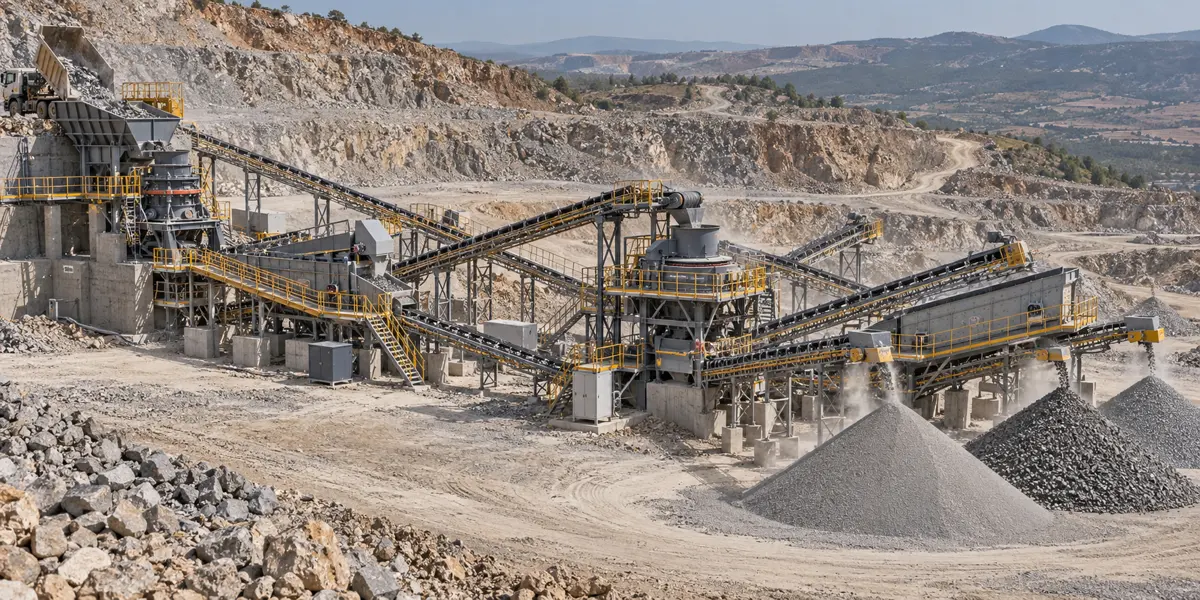
A credible final-shaping proposal shows where the feed is made suitable for the VSI and where the resulting product is separated. For hard basalt, the upstream cone and screen duty often matter as much as the VSI because they determine the size distribution and stability of the material entering the final stage.
| Circuit stage | Verification question |
|---|---|
| Upstream crushing | Does the primary/secondary circuit consistently prepare material within the proposed final-stage feed range? |
| Feed screen and surge | Which fractions go to the VSI, bypass it or return upstream, and what happens during a change in feed distribution? |
| VSI final shaping | Which rotor/chamber arrangement is proposed, what operating range is assumed and how will access for inspections be managed? |
| Product screen and return | Which screen cuts create the saleable products, where does oversize return and what recirculating-load assumption is used? |
| Fine-product control | Is washing, air classification, dust collection or another interface included when the product specification requires it? |
Do not infer this map from a headline throughput. Read the VSI feed-size guide alongside the closed-circuit versus open-circuit guide. They explain why a controlled feed and return path matter before final product output can be discussed.
Compare Proposals on One Like-for-Like Basis
Ask each supplier to complete the same one-page duty sheet. A quotation that includes only a VSI cannot be compared fairly with one that includes feed preparation, screening, conveyors, controls, dust interfaces, commissioning and initial wear parts.
| Comparison line | Put this in the common duty sheet |
|---|---|
| Material basis | Sample identification, feed-size distribution, moisture/fines observations and stated unknowns |
| Products | Each finished size, intended use, target tests, stockpile path and whether fine-product treatment is included |
| Equipment scope | Crushers, screens, feeders, conveyors, steelwork, guards, controls, dust/water interfaces and exclusions |
| Operating basis | Hours, feed stability, recirculation, screening availability and material-transfer assumptions |
| Wear and maintenance | Proposed wear parts, inspection access, initial spares, replacement method and the basis of any consumption estimate |
| Commercial interfaces | Delivery point, civil/electrical/site work, commissioning tasks, training, test period and acceptance record |
The cone crusher versus VSI crusher guide is useful for separating reduction duty from final shaping. It should not be used to assume one machine replaces the other in every basalt plant.
Turn a Trial or Acceptance Test Into a Purchase Control
The strongest evidence is a test or demonstration that uses material close to the agreed record and measures the output the buyer actually needs. Before ordering, define who supplies the sample, how it is prepared, what feed range is allowed, how the plant is set, which products are sampled and who records the results.
Where a live test is not practical, require every assumption to be named in the quotation and agree a commissioning procedure that uses representative feed. A capacity figure is only meaningful with its feed distribution, product split, screen duty, recirculating load and measurement period. Product compliance is a tested project result, not an automatic outcome of buying a VSI.
Use the VSI commissioning checklist to structure startup observations, and the factory-acceptance checklist to distinguish pre-shipment evidence from site acceptance.
Check the Interfaces That Commonly Distort a Price Comparison
Final-shaping costs are often hidden outside the machine price. A buyer should record whether the proposal includes the equipment and responsibility needed to make the final stage operable, maintainable and testable at the site.
| Interface risk | Buyer check before comparing price |
|---|---|
| Feed preparation | Pre-screen, surge capacity, bypass and transfer chutes are shown, not assumed |
| Screening and return | Deck sizes, apertures, return conveyor and product splits are part of the scope |
| Wear access | Lift points, guards, inspection clearance, initial spares and a safe changeout method are identified |
| Dust and fines | Collection, suppression, classification or washing boundaries are assigned to named parties |
| Power and controls | Motor/control scope, interlocks, cable routes and incoming power responsibilities are documented |
| Commissioning | Representative feed, safe site readiness, operators, sampling and recordkeeping are assigned before travel is booked |
Buyer Checklist Before Releasing a Final-Shaping Order
Before selecting a supplier, make sure the buyer’s team can answer these questions in writing:
- What representative basalt record will all bidders use?
- What finished products and test requirements define success?
- Which size fractions reach, bypass and return from the VSI?
- Is the product screen, fine-product treatment and dust-control interface included?
- Which capacity and product claims are conditional on named assumptions?
- Who provides the commissioning feed, sampling plan, operator support and acceptance record?
- Which wear parts, access equipment and initial spares are included or excluded?
Frequently Asked Questions
Is a VSI always needed for basalt aggregate?
No. A VSI is appropriate only when the required product, feed prepared by upstream equipment and complete screening/return arrangement justify final shaping or fine-product duty.
Can a VSI receive quarry-run basalt directly?
It should not be assumed to do so. Confirm the selected machine’s feed limits and use upstream crushing and screening to produce the stable feed range stated in the proposal.
What should a Turkey basalt buyer send for a quotation?
Send representative raw-material information, feed-size distribution, output sizes, capacity target, site photos, budget range, intended end use and any applicable project specification or test method.
Does a high catalog capacity prove the required product output?
No. Product output depends on the agreed material, feed distribution, screen duty, recirculation, settings and measurement basis. Ask suppliers to state each assumption.
How should suppliers compare wear cost?
Use the same material record, duty and operating assumptions. Request the proposed wear parts, initial spares, inspection method and the basis of any estimate; do not treat an estimate as a guaranteed service life.
Is a cone crusher or a VSI better for basalt?
They can serve different circuit duties. A cone crusher may provide upstream reduction while a VSI provides final shaping or fine-product work. The material and product plan determine whether both stages are justified.
Does a factory test replace site acceptance?
No. A factory test can verify agreed pre-shipment evidence, but site acceptance should use the stated commissioning conditions, representative feed, sampling and project-specific product checks.
Request a Comparable Basalt Final-Shaping Proposal
Send your raw material, feed size, output size, target capacity, site photos and budget range, plus a representative sample record and the intended aggregate use. Ask for a complete material-path drawing, a single duty sheet, stated assumptions, included/excluded interfaces and a proposed commissioning and acceptance plan.