Table of Contents
- Why Manufactured Sand Demand Is Growing in Vietnam
- Common Raw Materials for Vietnam Sand Projects
- Recommended Plant Configurations for Vietnam
- Configuration 1: Jaw Crusher + Cone Crusher + VSI + Screen
- Configuration 2: Jaw Crusher + Impact Crusher + VSI + Screen
- Configuration 3: Mobile Jaw + Mobile Cone or Impact + Mobile VSI
- Capacity Planning and Output Targets
- Sand Quality Factors Buyers Should Check
- Stationary or Mobile for Vietnam Projects?
- Cost Factors and Wear-Part Planning
- Common Buyer Mistakes
- What to Send Before Asking for a Quote
- Conclusion
- FAQ
- What is the best VSI sand making machine for granite in Vietnam?
- Can a VSI crusher make concrete-grade manufactured sand in Vietnam?
- Do I need a cone crusher before the VSI?
- Is limestone suitable for a VSI sand making plant?
- What capacity VSI plant should I choose?
- Is a mobile VSI plant better for Vietnam projects?
- How much does a sand making machine line cost in Vietnam?
- What information should I provide before asking for a quotation?
VSI Sand Making Machine for Vietnam Manufactured Sand Projects
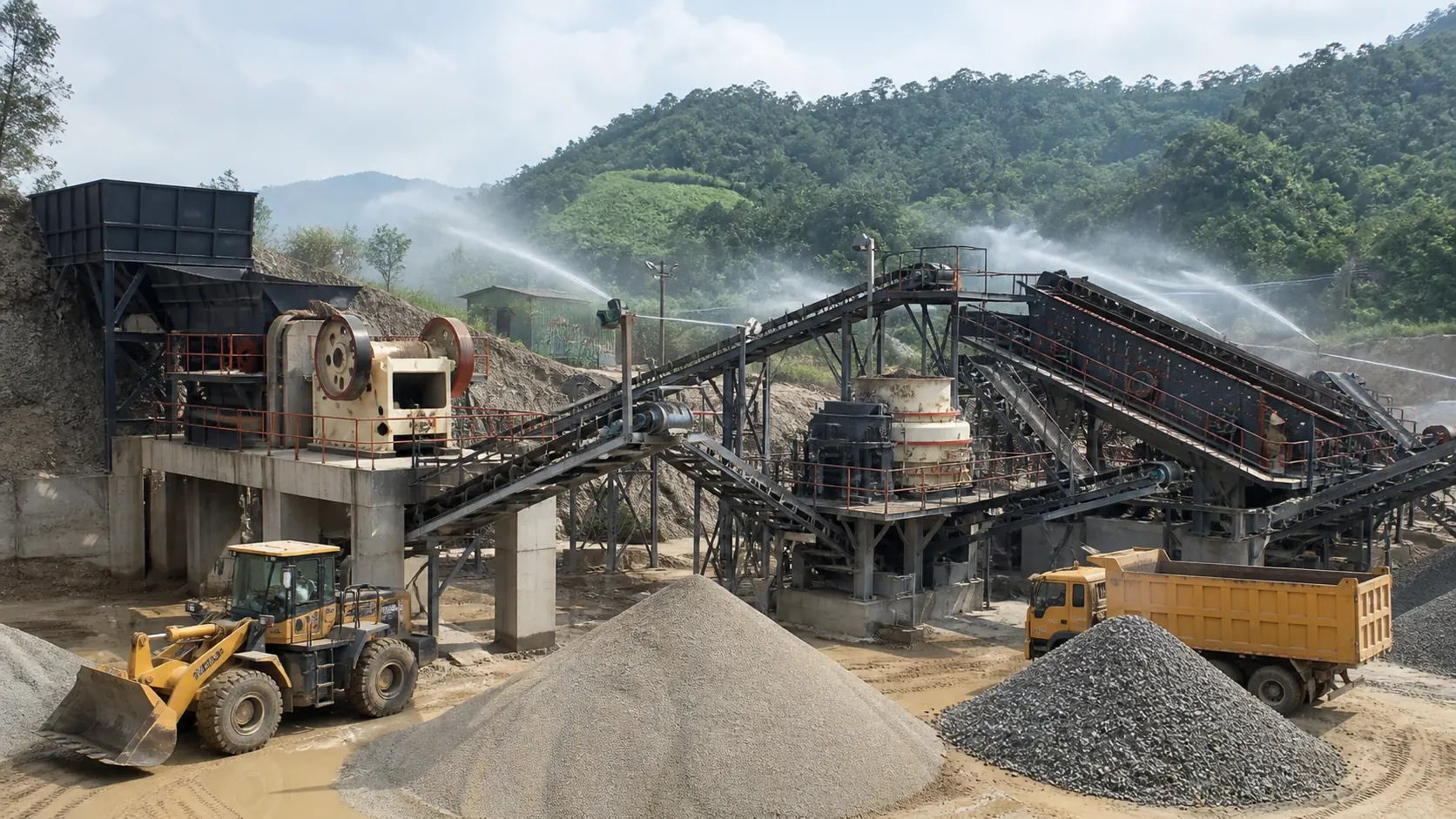
A VSI sand making machine for Vietnam should be chosen according to the raw material, feed size after secondary crushing, target sand gradation, stone powder limit, hourly capacity, and moisture condition. In many Vietnam projects, granite, basalt, limestone, and river pebble are used to produce manufactured sand for concrete, mortar, asphalt, and road base. For hard rock such as granite and basalt, a jaw crusher plus cone crusher plus VSI plus screen is usually the stable route. For limestone, the flow can be simpler. The best solution is the full sand production circuit that delivers consistent 0-5 mm product quality instead of only the lowest VSI price.
Why Manufactured Sand Demand Is Growing in Vietnam
Vietnam continues to invest in highways, industrial parks, ports, housing, and concrete supply. At the same time, many buyers are under pressure to reduce dependence on natural river sand because of supply limits, quality variation, and environmental controls. That is why manufactured sand has become a more practical option for many quarry and construction material operators.
For Vietnam buyers, the real question is not just whether a VSI crusher can make sand. The question is whether the complete system can produce stable grading, acceptable fines content, and good particle shape while keeping wear cost and downtime under control. If you are still comparing full line planning, see our complete stone crusher plant setup and our article on VSI crusher capacity from 50 TPH to 500 TPH.
Common Raw Materials for Vietnam Sand Projects
The correct VSI setup depends heavily on the rock being processed. In Vietnam, manufactured sand projects often use:
- Granite for concrete aggregate and manufactured sand where hard, abrasive rock is available.
- Basalt for high-strength aggregate and shaped sand, especially when the project needs better cubical grain.
- Limestone for mortar, concrete, and road projects where crushing is easier and wear cost is lower.
- River pebble when local supply requires shaping and sand production from rounded hard material.
- Quarry by-products from existing crushing plants that want to convert surplus chips into saleable sand.
Hard and abrasive materials normally need more careful rotor speed selection, chamber design, and wear-part planning. Softer limestone may be easier to crush, but buyers still need to control excess fines and moisture. If you need material-specific selection advice, read how to choose a VSI sand making machine for granite, basalt, and limestone.
Recommended Plant Configurations for Vietnam
Configuration 1: Jaw Crusher + Cone Crusher + VSI + Screen
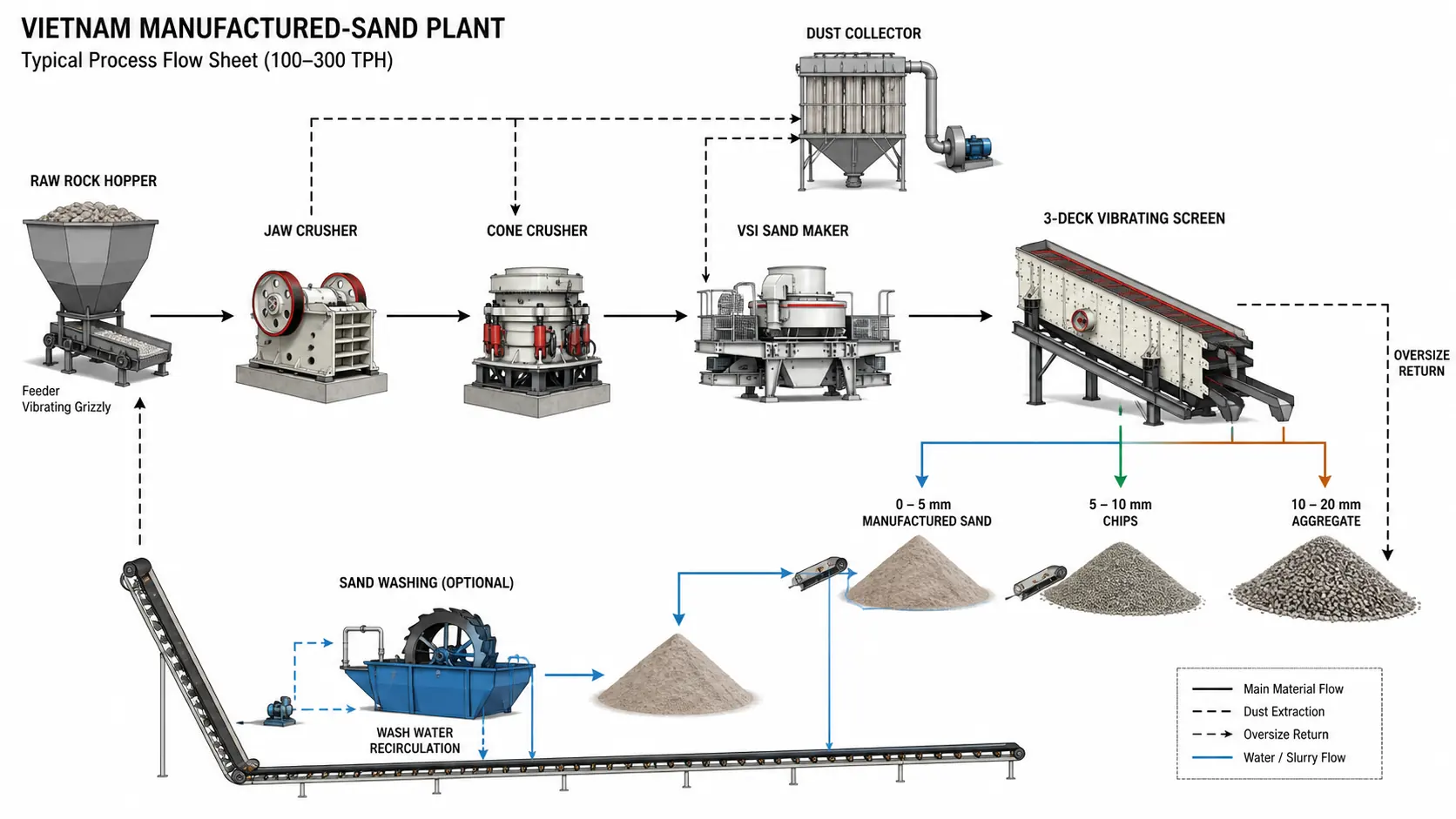
This is the most common route for granite, basalt, and other hard rock in Vietnam. The jaw crusher handles the large feed, the cone crusher reduces the stone to suitable VSI feed size, and the VSI completes shaping and final sand production. A vibrating screen returns oversize material to keep the circuit stable.
This configuration is suitable when the buyer needs higher product quality, more cubical particles, and consistent 0-5 mm output for concrete or asphalt applications.
Configuration 2: Jaw Crusher + Impact Crusher + VSI + Screen
For limestone or medium-hard rock, an impact crusher may replace the cone crusher before the VSI. This can simplify the flow and reduce initial investment in some projects. However, the suitability depends on abrasiveness, feed size, and the final sand specification.
Configuration 3: Mobile Jaw + Mobile Cone or Impact + Mobile VSI
For contractors or quarry operators that need relocation flexibility, a mobile arrangement can reduce civil work and shorten commissioning time. If mobility matters, compare the tradeoffs in is a mobile VSI crusher better than a stationary sand making plant.
Capacity Planning and Output Targets
Capacity should be planned around final saleable sand, not only the VSI nameplate number. Feed grading, recirculation load, screen efficiency, and stone powder control all affect the net output.
| Capacity Range | Typical Vietnam Application | Common Setup |
|---|---|---|
| 50-100 TPH | small quarry sand line, local concrete supply, pilot project | jaw + cone or impact + VSI + screen |
| 100-200 TPH | commercial manufactured sand, batching plant support, regional aggregate sales | jaw + cone + VSI + multi-deck screen |
| 200-300 TPH | larger quarry, industrial-zone concrete supply, long-term infrastructure demand | heavy jaw + cone + VSI + powder control |
| 300+ TPH | high-volume quarry or integrated aggregate-sand plant | multi-stage crushing, multiple screens, sand washing or classification as needed |
Many Vietnam buyers start by asking for 100 TPH or 150 TPH, but the better question is how many tons per hour of finished sand must meet the required gradation. If the project needs high shape quality and tight fines control, the upstream crushers, screen decks, and return loop must be sized correctly.
Sand Quality Factors Buyers Should Check
Good manufactured sand is not created by one machine alone. Buyers should verify:
- Feed size into the VSI.
- Rock hardness and abrasiveness.
- Rotor speed and chamber type.
- Screen opening and return ratio.
- Target grading for 0-5 mm sand.
- Stone powder content and moisture.
- Whether washing or classification is required.
If you need better particle shape, see how to improve cubical shape in manufactured sand with a VSI crusher. If you are comparing final-stage machine roles, review VSI crusher vs cone crusher for manufactured sand.
Stationary or Mobile for Vietnam Projects?
A stationary sand making plant is usually better for long-term quarry production with stable feed, enough land, and continuous demand from batching plants or commercial aggregate customers. It normally offers easier layout planning for stockpiles, powder control, screening, and maintenance access.
A mobile VSI plant is more suitable when the project has shorter duration, more difficult civil work, or a need to move between sites. The final decision should be based on how often the plant relocates, the required capacity, and whether the project values flexibility more than the lowest long-term cost per ton.
Cost Factors and Wear-Part Planning
The cost of a Vietnam manufactured sand line is affected by much more than the VSI crusher itself. Buyers should compare:
- Raw material type and abrasiveness.
- Required hourly output.
- Crusher and screen configuration.
- Motor power and electrical system.
- Wear parts such as rotor tips, anvils, liners, and feed tubes.
- Dust collection, powder control, and optional washing system.
- Steel structure, conveyors, and stockpile layout.
- Shipping, installation, commissioning, and spare-parts package.
Hard-rock sand projects can look attractive on paper but become expensive if the wrong chamber or wear material is selected. Buyers should ask the supplier to explain expected wear-part consumption and the recommended spare-parts list. For more maintenance detail, see VSI crusher wear parts.
Common Buyer Mistakes
Some buyers ask only for a “Vietnam sand making machine price” without providing rock type, feed size, or target sand specification. That usually leads to rough quotations that are not technically reliable.
Another common mistake is sending oversized feed directly to the VSI. A VSI should receive properly prepared material from jaw and cone or impact crushing. Buyers also underestimate the effect of moisture, powder control, and screen efficiency on final sand quality. In many cases, the problem is not the VSI itself but the balance of the full circuit.
What to Send Before Asking for a Quote
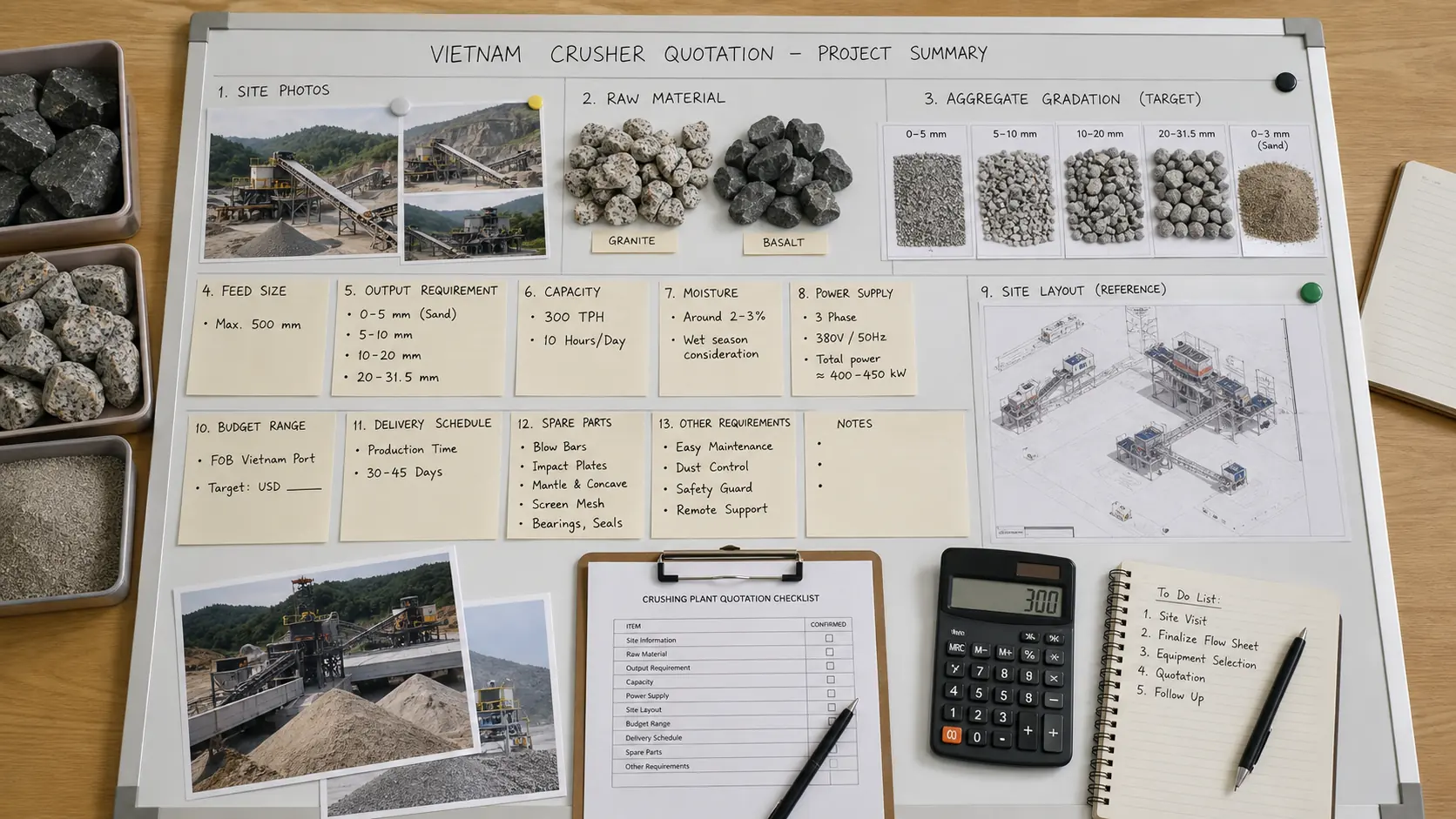
To get a useful quotation for a Vietnam manufactured sand project, prepare:
- Raw material name, such as granite, basalt, limestone, or river pebble.
- Maximum feed size before primary crushing and the expected VSI feed size.
- Required output size and grading target for the finished sand.
- Capacity in tons per hour of saleable product.
- Moisture condition and whether washing is required.
- Site photos, layout limits, and power condition.
- Whether the plant should be stationary or mobile.
- Budget range and expected delivery schedule.
With these details, MVSI can recommend a practical crusher, screen, and VSI configuration for the project.
Conclusion
For Vietnam manufactured sand projects, the best VSI sand making machine is the one matched to the local rock type, feed preparation, target sand quality, and operating conditions. Hard rock such as granite and basalt usually needs jaw plus cone plus VSI crushing, while limestone may allow a simpler arrangement. The key is to treat the VSI as part of a complete sand production system rather than a standalone machine.
If you are planning a manufactured sand line in Vietnam, send us your raw material, feed size, output size, capacity, site photos, and budget range. MVSI can review the application and suggest a practical sand making solution for quarry, concrete, and infrastructure work.
FAQ
What is the best VSI sand making machine for granite in Vietnam?
For granite, a VSI should usually be used after jaw and cone crushing so the feed is controlled before sand making. Granite is hard and abrasive, so chamber selection, rotor speed, and wear-part planning matter.
Can a VSI crusher make concrete-grade manufactured sand in Vietnam?
Yes, if the feed is properly prepared and the plant is designed for grading and powder control. The full circuit, including screening and optional washing, is as important as the VSI itself.
Do I need a cone crusher before the VSI?
For granite, basalt, and many hard rocks, yes. A cone crusher helps reduce feed to the correct size range and protects the VSI from oversized material.
Is limestone suitable for a VSI sand making plant?
Yes. Limestone is commonly used for manufactured sand and often has lower wear cost than granite or basalt. The plant still needs correct feed control and screen sizing.
What capacity VSI plant should I choose?
Choose the plant based on saleable sand output, not only machine nameplate capacity. Many projects start around 100-200 TPH, but the right size depends on demand, grading target, and recirculation load.
Is a mobile VSI plant better for Vietnam projects?
A mobile VSI plant is better when relocation and fast setup are major priorities. A stationary line is usually better for long-term production with stable feed and higher output.
How much does a sand making machine line cost in Vietnam?
The cost depends on rock type, capacity, upstream crushers, screen size, powder control, wear parts, electrical system, shipping, and service scope. A complete quotation should compare the entire line, not only the VSI price.
What information should I provide before asking for a quotation?
Provide raw material, feed size, output size, capacity, site photos, moisture condition, plant type preference, and budget range so the supplier can recommend the right solution.