Table of Contents
- Why 200 TPH Is a Practical Range for Road Projects
- What Materials Can a 200 TPH Mobile Crusher Plant Handle?
- Typical 200 TPH Mobile Plant Configurations
- Option 1: Mobile Jaw Crusher + Mobile Cone Crusher + Mobile Screen
- Option 2: Mobile Jaw Crusher + Mobile Impact Crusher + Mobile Screen
- Option 3: Add a Mobile VSI Stage for Shaping or Manufactured Sand
- Typical Output Sizes for Road Construction Aggregates
- Capacity Planning and Real Site Output
- Mobile vs Stationary for Road Aggregate Supply
- Cost Factors Buyers Should Compare
- Common Buyer Mistakes
- What to Send Before Asking for a 200 TPH Proposal
- Conclusion
- FAQ
- What is the best 200 TPH mobile crusher plant for road construction?
- Can a 200 TPH mobile plant produce several road aggregate sizes at the same time?
- Is a mobile crusher plant suitable for highway projects?
- Should I choose cone crusher or impact crusher for 200 TPH road aggregate?
- Can a 200 TPH mobile crusher plant make asphalt aggregate?
- How much does a 200 TPH mobile crusher plant cost?
- What information should I provide before asking for a quotation?
- Can MVSI help with spare parts and commissioning support?
200 TPH Mobile Crusher Plant for Road Construction Aggregates
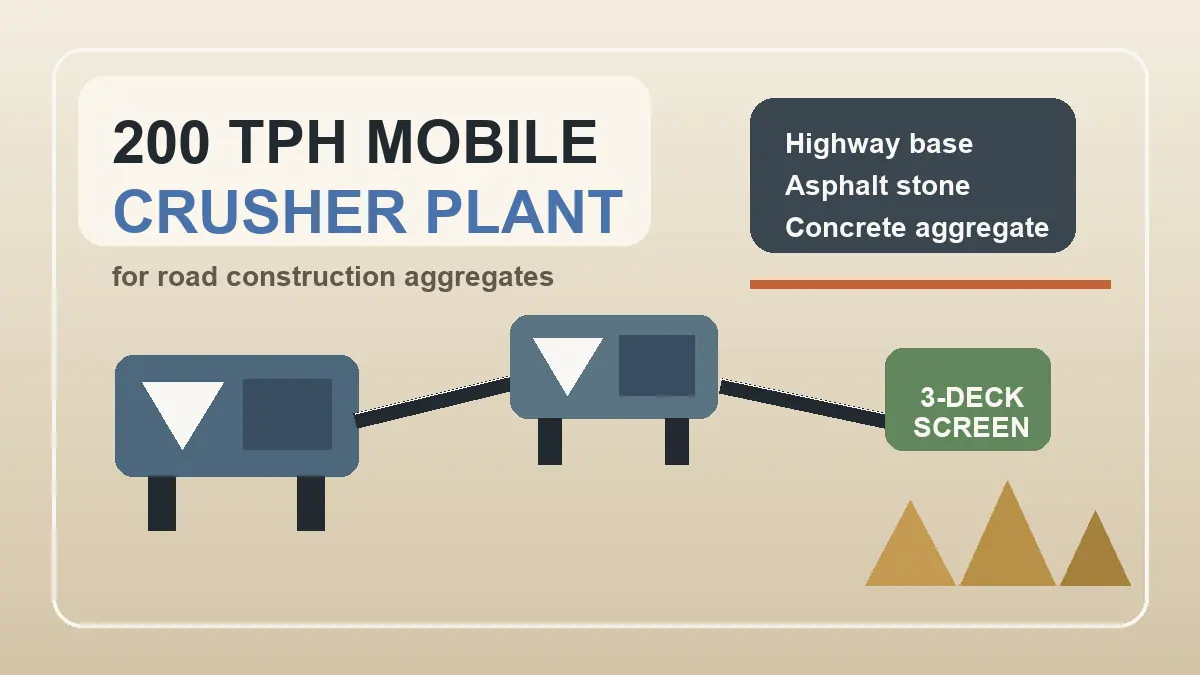
A 200 TPH mobile crusher plant is a strong fit for road construction aggregate projects that need stable output, several finished sizes, and faster setup than a fixed crushing line. It is commonly used for highway base course, sub-base, asphalt aggregate, concrete aggregate, and temporary infrastructure supply. A typical 200 TPH layout may include a mobile jaw crusher, mobile cone or impact crusher, mobile screen, return conveyor, and optional VSI shaping stage. The best configuration depends on raw material hardness, feed size, required gradation, relocation frequency, available power, and cost per ton.
Why 200 TPH Is a Practical Range for Road Projects
For many road contractors and aggregate suppliers, 200 TPH is the point where a mobile plant becomes large enough to support continuous roadwork without immediately moving into oversized quarry investment. It can feed asphalt plants, concrete batching plants, and road base production while still keeping mobility, shorter installation time, and lower civil work than a stationary system.
This capacity is often selected for expressway sections, municipal road packages, airport access roads, industrial park infrastructure, and contractors supplying several nearby projects. Compared with a smaller line, 200 TPH gives more buffer for peak demand, multiple finished products, and truck loading efficiency. Compared with a large fixed quarry plant, it is easier to deploy near the jobsite and reduce internal haulage.
If you are still comparing general mobile plant selection, read our Mobile Crushing Plant Buying Guide for Quarry and Mining Projects. If your project is smaller, our 100 TPH mobile crushing plant guide may be a better starting point.
What Materials Can a 200 TPH Mobile Crusher Plant Handle?
Road aggregate projects do not all use the same material. The right crusher combination should match hardness, abrasiveness, feed size, moisture, and the final road specification.
| Material | Common Road Use | Recommended Mobile Setup |
|---|---|---|
| Granite | asphalt aggregate, concrete aggregate, base layers | jaw + cone + screen |
| Basalt | high-strength aggregate, asphalt, heavy-duty road base | jaw + cone + screen, optional VSI |
| Limestone | road base, sub-base, concrete stone | jaw + impact + screen or impact + screen |
| River stone | concrete and asphalt aggregate | jaw + cone + screen, optional VSI |
| Recycled concrete | temporary road base, secondary aggregate | impact + screen + magnetic separator |
| Mixed quarry rock | local road aggregate | matched to hardness and gradation target |
For hard rock such as granite and basalt, cone crushing is usually more economical than impact crushing over time because wear parts last longer. For limestone and softer stone, impact crushing can give good particle shape with a simpler plant layout. If your road specification requires improved cubical shape or more 0-5 mm product, a VSI stage may be added after cone crushing. See Mobile Jaw Crusher vs Mobile Impact Crusher: Which One Should You Choose? if you are comparing secondary crusher types.
Typical 200 TPH Mobile Plant Configurations
There is no single standard 200 TPH flow sheet. The correct plant depends on the road material, how many products you need, and whether the line must move often.
Option 1: Mobile Jaw Crusher + Mobile Cone Crusher + Mobile Screen
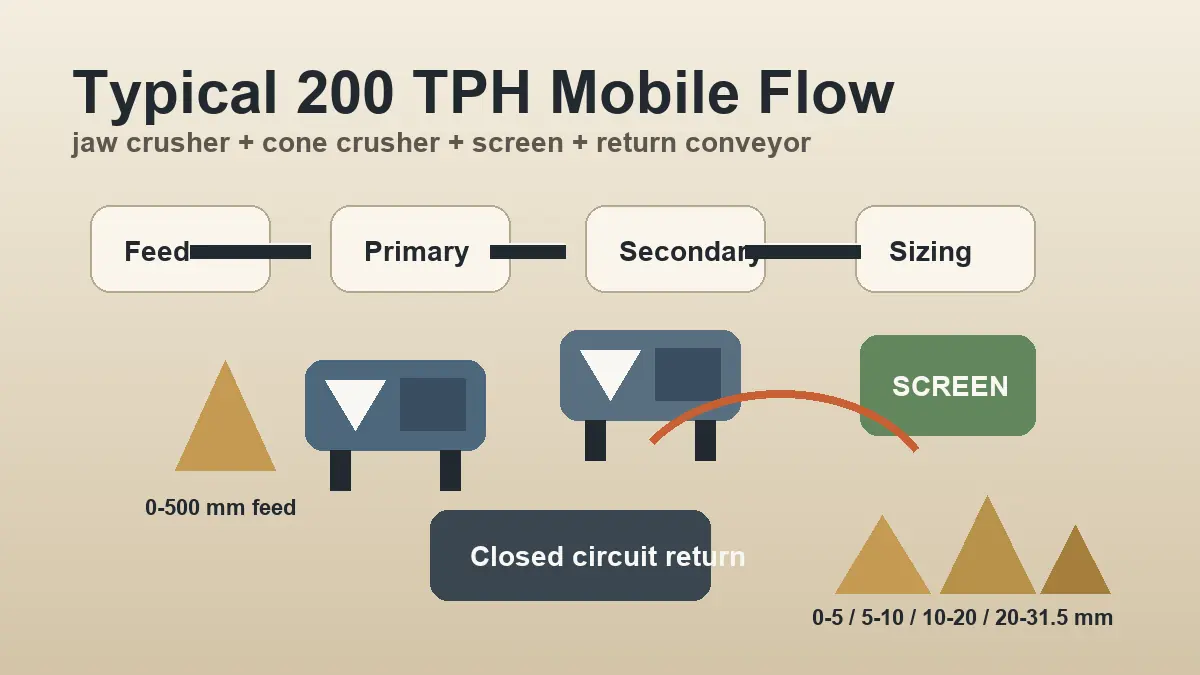
This is the most common solution for hard road aggregate. The jaw crusher takes large blasted rock, the cone crusher controls secondary reduction, and the screen separates finished sizes with recirculation.
- Best for: granite, basalt, hard river stone, long road projects, commercial aggregate supply.
- Typical output: 0-5 mm, 5-10 mm, 10-20 mm, 20-31.5 mm depending on screen decks.
- Main advantage: stable capacity, lower wear cost on hard rock, better control of graded products.
- Main limitation: higher initial investment than impact-only mobile layouts.
Option 2: Mobile Jaw Crusher + Mobile Impact Crusher + Mobile Screen
This option is often selected for limestone and medium-hard stone where the buyer wants a simpler layout and good particle shape for road base or concrete aggregate.
- Best for: limestone, softer quarry rock, some recycled feed, road contractors with moderate abrasiveness.
- Main advantage: strong shaping effect and compact layout.
- Main limitation: blow bars can wear faster on hard or highly abrasive feed.
Option 3: Add a Mobile VSI Stage for Shaping or Manufactured Sand
Some road projects require better cubical aggregate, asphalt-friendly shape, or extra fine aggregate for concrete or bedding material. In these cases, a mobile VSI can be added after cone crushing or after screening oversize recirculation.
This is more common when the project needs high-quality 0-5 mm sand, stricter asphalt aggregate shape, or the contractor wants one plant train to supply both coarse and fine products. For more on shaping, see How to Improve Cubical Shape in Manufactured Sand with a VSI Crusher and Is a Mobile VSI Crusher Better Than a Stationary Sand Making Plant?.
Typical Output Sizes for Road Construction Aggregates
A 200 TPH mobile plant is usually selected because it can support several final products in one circuit. Common road aggregate targets include:
- 0-5 mm manufactured sand or crusher dust
- 5-10 mm fine aggregate
- 10-20 mm asphalt and concrete aggregate
- 20-31.5 mm road base or drainage stone
- 0-31.5 mm or 0-40 mm blended base course where required
The exact gradation depends on screen deck size, crusher closed-side setting, material cleanliness, and whether the plant is running open circuit or closed circuit. Buyers should define the saleable product sizes before asking for a machine price. A plant producing one road base product is very different from a plant producing four clean aggregate grades at the same nominal capacity.
Capacity Planning and Real Site Output
Rated capacity is only part of the selection. Real road-project output depends on:
- Maximum feed size and whether pre-splitting or pre-breaking is needed
- Rock hardness and abrasiveness
- Moisture and clay content
- Number of finished products
- Screen area and screening efficiency
- Return load in closed-circuit crushing
- Loader, excavator, truck, and stockpile coordination
- Working hours per day and required project schedule
In many cases, a 200 TPH plant means approximately 200 tons per hour of plant feed under matched conditions, not automatically 200 TPH of each final product. If the project requires multiple clean grades with strict shape control, the actual saleable output of some sizes may be lower. That is why capacity discussion should always be tied to material and product specification, not just headline tonnage.
Mobile vs Stationary for Road Aggregate Supply
For road construction, the main value of a mobile plant is not only movement. It is the ability to shorten raw material haul distance, start quickly, reduce foundation work, and shift production as the project front changes.
Mobile plants are usually better when:
- the jobsite changes along the road corridor
- foundation work must stay light
- the project duration is limited
- access roads are temporary
- several short-term contracts must be served from one equipment package
Stationary plants are usually better when:
- the quarry is permanent
- land and foundation work are available
- the plant will stay in one place for years
- lower long-term cost per ton matters more than mobility
If you are evaluating overall capital cost, read Stone Crusher Plant Cost: What Determines the Final Price? for a broader comparison of scope and pricing factors.
Cost Factors Buyers Should Compare
The cost of a 200 TPH mobile crusher plant is shaped by the whole process, not just the main crusher model. Important pricing factors include:
- jaw + cone or jaw + impact configuration
- track-mounted or tire-mounted chassis
- screen size and number of decks
- return conveyor and recirculation design
- diesel, electric, or hybrid drive
- dust suppression and environmental control
- magnetic separator for recycled concrete
- control system and automation level
- wear parts package and spare parts support
- shipping route, local transport, and installation service
Two plants can both be described as “200 TPH mobile crusher plants” while having very different delivered prices. One may be designed for simple 0-40 mm road base from limestone. Another may be built to make several clean basalt aggregate sizes with a closed-circuit screen and VSI shaping. The second solution needs more steel, more power, more screening, more conveyors, and a heavier wear-parts plan.
Common Buyer Mistakes
One common mistake is asking only for “200 TPH” without saying whether the job is for sub-base, asphalt aggregate, concrete aggregate, or recycled road material. The product requirement changes the entire plant.
Another mistake is choosing an impact crusher for highly abrasive basalt because the initial quote looks lower. In road projects with hard rock, wear cost and downtime can erase the apparent savings quickly.
Some buyers also ignore transport and site layout limits. A mobile plant may fit the capacity target, but if stockpile area is too small, truck circulation is poor, or the access road cannot handle the equipment modules, real output will drop. Others forget to confirm whether grid power is available or whether the plant must run from a diesel generator.
What to Send Before Asking for a 200 TPH Proposal
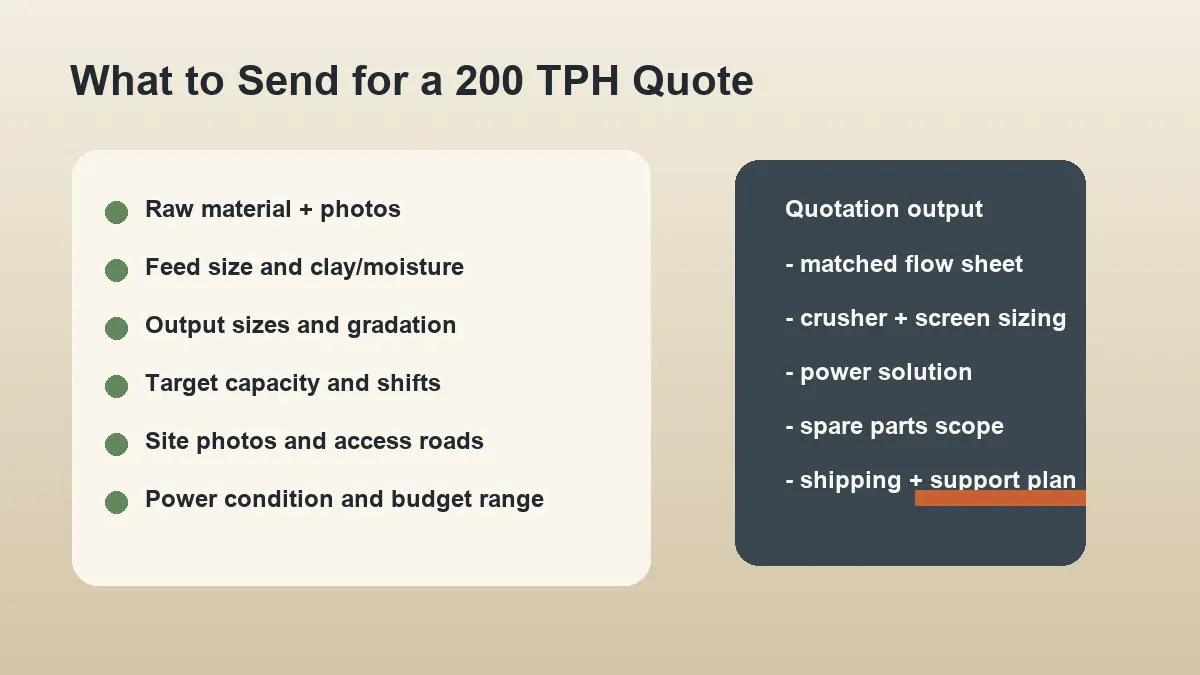
To get a useful 200 TPH mobile crusher plant quotation, send the following information:
- Raw material name and photos, such as granite, basalt, limestone, river stone, or recycled concrete.
- Maximum feed size and whether oversize rock appears frequently.
- Required output sizes and target gradation for road base, asphalt, or concrete use.
- Target capacity in tons per hour and daily working hours.
- Site photos, working space, transport access, and whether the plant must move often.
- Power condition: diesel, grid electricity, generator, or hybrid preference.
- Moisture, clay content, and whether dust suppression or washing is needed.
- Budget range, expected delivery schedule, and whether you need installation and spare parts support.
With these details, MVSI can recommend a more accurate flow sheet, crusher combination, screen deck arrangement, power solution, and quotation scope.
Conclusion
A 200 TPH mobile crusher plant is a practical choice for road construction aggregate supply when the project needs steady production, several final sizes, and flexible relocation. For hard rock road aggregate, jaw + cone + screen is usually the safest configuration. For limestone and softer stone, jaw + impact + screen may be more economical. If the road specification needs better shape or additional fine aggregate, a VSI stage can be added.
If you are planning a 200 TPH road aggregate project, send us your raw material, feed size, output size, capacity, site photos, and budget range. MVSI can help review the application and suggest a practical mobile crushing and screening configuration.
FAQ
What is the best 200 TPH mobile crusher plant for road construction?
For hard road aggregate such as granite or basalt, a mobile jaw crusher plus mobile cone crusher plus mobile screen is usually the most reliable choice. For limestone, a jaw plus impact configuration may be more economical.
Can a 200 TPH mobile plant produce several road aggregate sizes at the same time?
Yes. With the right screen decks and return conveyor layout, a 200 TPH mobile plant can produce several sizes such as 0-5 mm, 5-10 mm, 10-20 mm, and 20-31.5 mm. The exact output depends on material and circuit design.
Is a mobile crusher plant suitable for highway projects?
Yes. Mobile plants are widely used for highway, municipal road, airport access road, and industrial infrastructure projects because they reduce foundation work and can move closer to the construction front.
Should I choose cone crusher or impact crusher for 200 TPH road aggregate?
Choose cone crusher for hard and abrasive rock such as granite, basalt, and hard river stone. Choose impact crusher for limestone, softer rock, and some recycling applications where particle shape matters and wear cost is acceptable.
Can a 200 TPH mobile crusher plant make asphalt aggregate?
Yes. Many 200 TPH mobile plants are designed to produce asphalt aggregate, but the plant must be configured for the required shape, cleanliness, and gradation. In some cases, adding a VSI stage improves aggregate shape further.
How much does a 200 TPH mobile crusher plant cost?
The cost depends on material hardness, crusher combination, chassis type, screen size, power system, automation, dust control, shipping, and after-sales scope. A jaw + cone + screen layout usually costs more than a simpler impact-based solution.
What information should I provide before asking for a quotation?
Provide raw material, maximum feed size, final output sizes, target capacity, site photos, power condition, mobility requirement, and budget range. These details help the manufacturer match the plant to the road project instead of sending a generic quote.
Can MVSI help with spare parts and commissioning support?
Yes. Spare parts planning, commissioning guidance, and operator support should be defined before order confirmation so the plant can reach the expected road aggregate output after delivery.