Table of Contents
- Information Gain: Verify the Mine-to-Handover Boundary, Not Just the Crusher
- Choose the Primary-Crusher Type Only After the ROM Feed Is Defined
- Draw the Whole Primary-Crushing Scope Before Comparing Price
- Put Civil, Electrical, Dust and Access Interfaces on the Same Comparison Sheet
- Compare Proposals as Evidence, Scope and Handover—Not a Single Total
- Buyer Checklist Before Selecting a Copper Ore Primary Crusher
- Send a Primary-Crushing Project Brief Before Requesting Comparable Quotes
- Frequently Asked Questions
- Is a jaw crusher always the right primary crusher for copper ore?
- What copper ore information should I send before asking for a primary-crusher quotation?
- Why are two primary-crusher capacity figures difficult to compare?
- Should a feeder and grizzly be included with a primary crusher?
- Does a primary-crusher quotation include a coarse-ore stockpile or bin?
- What should be agreed before commissioning a copper ore primary crusher?
- Can a supplier select a primary crusher from ore photos alone?
What Copper Ore Buyers Should Verify Before Choosing a Primary Crusher
A copper ore buyer should choose a primary crusher only after defining the run-of-mine feed and the handover to the next process stage. A jaw or gyratory-type primary stage may be appropriate where large rock must be received, but neither machine name nor a headline capacity settles the choice. Compare quotations on the same maximum and typical feed size, fragmentation and fines condition, moisture or clay, contamination risk, operating duty, product handover, mine layout, power and civil interfaces. The decisive question is whether each scope can safely receive the released ore and deliver the required coarse-ore condition—not whether its isolated crusher looks larger or cheaper.
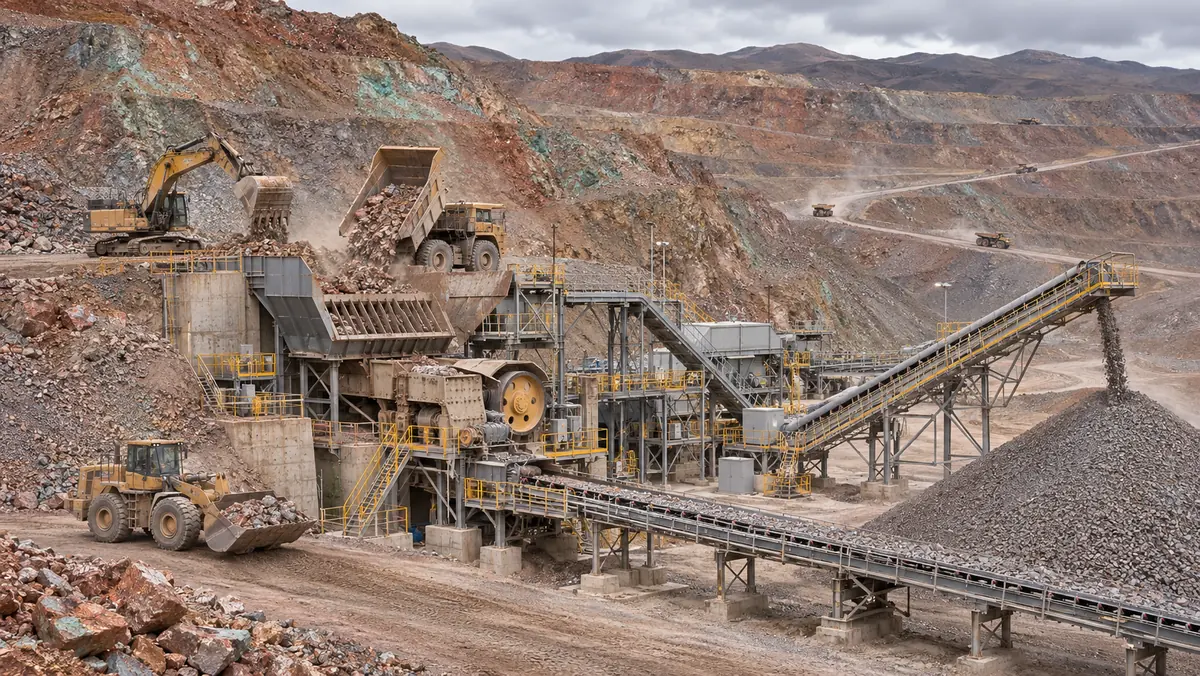
Information Gain: Verify the Mine-to-Handover Boundary, Not Just the Crusher
The useful purchasing unit is a material path from mine receiving to a named downstream handover point. A primary crusher can be correctly specified on a catalogue sheet and still be the wrong purchase scope if the dump arrangement, feed control, oversize route, fines handling, conveyor transfer, coarse-ore buffer, access or commissioning responsibility is left unresolved.
The U.S. EPA’s archived copper mining profile describes primary crushing as more than a crusher alone: feeders, dust controls and conveyors to coarse-ore storage can be part of the system, and jaw or gyratory machines are commonly used where large rock must be handled. That is useful context, not a universal circuit design or a project-specific equipment recommendation. Start by releasing one common record to every bidder.
| Record to release | What the buyer should state | Why it changes a primary-crusher quotation |
|---|---|---|
| Ore and mine-domain record | Known ore types or weathered zones, representative sample or assay/mineralogy information if available, photos and visible variability | “Copper ore” does not describe rock competency, abrasion, clay or fragmentation well enough to compare a machine duty |
| ROM feed condition | Typical and maximum piece dimensions, size distribution, fines, moisture, sticky material, tramp-material risk and feed presentation | The opening, hopper, grizzly, feeder, oversize route and clearing method all depend on the actual incoming stream |
| Operating duty | Required capacity basis, operating hours, truck or loader cycle, surge expectation and whether the stated rate is average or instantaneous | It prevents a catalogue number from being compared with a different feed or duty definition |
| Downstream handover | Required top size or feed condition, coarse-ore stockpile/bin, conveyor, secondary crushing or mill-feed interface | The correct crusher setting and discharge arrangement depend on what must receive the crushed ore next |
| Site and utilities | Layout, elevation, geotechnical/civil inputs, access, lifting space, power, dust and drainage interfaces | A crusher price cannot establish who supplies the foundation, cables, transfer chute, water or site works |
| Acceptance record | First-material basis, site-ready conditions, permitted adjustments, inspection records and handover decision | It keeps commissioning from becoming an undefined promise after delivery |
For the wider copper process, see the copper ore processing plant guide. It explains the possible crushing-to-beneficiation sequence; this page focuses on what a buyer must verify before selecting the first crusher package.
Choose the Primary-Crusher Type Only After the ROM Feed Is Defined
For large, variable run-of-mine rock, buyers commonly compare jaw and gyratory-type primary-crushing arrangements. The appropriate choice depends on the confirmed feed and mine interface, not on the ore name or an assumed tonnage alone. A supplier should state what the proposed machine can receive and which conditions require upstream preparation or a different scope.
| Decision factor | What to ask each bidder | Purchasing risk if it is left open |
|---|---|---|
| Largest rock and feed geometry | What maximum dimension, orientation and feed presentation are assumed at the receiving point? | A nominal opening is treated as permission for any blast fragment or bridging condition |
| Fragmentation and fines | How are run-of-mine fines, wet fines and variable blast fragmentation handled or bypassed? | The proposal prices a crusher but omits the feed regulation needed for a stable duty |
| Rock competency and abrasion | Which material evidence was used, which wear assumptions are provisional and what inspection/access provisions are included? | The buyer compares initial equipment totals without knowing the evidence boundary for wear or maintenance planning |
| Moisture, clay and sticky material | What hopper, chute, scalping, liner and cleaning assumptions are made? | Material buildup or poor flow becomes a site dispute rather than a stated design condition |
| Tramp material and oversize | What route exists for metal detection, magnet where relevant, safe isolation, oversize removal and blockage response? | The mine assumes the crusher will absorb conditions that no scope has allocated |
| Product handover | What product condition, discharge point and downstream conveyor or storage interface are included? | Different bidders stop their scope at different points while their totals are compared as like-for-like |
The crusher guide for hard ore and abrasive rock gives a material-led comparison of jaw, cone, impact and VSI roles. It is not a substitute for the actual copper ore record, a supplier’s current documentation or a site-specific safety review.
Draw the Whole Primary-Crushing Scope Before Comparing Price
Each quotation should show the physical sequence from ROM receiving to the downstream handover. A primary crusher, a crusher-plus-feeder package and a crusher-to-stockpile package are different purchase scopes even if their model descriptions sound similar.
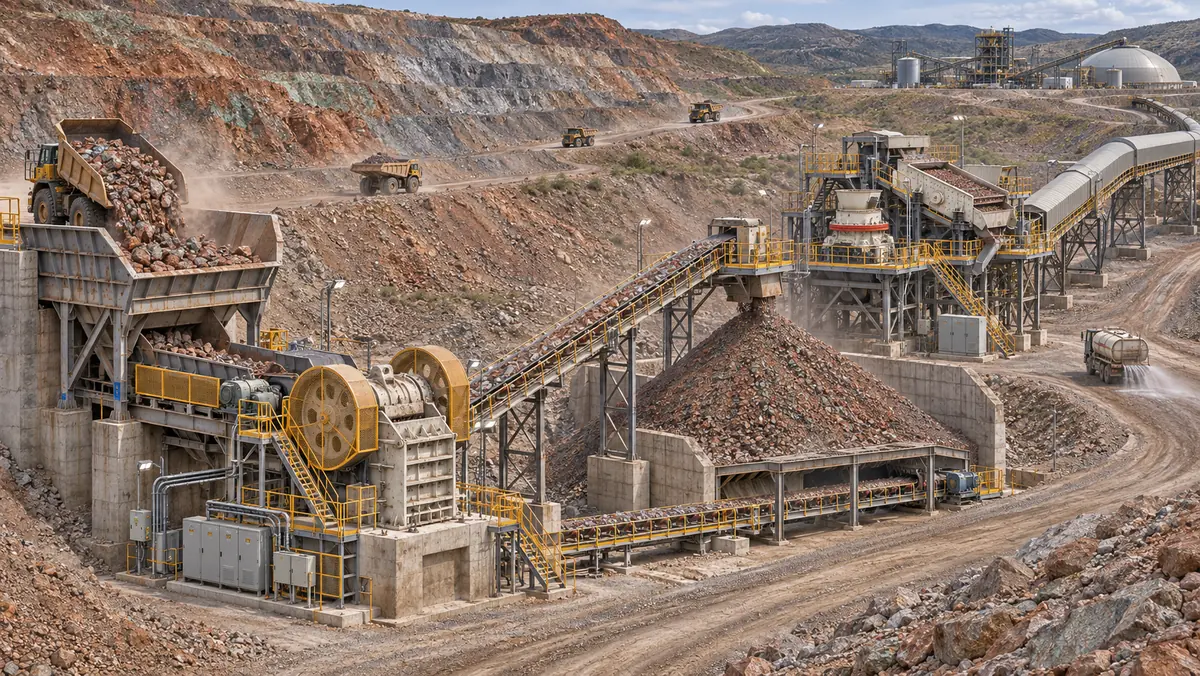
| Physical area | Scope boundary to make explicit | Typical gap to expose |
|---|---|---|
| ROM receiving | Truck or loader interface, dump pocket/hopper, grizzly, liner arrangement, safe access and clearing method | The crusher is offered without the receiving arrangement needed to present rock consistently |
| Feed regulation | Apron, vibrating or other feeder type, controls, surge basis, scalping/bypass and fines route | A machine rating is quoted without the flow-control equipment that supports it |
| Primary crusher | Exact model, opening, adjustment method, drive, lubrication, protection, wear scope, maintenance access and guards | Brochure features are assumed to be included instead of listed in the supplied scope |
| Discharge and transfer | Chute, belt, dust interface, spillage controls, sampling/metal protection if required and conveyor handover | The physical tie-in between crusher and downstream equipment belongs to no one |
| Coarse-ore buffer | Stockpile/bin capacity basis, reclaim method, level/control interface and containment | Crushing and grinding are bought as isolated islands with no stated buffer responsibility |
| Downstream handover | Product condition, top size, transfer elevation, secondary crushing/screen/mill-feed boundary and responsible party | One bidder’s “complete” package stops where another bidder’s begins |
The crushing and screening before beneficiation guide explains why a stable, defined feed condition matters downstream. Use it to frame the handover, not to assume a universal product size.
Put Civil, Electrical, Dust and Access Interfaces on the Same Comparison Sheet
The lowest equipment total may not represent the lowest installed scope. A responsible supplier can exclude work, but the exclusion should state the design input, handover point and party responsible so the buyer can price the remaining work separately.
| Interface | Questions to record before award |
|---|---|
| Foundation and structure | Who provides loads, base-frame information, drawings, embedded items, steel, grouting, installation tolerance and final engineering sign-off? |
| Power and controls | Where is the electrical point of supply; who provides motors, starters/drives, panel, cables, earthing, interlocks, field instruments and commissioning labour? |
| Dust, drainage and containment | What collection/suppression, water, drainage, spillage containment and housekeeping interfaces are included or excluded? |
| Transport and lifting | What delivery boundary, package weights, site access, crane/lifting plan and assembly responsibility are assumed? |
| Maintenance and safe access | Which platforms, stairs, guardrails, lifting points, isolation points, guards and lighting are supplied? |
| Installation and local obligations | Who coordinates erection, permits, local design checks, testing, safety systems and construction supervision? |
The iron ore crushing plant guide shows how primary crushing can connect to screening, secondary reduction and conveying. Its sequence is illustrative only; a copper project still needs its own released material and site basis.
Compare Proposals as Evidence, Scope and Handover—Not a Single Total
Ask every bidder to return the same schedule and label each line included, optional, buyer-supplied, excluded or provisional. Price becomes meaningful only after the buyer can see which physical work and technical evidence each total actually covers.
| Comparison line | Written evidence to request | Buyer action |
|---|---|---|
| Design basis | The issued ROM record, duty point, downstream handover and every material or site assumption | Reject silent substitutions or generic “standard conditions” in a supposedly comparable offer |
| Equipment and drawing | Itemised supply list, exact model references, layout/process drawing, auxiliaries and battery limits | Check that hopper, feeder, crusher, transfers, buffer, controls and access are included or named as exclusions |
| Capacity statement | Feed condition, setting, operating basis, material assumption and whether a figure is indicative, design or subject to an agreed test | Compare definitions rather than isolated tonnes-per-hour claims |
| Factory documentation | Current product documentation, inspection/quality records within the supplier’s authority and data for the exact proposed scope | Treat unverified project photos, certificates or generic claims as questions to clarify, not proof |
| Delivery and installation | Delivery term, packing, unloading, lifting, site assembly, civil/electrical boundary and responsible parties | Separate equipment value from logistics and installed-plant work |
| Commissioning and training | Preconditions, personnel, duration, documents, setting support, operator training, punch-list and handover process | Determine whether the offer supplies equipment only or a defined start-up scope |
| Spares and post-handover path | Recommended start-up/critical spares, wear identification, manuals, warranty wording and contact route | Do not infer local parts availability or response times without a documented scope |
For a related commercial comparison method, see how to compare Chinese manufacturers for copper ore beneficiation equipment. That page compares wider beneficiation-package responsibilities; it does not establish a primary-crusher supplier’s capability for a specific mine.
Buyer Checklist Before Selecting a Copper Ore Primary Crusher
The right pre-award checklist makes the unknowns visible before a purchase order fixes the interfaces. It should be completed with the mine, process, engineering and purchasing teams rather than treated as a substitute for their design review.

- Release the same raw material description, sample/testwork record if available, mine-domain information, feed size range, fines, moisture, clay/sticky-material condition and contamination risk to every bidder.
- State the capacity and operating-hours basis, expected feed variation, truck/loader presentation, downstream output/handover and whether a coarse-ore buffer belongs in the scope.
- Require an itemised material path for receiving, hopper, grizzly/scalping, feeder, primary crusher, discharge chute, conveyor, stockpile/bin, reclaim and downstream tie-in.
- Separate machine supply from civil, structural, electrical, dust, drainage, transport, lifting, erection, control integration, local compliance and operator-labour responsibilities.
- Ask which input values are measured, assumed, provisional, optional or excluded; do not turn a missing line item into an assumed inclusion.
- Agree the site-ready checklist, representative first material, permitted adjustment authority, inspection records, training, documentation, acceptance route and change-control process before order release.
Send a Primary-Crushing Project Brief Before Requesting Comparable Quotes
MVSI can review the information needed to place copper ore primary-crusher quotations on a common basis. Send the raw material description and representative sample or available testwork, typical and maximum feed size, target downstream output or handover, required capacity and operating-hours basis, site photos and layout constraints, power/civil/dust information, preferred delivery boundary and budget range. Those inputs do not replace engineering; they make the assumptions, interfaces and next technical questions visible before a supplier proposal is compared.
Frequently Asked Questions
Is a jaw crusher always the right primary crusher for copper ore?
No. A jaw crusher is commonly considered for large run-of-mine rock, but the correct primary arrangement depends on maximum feed size, feed variability, material condition, capacity basis, mine layout, downstream handover, maintenance strategy and the supplier’s documented scope. Compare the released project record rather than deciding from the word “copper.”
What copper ore information should I send before asking for a primary-crusher quotation?
Send the raw material description, representative sample or available testwork, typical and maximum feed size, feed-size distribution, fines, moisture, clay or sticky behavior, tramp-material risk, target capacity, operating hours, required downstream output/handover, site photos, layout, power and civil information, delivery boundary and budget range.
Why are two primary-crusher capacity figures difficult to compare?
Each figure can use different assumptions about feed geometry, size distribution, material condition, setting, duty cycle, feed regulation and downstream constraint. Ask each bidder to state its exact basis and whether the number is indicative, design or subject to an agreed acceptance method.
Should a feeder and grizzly be included with a primary crusher?
They should be evaluated whenever the mine feed needs controlled presentation, surge handling, fines removal or oversize management. Whether they are included depends on the released ROM record and process design, but their responsibility should be explicit so the crusher is not quoted as an isolated machine.
Does a primary-crusher quotation include a coarse-ore stockpile or bin?
Not necessarily. Some offers stop at the crusher discharge, while others include conveyors and coarse-ore storage. Require a layout and itemised scope that show the start, end and handover point of the package before comparing totals.
What should be agreed before commissioning a copper ore primary crusher?
Agree the site-ready conditions, representative first material, safety and guarding checks, power and controls, dust/drainage arrangements, people responsible, permitted adjustments, inspection records, training, documentation, product handover, outstanding-items process and response if the feed differs from the released basis.
Can a supplier select a primary crusher from ore photos alone?
Photos help describe visible rock size and site context, but they do not replace a representative material record, feed-size information, stated assumptions, current product documentation or an agreed acceptance method. A preliminary recommendation should clearly say what remains to be confirmed.