Table of Contents
- Why Iron Ore Crushing Plant Design Matters
- Typical Iron Ore Crushing Process
- 1. Feeding and Scalping
- 2. Primary Crushing by Jaw Crusher
- 3. Secondary Crushing by Cone Crusher
- 4. Screening and Recirculation
- 5. Belt Conveying and Stockpile Management
- Recommended Equipment Configuration
- Choosing Jaw Crusher for Iron Ore
- Choosing Cone Crusher for Iron Ore
- What Product Size Should the Plant Produce?
- Capacity Planning for Iron Ore Projects
- Stationary or Mobile Iron Ore Crushing Plant?
- Common Buyer Mistakes
- What to Send Before Asking for a Quote
- Conclusion
- FAQ
- What equipment is needed for an iron ore crushing plant?
- Is jaw crusher suitable for iron ore?
- Why is cone crusher used for iron ore?
- What size should iron ore be crushed to before grinding?
- Can impact crusher be used for iron ore?
- How much does an iron ore crushing plant cost?
- Is a mobile crusher suitable for iron ore mining?
- What information should I provide before asking for a quotation?
Iron Ore Crushing Plant: Jaw Crusher, Cone Crusher, Screen, and Conveyor
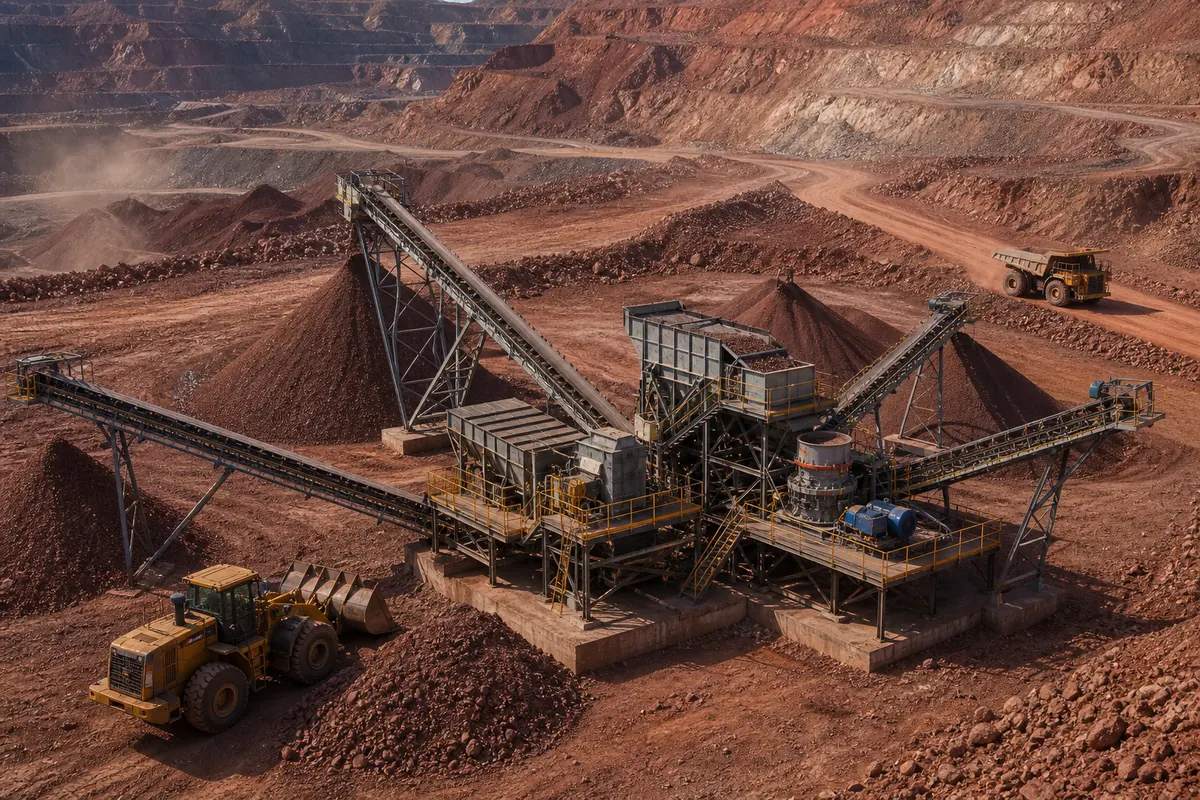
An iron ore crushing plant reduces run-of-mine ore to a controlled size before grinding, screening, stockpiling, or beneficiation. A typical configuration uses a vibrating feeder and jaw crusher for primary crushing, a cone crusher for secondary or tertiary crushing, a vibrating screen for size separation, and belt conveyors for transfer and stockpile management. The best design depends on ore hardness, abrasiveness, maximum feed size, moisture, clay content, required product size, capacity, and whether the crushed ore will feed a ball mill, dry magnetic separation, or direct lump ore screening.
Why Iron Ore Crushing Plant Design Matters
Iron ore is usually harder and more abrasive than limestone or recycled concrete. It may also contain fines, clay, moisture, and mixed particle sizes from drilling and blasting. If the crushing circuit is undersized, the downstream beneficiation plant receives unstable feed. If the crusher selection is wrong, wear cost, liner change frequency, power use, and downtime can rise quickly.
For mining operators, the crushing plant is not only a size reduction system. It is the front end of the whole mineral processing flow. It must produce a stable feed size for grinding, dry screening, magnetic separation, stockyard blending, or transport. The plant also needs enough surge capacity so that a short stop in one section does not shut down the entire mine process.
If you are comparing crushing circuits for other ores, see our gold ore crushing and grinding process guide and the broader crushing plant flow sheet guide.
Typical Iron Ore Crushing Process
A practical iron ore crushing plant is usually arranged in stages. The exact number of stages depends on maximum feed size, required final product size, plant capacity, and the downstream process.
1. Feeding and Scalping
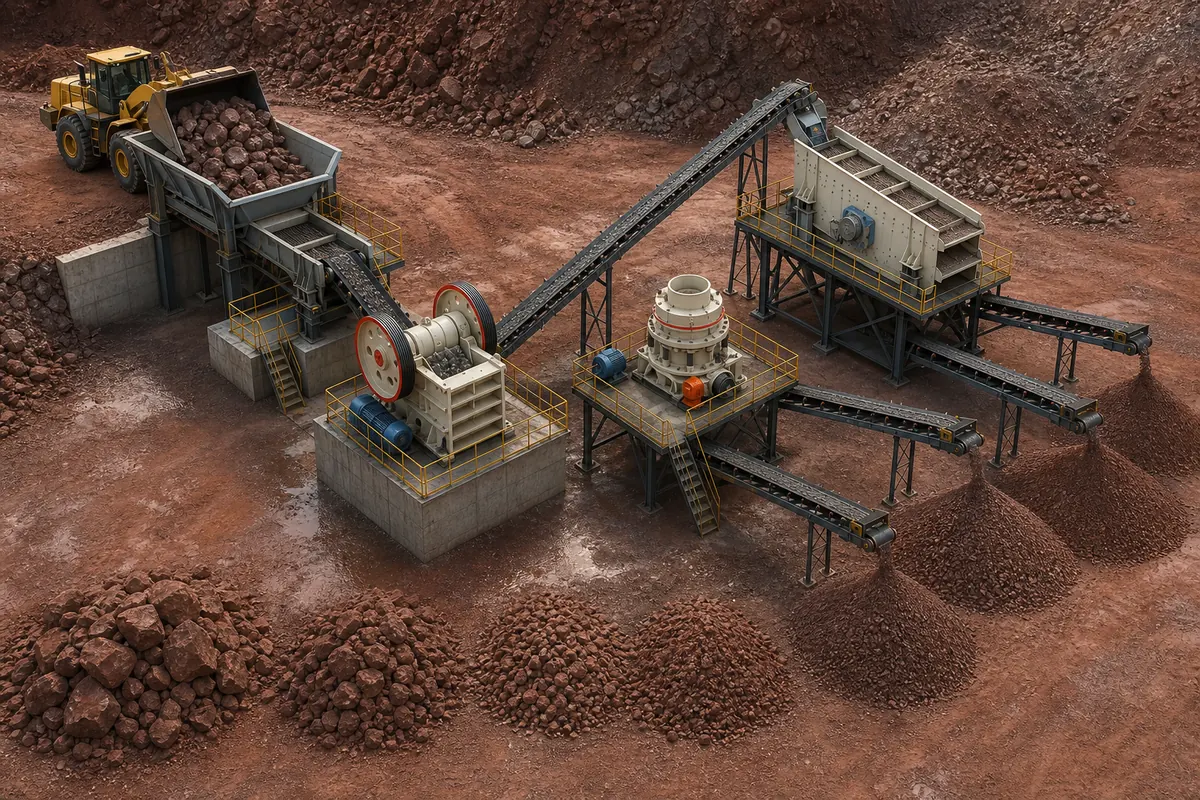
Run-of-mine iron ore is dumped into a hopper by loader or haul truck. A vibrating feeder sends material evenly to the primary crusher. In many plants, the feeder includes a grizzly section to remove fine material before the jaw crusher. This reduces unnecessary crusher load and helps prevent wet fines from packing inside the crushing chamber.
Scalping is especially important when the ore contains clay or a high percentage of natural fines. The removed fines can bypass primary crushing and join the product stream later if they meet the target size.
2. Primary Crushing by Jaw Crusher
The jaw crusher handles large iron ore lumps and reduces them to a size suitable for secondary crushing or direct screening. It is selected by feed opening, capacity, discharge setting, motor power, jaw plate material, and frame strength.
For iron ore, the jaw crusher should have enough mechanical strength and a suitable wear profile. A machine that works well for soft stone may not be durable enough for abrasive ore. The discharge setting should also match the cone crusher feed requirement, not only the theoretical capacity of the jaw crusher.
3. Secondary Crushing by Cone Crusher
After jaw crushing, iron ore commonly enters a cone crusher. Cone crushers are widely used for hard and abrasive materials because they provide stable reduction and better wear control than impact crushers in many ore applications.
The cone crusher can operate in open circuit or closed circuit. In closed circuit, a vibrating screen separates qualified material while oversize returns to the cone crusher. This improves product size control and helps keep the grinding or beneficiation section stable.
4. Screening and Recirculation
A vibrating screen separates crushed iron ore into required size ranges. Oversize material returns to the crusher. Qualified material goes to stockpile, fine ore bin, dry magnetic separation, or the next processing stage.
Screen size, deck number, aperture, stroke, angle, and feed distribution all affect real capacity. A strong crusher cannot deliver rated plant capacity if the screen is too small or if wet fines blind the screen mesh.
5. Belt Conveying and Stockpile Management
Belt conveyors connect the entire plant. They move ore from feeder to crusher, crusher to screen, return conveyor to cone crusher, and product conveyor to stockpile. Conveyor width, speed, length, slope, skirt sealing, dust control, belt cleaning, and transfer chute design should match the tonnage and ore properties.
For mining projects, stockpile layout matters. A fine ore bin or surge pile can stabilize feed to the downstream plant. Separate stockpiles may be needed for lump ore, fines, or different product sizes.
Recommended Equipment Configuration
The most common iron ore crushing configuration is feeder, jaw crusher, cone crusher, vibrating screen, return conveyor, product conveyors, and stockpile system. For higher capacity or stricter product size, the plant may add a second cone crusher or a larger multi-deck screen.
| Plant Section | Main Equipment | Selection Focus |
|---|---|---|
| Feeding | hopper, vibrating feeder, grizzly feeder | loader or truck size, maximum feed size, clay and fines content |
| Primary crushing | jaw crusher | feed opening, capacity, discharge setting, jaw plate wear life |
| Secondary crushing | cone crusher | chamber type, closed side setting, liner material, motor power |
| Screening | vibrating screen | deck number, screen area, aperture sizes, wet fines control |
| Conveying | belt conveyors, return conveyor | belt width, transfer height, dust sealing, stockpile reach |
| Buffer storage | surge bin, fine ore bin, stockpile | downstream stability, blending, truck loading or mill feed control |
| Control and safety | electrical cabinet, sensors, guards | interlock logic, overload protection, emergency stops |
For buyers still comparing machine types, our guide to jaw crusher, cone crusher, impact crusher, or VSI selection explains where each crusher fits in a crushing plant.
Choosing Jaw Crusher for Iron Ore
The jaw crusher is usually the first major machine in the circuit. It must accept the largest practical ore size while maintaining stable throughput.
Important selection points include:
- Maximum feed size from the mine or stockpile.
- Required discharge size for secondary crushing.
- Ore compressive strength and abrasiveness.
- Moisture and clay that may affect feeder and chamber behavior.
- Wear plate material and spare jaw plate availability.
- Foundation, maintenance access, and lifting arrangement.
Do not select the jaw crusher only by catalog capacity. Real capacity changes with feed grading, moisture, ore shape, discharge setting, and operating discipline. It is better to leave practical capacity margin than to run the primary crusher at its limit every shift.
Choosing Cone Crusher for Iron Ore
Cone crushers are usually the preferred secondary crusher for hard iron ore. They can produce a controlled product size and handle abrasive feed more economically than impact crushers in many mining circuits.
Key cone crusher factors include:
- Standard, medium, or fine chamber selection.
- Closed side setting and target product size.
- Liner profile and wear material.
- Feed size distribution from the jaw crusher.
- Closed-circuit screen capacity.
- Lubrication, cooling, and dust protection.
- Automation for load control and tramp iron protection.
If the final product must be very fine before grinding, the plant may need a tertiary cone crusher or a closed-circuit fine crushing stage. If the target is lump ore and fines separation, the circuit may rely more on screening and less on fine crushing.
What Product Size Should the Plant Produce?
Product size depends on what happens after crushing. A plant feeding a ball mill often aims for a controlled fine ore size such as under 10-25 mm, depending on mill design. A plant producing lump ore may separate larger material and fines by screening. A dry magnetic separation plant may need a specific size range for separation efficiency.
Common product goals include:
- Coarse crushed ore for stockpile or transport.
- Lump ore and fines separated by screen.
- Fine ore feed for ball mill grinding.
- Controlled feed for dry magnetic separation.
- Blended stockpile feed for beneficiation.
The crushing plant should be designed backward from the downstream requirement. If the mill, screen, or beneficiation equipment needs a stable size, that requirement should guide crusher settings and screen apertures.
Capacity Planning for Iron Ore Projects
Capacity should be calculated from daily production target, operating hours, equipment availability, and downstream demand. A mine that needs 2,000 tons per day may not need the same hourly crushing capacity as a mine that runs only one shift or needs rapid stockpile building before the rainy season.
| Target Capacity | Typical Application | Practical Notes |
|---|---|---|
| 50-100 TPH | small mine, pilot plant, local ore supply | simple jaw and cone circuit may be enough |
| 100-200 TPH | small to medium beneficiation plant | closed-circuit cone and screen improve feed stability |
| 200-400 TPH | commercial mine or concentrator feed | larger jaw, cone, screen, conveyors, and surge storage needed |
| 400+ TPH | large mine or stockyard system | multiple crushers, parallel screens, and stronger automation may be required |
For cost planning, compare total installed capacity, wear parts, civil works, power, conveyors, control system, and spare parts. The cheapest crusher alone may not create the lowest cost per ton. Our stone crusher plant cost guide gives a useful framework for comparing full plant quotations.
Stationary or Mobile Iron Ore Crushing Plant?
Most long-term iron ore projects use stationary crushing plants because they offer strong foundations, larger stockpiles, stable conveyors, and easier integration with grinding or beneficiation plants. Stationary plants are suitable when the mine has a fixed pit, long project life, reliable power, and planned civil works.
Mobile crushing can still make sense for temporary mining, contractor crushing, remote exploration, pre-crushing near the pit, or projects where relocation is valuable. The tradeoff is that mobile equipment may have higher purchase cost per installed ton and more limits on stockpile layout.
For a fixed beneficiation plant, stationary crushing is usually easier to integrate. For short-term mining or changing pit locations, mobile crushing may reduce haul distance and installation time.
Common Buyer Mistakes
Many quotation problems start with incomplete technical information. Asking only for “iron ore crusher price” is not enough. The supplier cannot size the feeder, jaw crusher, cone crusher, screen, conveyor, and motor power without real material and production data.
Common mistakes include:
- Ignoring ore abrasiveness and selecting wear parts too lightly.
- Sizing the jaw crusher without checking the cone crusher feed limit.
- Using a screen that is too small for wet fines or high circulating load.
- Forgetting surge capacity between crushing and grinding.
- Underestimating conveyor length, transfer height, and dust sealing.
- Comparing supplier prices without matching scope of supply.
- Leaving out installation tools, spare liners, commissioning, and operator training.
What to Send Before Asking for a Quote
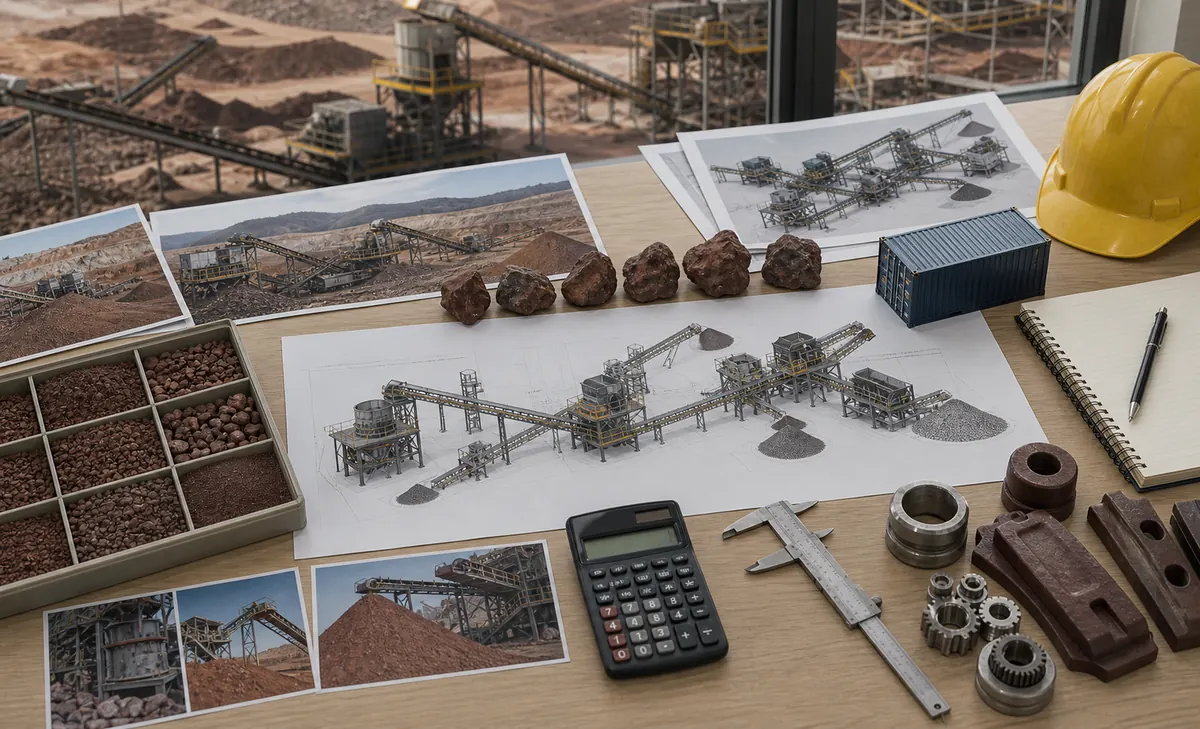
To receive a useful iron ore crushing plant quotation, prepare clear application data before contacting the supplier.
Send the following information:
- Raw material name and ore type, such as hematite, magnetite, limonite, or mixed iron ore.
- Maximum feed size from mine blasting or stockpile.
- Required output size before grinding, screening, magnetic separation, or transport.
- Target capacity in tons per hour or tons per day.
- Ore hardness, abrasiveness, moisture, clay content, and bulk density if available.
- Downstream process, such as ball mill grinding, dry magnetic separation, or lump ore screening.
- Site photos, layout limits, power condition, altitude, and water availability.
- Budget range, delivery country, project schedule, and spare parts requirements.
With these details, MVSI can review the application and recommend a practical combination of feeder, jaw crusher, cone crusher, vibrating screen, conveyors, control system, and spare parts.
Conclusion
An iron ore crushing plant should be designed around ore hardness, feed size, target product size, capacity, downstream process, and site conditions. A common flow uses vibrating feeder, jaw crusher, cone crusher, vibrating screen, return conveyor, product conveyors, and stockpile or fine ore bin. The right configuration helps protect the grinding or beneficiation section from unstable feed and reduces operating cost over the life of the project.
If you are planning an iron ore crushing project, send MVSI your raw material, feed size, output size, capacity, site photos, and budget range. Our team can help compare stationary and mobile options, estimate the equipment scope, and prepare a suitable crushing and screening configuration.
FAQ
What equipment is needed for an iron ore crushing plant?
An iron ore crushing plant commonly needs a hopper, vibrating feeder, jaw crusher, cone crusher, vibrating screen, belt conveyors, return conveyor, electrical control system, dust control, and stockpile or fine ore bin.
Is jaw crusher suitable for iron ore?
Yes. A jaw crusher is commonly used as the primary crusher for iron ore because it can accept large feed size and handle hard rock. Jaw plate material and discharge setting should match the ore abrasiveness and secondary crusher requirement.
Why is cone crusher used for iron ore?
Cone crusher is widely used for secondary and tertiary iron ore crushing because it handles hard abrasive material and can produce a controlled product size in closed circuit with a vibrating screen.
What size should iron ore be crushed to before grinding?
The target size depends on the ball mill and beneficiation process. Many plants require a controlled fine ore feed, often in the range of under 10-25 mm, but the final target should be based on mill design and test data.
Can impact crusher be used for iron ore?
Impact crusher can crush some iron ore, but for hard and abrasive ore it usually has higher wear cost than cone crusher. Jaw crusher plus cone crusher is often more practical for long-term mining operation.
How much does an iron ore crushing plant cost?
Cost depends on capacity, ore hardness, feed size, required product size, number of crushing stages, screen size, conveyor length, control system, civil work, installation, and spare parts package.
Is a mobile crusher suitable for iron ore mining?
Mobile crushing can be suitable for temporary mining, contractor work, remote sites, or pre-crushing near the pit. Long-term iron ore beneficiation projects usually prefer stationary plants for stability and downstream integration.
What information should I provide before asking for a quotation?
Provide raw material, feed size, output size, target capacity, ore hardness, moisture, downstream process, site photos, power condition, delivery country, budget range, and project schedule.