Table of Contents
- When does each power option make sense for a quarry?
- Does diesel-electric mean the crusher can plug into the grid?
- What power evidence should the buyer collect before comparing prices?
- Why can a generator sized from running kW still be unsuitable?
- Compare usable grid-powered hours and complete costs
- What must the quotation include before you place an order?
- Frequently asked questions
- Can any diesel-electric mobile crusher run on mains power?
- Is a grid-powered mobile crusher always cheaper to operate?
- When should a quarry favor a self-contained diesel package?
- How do I choose the generator size for a mobile crushing line?
- Does grid operation remove every diesel requirement on site?
- What should be checked before accepting a dual-power quotation?
- What information should I send for a diesel-versus-electric proposal?
- Request a proposal based on your material and site power
Should You Buy a Diesel or Grid-Powered Mobile Crusher?
Choose a diesel-powered mobile crusher when the work must continue at sites without a suitable electrical supply or when frequent moves make cable infrastructure impractical. Consider a grid-powered model when the proposed machine supports external power and the site can supply the complete crushing line during production, starting and restart. A dual-power package may bridge both duties, but its exact functions must be documented. Compare the same material, product sizes, saleable output and operating hours before comparing energy costs. The purchase decision depends on usable grid-powered hours and the full supply package, including connection works, cables, backup arrangements and commissioning responsibilities.
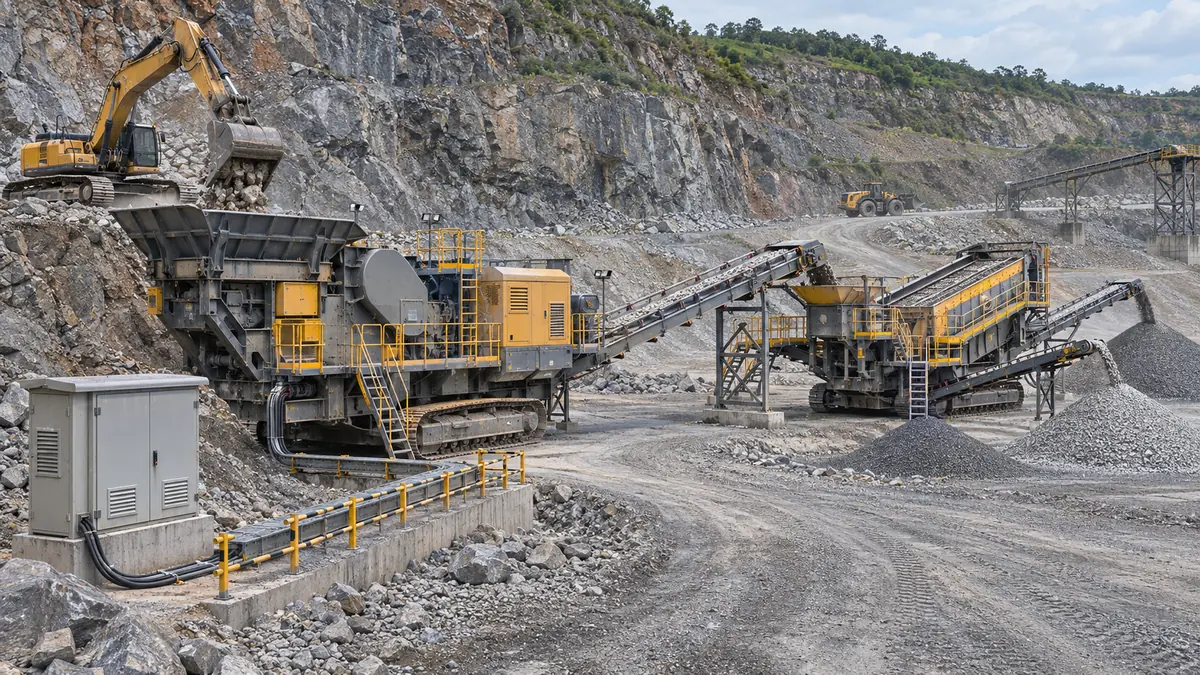
When does each power option make sense for a quarry?
A serviced quarry with long production runs is a stronger candidate for grid operation than a short, off-grid contract. Diesel independence can be more valuable where the plant follows a changing work front or moves between sites without prepared electrical connections.
| Project condition | Option worth comparing | Evidence needed before ordering |
|---|---|---|
| Established quarry with a nearby, adequate supply | External-power-capable mobile plant | Written available capacity, connection location, operating window and complete supply scope |
| Remote quarry or frequent contracts at unserviced sites | Self-contained diesel-powered package | Fuel access, engine specification, service requirements and comparable production duty |
| Long grid-connected campaigns plus off-grid assignments | Documented dual-power package | Functions available in each mode, switching procedure, generator capability and relocation requirements |
| Shared supply already serving other heavy equipment | Either option, pending a load study | Simultaneous loads, starting sequence, site power quality and an agreed restart plan |
These are screening conditions, not a model recommendation. Start with the mobile crushing plant buying guide to define the crushing duty. Then compare the power arrangement for the same required line, rather than comparing unrelated crusher sizes.
Does diesel-electric mean the crusher can plug into the grid?
The label alone does not confirm external-power operation. Ask for the exact model, drive arrangement and external-power option in the offered configuration, including which functions still need the engine.
Kleemann’s drive-technology documentation distinguishes a direct engine-driven crusher with electrically driven auxiliaries from a diesel-electric arrangement with an external-supply option. Electric conveyors do not establish that the crushing drive can operate with the engine stopped.
Metso’s LT120E product brochure explicitly documents external-network and onboard-generator operation for that model. This is an example of the evidence to request, not a specification for an MVSI machine or another manufacturer’s model.
- Identify the crusher drive, feeder, screen, conveyors, pumps, magnet and control supply separately.
- Confirm whether external-power hardware is included, optional or unavailable in the quotation.
- Ask how tracking, setup hydraulics and clearing functions are powered, rather than assuming every function is electric.
- Obtain the approved supply voltage, frequency, connection arrangement and operating limits in writing.
What power evidence should the buyer collect before comparing prices?
Collect both a plant load schedule and evidence of the power actually available at the intended connection point. A nearby power line or a transformer nameplate does not establish spare capacity for a complete mobile crushing and screening train.
Keep three quantities separate: running demand in kW, apparent-power demand in kVA and energy consumed over time in kWh. An energy estimate helps cost a shift; it does not prove that motors will start or that other equipment can operate simultaneously.
| Input | Ask the equipment supplier for | Ask the site team or power provider for |
|---|---|---|
| Crushing duty | Material assumptions, feed size, product grading and output basis | Representative material data and required saleable product split |
| Running load | Connected loads and expected simultaneous demand for every included module | Existing site demand and confirmed spare supply capacity |
| Starting and restart | Starter/drive type, load steps, sequence and permitted supply disturbance | Supply response and other loads that must remain operating |
| Electrical interface | Approved voltage/frequency, connection drawings and protection requirements | Connection location, route length, earthing information and local design requirements |
| Operating availability | Permitted operating conditions and any mode restrictions | Planned production hours, outage history and relocation schedule |
Treat material hardness, abrasiveness, moisture, clay and feed variability as production inputs. Hold them constant across bids; a different feed or product target can change the required configuration and invalidate a power comparison. The feeder, crusher, screen and conveyor selection guide helps define the equipment boundary.
Why can a generator sized from running kW still be unsuitable?
A generator must support the actual load sequence and transient response, not only steady running demand. Obtain a sizing review for the complete proposed package, including its motor starters and any drive-fed loads.
Cummins’ motor-starting capability white paper explains that starting behavior depends on the combined alternator, excitation, engine, motor and driven-load response. Its generator application manual, chapter 3 also separates running and starting requirements and addresses nonlinear loads. These are reasons to request an application review, not to apply one universal motor-to-generator multiplier.
Have the supplier and site electrical designer agree on an approved sequence for conveyors, screen, crusher and feeder; the treatment of an outage with material remaining in the line; and the permissible voltage and frequency disturbances. Confirm the generator rating basis and site conditions. A soft starter or variable-frequency drive changes the assessment; neither removes the need for it.
Supply conditions can affect an actual equipment choice. In Kleemann’s published account of Metzner Recycling’s electric demolition application, the operator identified low starting current as a selection factor, and the report describes infrastructure upgrades. That is an OEM-reported recycling example, not an MVSI case or a quarry performance guarantee.
Compare usable grid-powered hours and complete costs
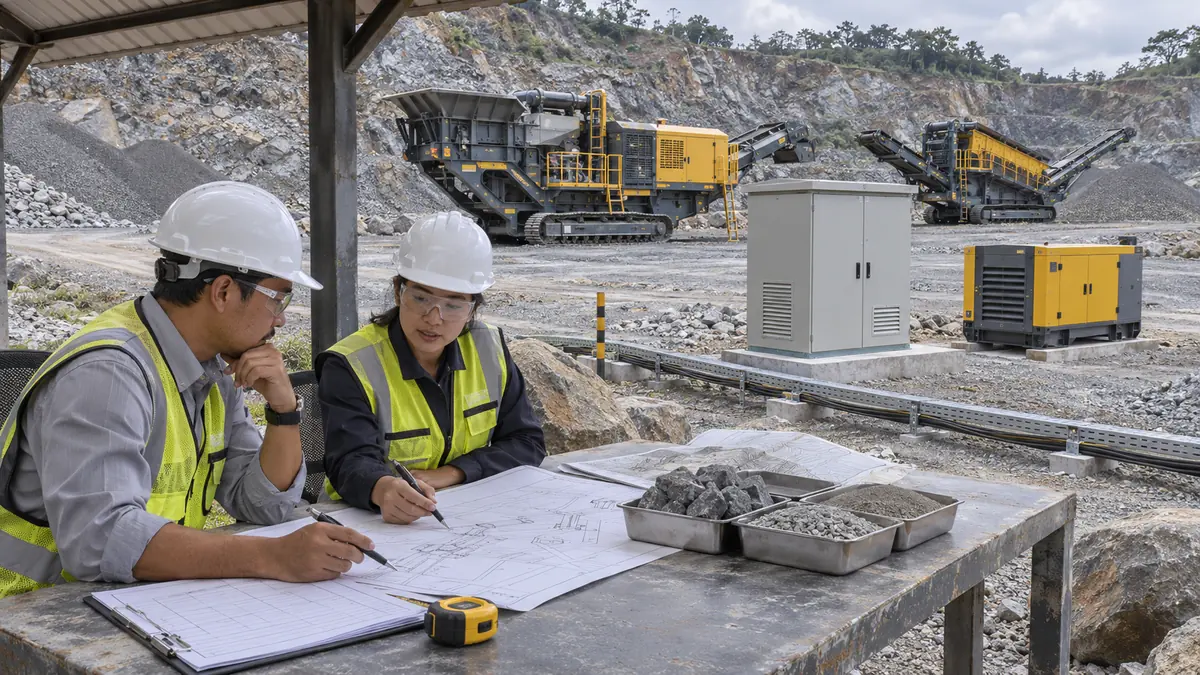
Base the economic comparison on productive hours during which a suitable grid supply is genuinely available. A low electricity tariff is not enough if the line spends much of its contract on diesel, waiting for connection work or disconnected during moves.
Use the same feed, product mix, shift length and saleable-tonnage basis for each proposal. Ask for an energy estimate with its load assumptions, and replace forecasts with measured consumption when comparable site evidence exists.
- Diesel energy cost: fuel consumed over the stated duty multiplied by delivered fuel price.
- Grid energy cost: metered kWh over that duty multiplied by the applicable tariff, plus relevant demand or connection charges.
- Additional supply scope: power-option premium, connection works, transformer if required, distribution, cables, cable handling, installation and testing.
- Availability costs: backup provision, outages, reconnection time, maintenance and productive time lost during moves.
A simple comparison is annual energy and maintenance cost avoided, less additional annual supply, backup and relocation costs. Compare that result with the additional installed investment over the intended ownership period. If the assumed grid-powered hours are not credible, the result is not a reliable purchase justification. No universal savings percentage or payback period follows from the drive label.
Use the mobile crusher operating-cost worksheet approach for the broader cost-per-saleable-ton calculation. For frequent moves, also review tracked versus tire-mounted deployment; the power connection and cable plan must fit the proposed relocation method.
What must the quotation include before you place an order?
Ask every bidder to price the same functional boundary from the site connection to the complete production line. Separate confirmed inclusions, buyer-supplied items, options and exclusions so that a low machine price does not hide missing infrastructure.
| Quotation item | Written confirmation to request |
|---|---|
| Machine and drive package | Exact model, engine/generator/motor arrangement and external-power option supplied |
| Complete production line | Feeder, crushers, screen, return conveyors, stockpiling and auxiliary equipment included in load calculations |
| External supply boundary | Who designs and supplies each transformer, cable, distribution/protection item and connection work |
| Moves and interruptions | Cable handling, isolation and reconnection responsibilities; supported backup and restart arrangements |
| Commissioning and acceptance | Approved supply conditions, startup/load sequence, representative material, measurement points and agreed acceptance records |
| Support and documentation | Electrical drawings, component identification, manuals, training scope and documented responsibility for faults at the machine/supply interface |
Do not accept a no-load demonstration as evidence of the required loaded duty. Agree what will be checked under representative production conditions and record unresolved assumptions before order release. Electrical installation, protection and connection design should be completed by qualified parties for the actual site; this purchasing checklist is not a wiring design.
Common mistakes are buying the word hybrid without a function list, sizing only the crusher while omitting the screen and conveyors, comparing fuel against average electricity demand without startup evidence, and promising output before the feed and product requirements are fixed.
Frequently asked questions
The correct power package follows the documented machine functions and the site supply. These answers summarize the purchase boundaries above.
Can any diesel-electric mobile crusher run on mains power?
No. Verify the exact model and supplied external-power option. Electric auxiliary drives or an onboard generator alone do not prove that the complete crushing duty can run with the engine stopped.
Is a grid-powered mobile crusher always cheaper to operate?
No. Compare the same saleable output and include the tariff, usable grid-powered hours, connection works, cables, backup, maintenance and relocation. Savings cannot be inferred from the power label alone.
When should a quarry favor a self-contained diesel package?
Consider it where suitable site electricity is unavailable, connection work cannot be justified for the contract, or frequent moves make external cables impractical. The proposed diesel configuration still needs a comparable production and ownership-cost assessment.
How do I choose the generator size for a mobile crushing line?
Request an application-specific review of all simultaneous and starting loads, the drive types, load sequence, allowable voltage and frequency disturbance, rating basis and site conditions. Do not select a generator from the crusher motor running kW alone.
Does grid operation remove every diesel requirement on site?
Not necessarily. Confirm how tracking, setup and auxiliary functions operate on the exact model, and include other site machines and backup arrangements. Running the crusher from the grid does not establish that the entire quarry is diesel-free.
What should be checked before accepting a dual-power quotation?
Confirm the functions and restrictions in each mode, external-power hardware, supported changeover procedure, generator capability, complete-line load basis, infrastructure responsibility and commissioning acceptance conditions.
What information should I send for a diesel-versus-electric proposal?
Send raw material, maximum and typical feed size, required output size, capacity, site photos and budget range. Add supply voltage/frequency, confirmed spare capacity, connection distance, working hours, relocation plans and outage history.
Request a proposal based on your material and site power
Send MVSI your raw material, feed size, output size, capacity, site photos and budget range, together with the supply voltage/frequency, confirmed spare capacity, connection-point distance, operating hours and move schedule. Request a proposal identifying the supported power arrangement, assumptions, exclusions and commissioning scope for the exact equipment offered. This information allows the available configurations to be assessed without assuming an undocumented grid-power or dual-power capability.