Table of Contents
- What must a capacity claim actually identify?
- Give bidders one material and product specification
- Join product grading to the mass measured in the same run
- Normalize moisture and time before comparing offers
- When is a supplier demonstration sufficient?
- Frequently asked questions
- Is catalogue feed capacity the same as saleable aggregate output?
- Can a sieve report alone prove the screen capacity?
- Should the comparison use wet tonnes or dry tonnes?
- How long should the material trial last?
- Does a no-load factory test verify production capacity?
- What should happen if one product fails the trial?
- Select the proposal with a traceable acceptance basis
- Sources and technical references
How to Verify Mobile Screen Capacity Before You Buy
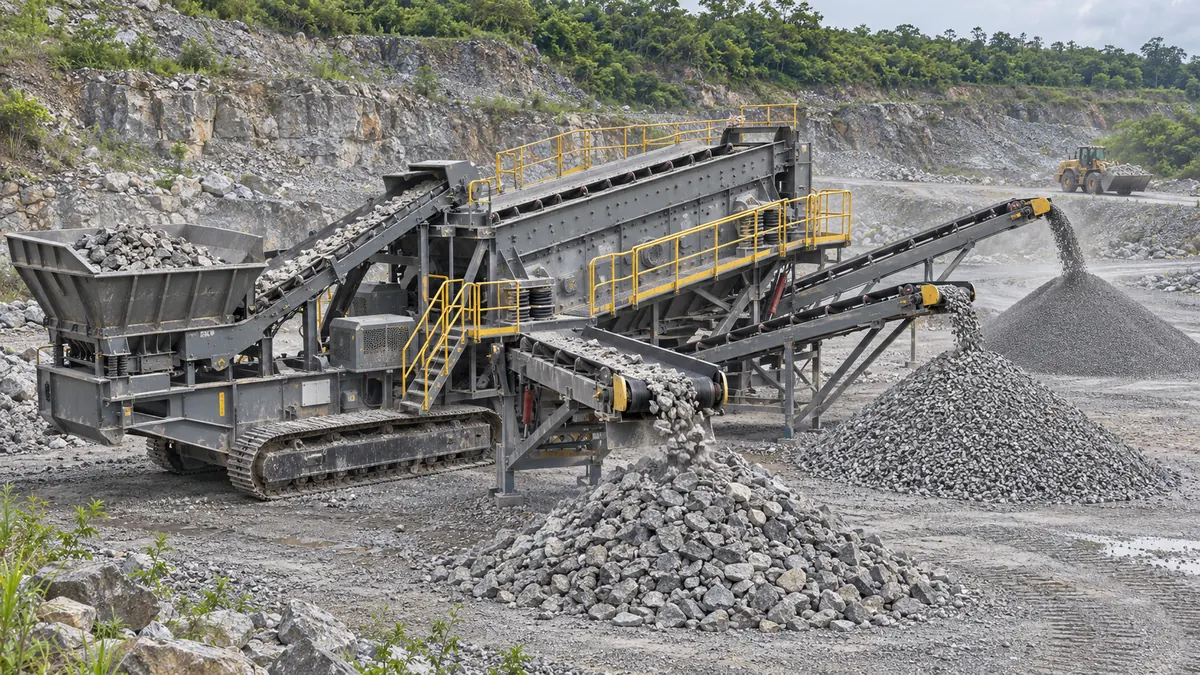
Verify a mobile screen capacity claim with a material trial that measures both feed throughput and the output meeting your agreed product grading. Use representative feed, identify every discharge stream, and link its measured mass to sieve results from the same test window. Agree the moisture basis, elapsed time, stoppage treatment and retest rules before the trial. A high inlet rate, a clean sample or a short video alone cannot establish saleable output. If the supplier cannot connect these records, treat the quoted capacity as unverified for your purchase specification.
By MVSI Company. Published 2026-11-16.
What must a capacity claim actually identify?
A capacity statement needs a material, a measurement boundary and a time basis. For a purchase intended to make graded aggregate, record feed rate and accepted output separately, including the result for each required product.
| Decision fact | Evidence to request before accepting the claim |
|---|---|
| Material basis | Representative feed gradation, maximum lump, moisture, clay/fines description and source of trial material |
| Configured screen | Exact machine, deck media and apertures, settings, feeder and discharge arrangement used in the run |
| Feed throughput | Measured new feed in metric tonnes per hour (t/h), with wet/as-received or dry-solids basis identified |
| Accepted output | Measured mass for each required product, paired with its grading result and agreed acceptance specification |
| Time basis | Common trial start/end, stabilization treatment, interruptions and both running and elapsed time |
| Evidence boundary | Catalogue estimate, analogous-site record, your material trial or written contractual guarantee: identify which one is offered |
The MVSI mobile-screen family is a relevant starting point for aggregate screening proposals. Its family description does not verify a particular capacity on your material. Request the current offered machine and configuration, together with the evidence the bidder will provide.
Give bidders one material and product specification
A useful trial represents the feed you expect the purchased screen to handle. A convenient dry sample cannot demonstrate performance on a materially different production feed.
McLanahan’s screening-equipment sizing guidance identifies particle-size distribution, density, moisture, required separations and media as application inputs. Give bidders one shared feed record, including sizes on both sides of the proposed cuts. Record which stockpile or production period the sample represents.
Define each required product by its grading limits and the applicable end-use specification. Passing grading does not establish compliance with every aggregate requirement: other material properties remain separate acceptance items where the project requires them. Keep a description of unsuitable or excluded feed in the offer, rather than extending a trial result to all quarry material.
For the hardware decision, use the screen area and deck-selection guide. If seasonal adhesion is the dominant risk, the wet, clay-bearing feed comparison addresses that process boundary. Here the question is whether the supplier’s claimed rate has been demonstrated on the agreed duty.
Join product grading to the mass measured in the same run
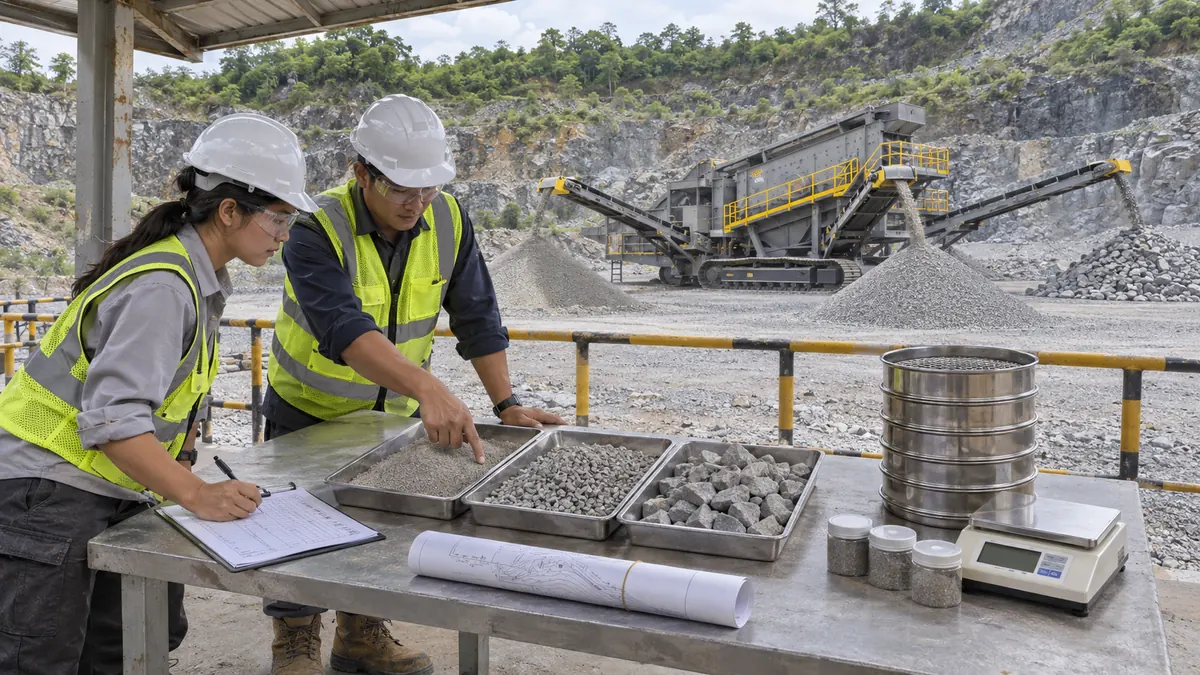
A sieve result describes a sample; a tonnage record describes a material flow. To substantiate accepted production, the test plan must connect those records to the same discharge stream and production interval.
Metso’s Crushing and Screening Handbook, seventh edition, printed page 97, distinguishes screening efficiency from meeting the desired product curve. Specify product grading acceptance as well as throughput, rather than treating an efficiency percentage as proof that each stockpile is acceptable.
Ask for a stream map from feed through every outlet. Separate accepted products, oversize return, rejects and any material held in the hopper or on conveyors. When return is present, do not count the same material again as new plant production. Explain changes in stored material and unmeasured losses; a feed/output discrepancy needs investigation before the result is used in a purchase comparison.
| Trial-record field | What the buyer should be able to trace |
|---|---|
| Run identity | Date, material source, exact configuration and agreed start/end time |
| Stream identity | Outlet or belt, intended product specification and destination |
| Mass and rate | Weighing method, calibration/check record, measured mass, moisture basis and matching time interval |
| Sample and grading | Sample ID, collection interval, preparation/test method, laboratory report and pass/fail against the agreed limits |
| Interruptions | Cleaning, blocked openings, loader delays, adjustments and any excluded periods, with reasons |
| Reconciliation and decision | Feed/output/storage reconciliation, measurement uncertainty, results for each required product and agreed retest action |
This is a proposed procurement worksheet, not a replacement for a project-approved test procedure. The WAQTC aggregate methods v. 2026 index separates aggregate sampling, sample reduction, moisture measurement and sieve analysis. Have the responsible testing party select the methods and editions applicable to your contract and jurisdiction, including how samples represent the trial interval. Use qualified personnel and approved safe sampling arrangements; never improvise collection from operating conveyors.
Normalize moisture and time before comparing offers
Two quoted t/h values are comparable only when their material and time bases match. State whether the mass includes moisture, and distinguish output during running time from output over the full agreed trial window.
If one offer reports dry solids and another reports as-received tonnes, ask for measured moisture and a documented conversion to the agreed basis. Keep water added for a process separate from the solids accounting. No universal moisture correction or acceptable moisture limit is implied here.
For the proposed comparison, accepted output rate is the qualifying product mass divided by the agreed elapsed hours. Define how qualifying lots and samples are associated before the trial; do not estimate acceptable tonnage by multiplying feed tonnes by the percentage passing one sieve. Report each required fraction separately so a large quantity of one grade cannot conceal a shortage of another.
Record planned stabilization and every interruption. A short stable operating interval can help assess the separation, but cannot by itself establish sustained shift production. Agree whether cleaning and feeding delays remain within the elapsed-time result, and report excluded periods transparently. For a separate media purchase, the wire-versus-polyurethane comparison explains why the tested media construction and mounting must also be identified.
When is a supplier demonstration sufficient?
A demonstration is useful when its material, configuration, products and measurement record match the decision being made. It is insufficient as proof of your required output when important conditions or records are missing.
Illustrative comparison, not a customer case: Offer A includes a video and an inlet-rate reading, while Offer B includes timed outlet masses and corresponding grading reports. Offer B provides a better basis for checking accepted output, but only if its feed and setup represent the agreed duty. Neither offer establishes your required rate without the actual records and thresholds. No output, price or supplier result is assumed in this example.
- Use a relevant existing-site record to identify questions and narrow candidates; document material and configuration differences before treating it as transferable evidence.
- Use a representative material trial where product acceptance or feed variability is unresolved. Ask whether the trial is available, where it would take place, who supplies the material and who pays.
- Do not use an unloaded factory check as proof of graded output. It serves a different inspection purpose.
- Put required product rates, grading limits, feed envelope, witnessing, measurement uncertainty, exclusions and retest responsibilities in writing before ordering. A test observation becomes a contractual obligation only through the agreed contract wording.
Frequently asked questions
Use these questions to close gaps in the proposed evidence before approving the capacity basis.
Is catalogue feed capacity the same as saleable aggregate output?
No. Feed throughput is the material entering the defined boundary. Accepted output is the measured product meeting the agreed requirements over a stated period. Report each required product separately and identify returns and rejects.
Can a sieve report alone prove the screen capacity?
No. It can support a grading result for the sampled material, but capacity also needs a measured mass and time record linked to that stream and sampling interval.
Should the comparison use wet tonnes or dry tonnes?
Use the basis agreed for the purchase specification and identify it on every result. If offers use different bases, require measured moisture and a documented conversion before comparing them.
How long should the material trial last?
Agree a window that represents the duty and its relevant variability, with stabilization, sampling and stoppage treatment defined in advance. There is no universal trial duration that proves every mobile-screen application.
Does a no-load factory test verify production capacity?
No. A no-load check cannot establish product grading and output on representative feed. Define material testing and any factory inspection as separate evidence requirements.
What should happen if one product fails the trial?
Record the failed product, its mass, grading and operating conditions. Follow the agreed adjustment and retest process; do not accept the total tonnage as proof that every required fraction meets the order.
Select the proposal with a traceable acceptance basis
Approve the capacity basis when each required product has a traceable mass, grading result and time window on representative feed. If that link is missing, request the evidence or keep the rate provisional before placing the order.
For a mobile-screen proposal, contact MVSI through its listed WhatsApp or email route. Send raw material, maximum and typical feed size, required output size, capacity in t/h, project country, site photos and budget range. Add feed grading and moisture records, product grading limits, the required rate for each product, proposed trial location, weighing and sampling arrangements, available feed quantity and expected interruptions. Ask which evidence and trial scope can be included in the quotation.
Sources and technical references
Sources retrieved 2026-11-16. Other OEM guidance supports general screening principles, not MVSI ratings, trial availability or service promises.
- MVSI Mobile Screens, linked above: documented product-family scope.
- McLanahan, 8 Questions to Ask When Sizing Screening Equipment, linked above: material and separation inputs for screen selection.
- Metso, Crushing and Screening Handbook, seventh edition, printed page 97, linked above: product grading and screening efficiency are distinct checks.
- WAQTC, Aggregate Test Methods v. 2026, linked above: separate sampling, reduction, moisture and gradation method families. Select the applicable procedure with the project testing authority.