Table of Contents
- Which facts decide whether extra surge storage is needed?
- How does a surge hopper differ from the cone inlet?
- How much reserve can the hopper actually supply?
- Can the reserve refill before the next interruption?
- What should the hopper, feeder and control quotation include?
- Frequently asked questions
- Does every mobile cone crusher need a separate surge hopper?
- Can advertised hopper volume be used as available surge capacity?
- How is the reserve for a complete feed interruption calculated?
- Why does refill time matter when comparing hoppers?
- Will a larger hopper fix inadequate average upstream supply?
- What evidence should a surge-hopper quotation contain?
- Choose storage that covers the gap and can recover
- Sources and technical references
Does a Mobile Cone Crusher Need a Surge Hopper?
A mobile cone crusher needs additional surge storage when its existing feed arrangement cannot bridge measured supply gaps while maintaining the specified chamber level. Compare usable inventory and the time available to refill it before the next interruption, rather than choosing from the hopper’s advertised volume alone. An external bin may be unnecessary when an existing stockpile, feeder or onboard hopper already provides sufficient controlled reserve. It will not correct persistently inadequate average supply, a blocked discharge or an unsuitable chamber. Ask for a timed feed record and an integrated hopper, feeder and control proposal.
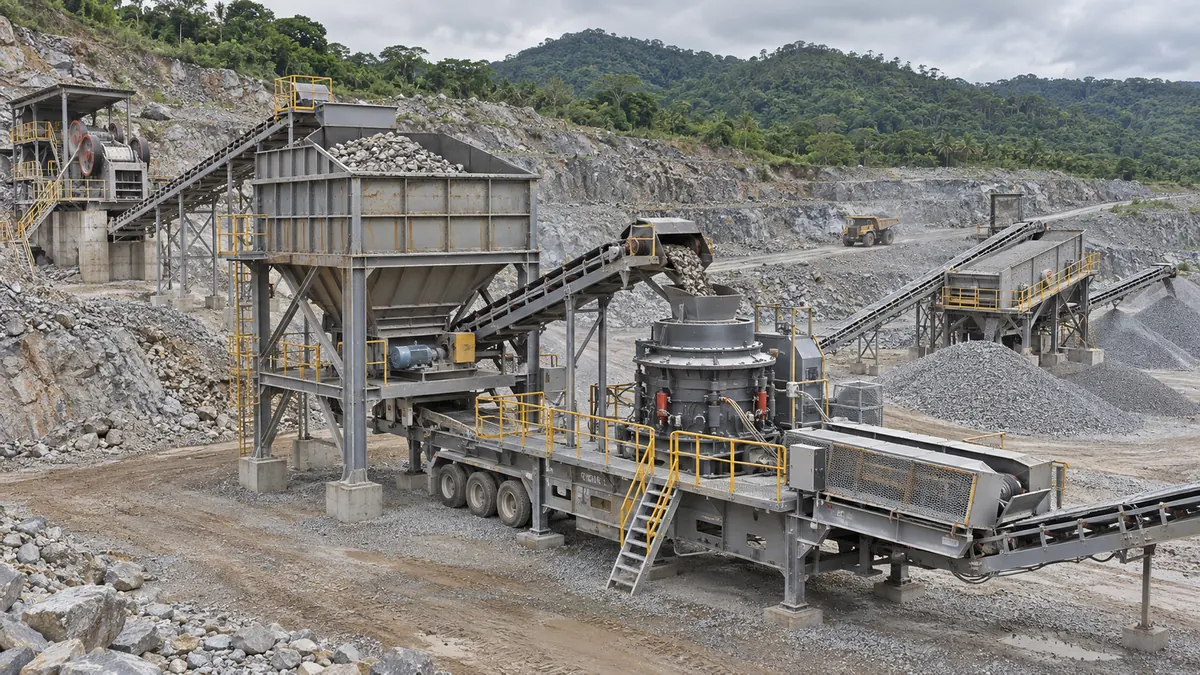
Which facts decide whether extra surge storage is needed?
Additional storage is justified by a measured interruption that the existing feed system cannot absorb. Establish both the material available at the start of that interruption and the opportunity to replenish it afterward.
| Decision fact | Record to compare | Implication for the purchase |
|---|---|---|
| Feed interruptions | Time-stamped inlet flow, gap duration and frequency over representative operation | Size the buffer for a defined disturbance; do not assume one universal number of minutes |
| Usable reserve | Dischargeable tonnes above the agreed low operating limit at the start of a gap | Gross hopper volume is not the reserve available on demand |
| Recovery opportunity | Actual inlet rate while feeding and uninterrupted time before the next gap | A bin that covers one gap can still run down over repeated cycles |
| Cone requirement | Exact chamber, permitted feed, target level and operating limits | Confirm the required feed regime for the offered machine and crushing stage |
| Material flow | Feed grading, moisture/clay, bulk density and observed hang-ups | A larger vessel does not establish reliable discharge |
| Existing and downstream equipment | Onboard hopper, stockpile reclaim, feeder, screen, belts and return route | Identify whether extra storage removes the constraint or duplicates existing provision |
How does a surge hopper differ from the cone inlet?
A surge hopper stores material to absorb upstream variation; the cone inlet presents material to the crushing chamber. Those are different functions, even when a supplier combines parts of them in one mobile package.
Sandvik’s feed-arrangement guidance describes non-segregated choke feeding, a level signal and variable-speed feeder, with a pre-crusher surge bin as another feeding provision. The required level depends on the crusher, chamber, stage and bridging risk. Obtain that requirement for the proposed machine instead of transferring another model’s level or geometry.
The useful arrangement may be an existing stockpile with controlled reclaim, an adequate onboard feed system, or a separate bin and metered delivery belt. The comparison is whether the complete arrangement maintains the specified feed condition through the agreed disturbances. A separate bin is not automatically necessary merely because the plant is mobile.
There are also design-specific exceptions. Metso’s discussion of GP Secondary cones describes some tolerance of intermittent feeding for that range. This does not establish the same tolerance for an MVSI machine. Ask the supplier to identify the feed regime supported by the exact proposed cone.
The MVSI mobile secondary crushing plant page is the relevant product-family route for this inquiry and describes a mobile cone option alongside impact equipment. Request written confirmation of the cone, feed package and interfaces offered. The family page alone does not establish an external surge bin, its capacity, a particular control function or compatibility with an existing machine.
Resolve the chamber and feed-grading requirement using the cone chamber selection guide before treating hopper volume as the only selection variable.
How much reserve can the hopper actually supply?
Count only material that can discharge above the agreed low operating limit. The reserve available when a gap starts can be smaller than the maximum working inventory shown on a drawing.
For a constant draw during a complete supply interruption, the basic mass balance is: required reserve in tonnes = draw rate in t/h multiplied by interruption seconds, divided by 3,600. For variable flow, calculate the cumulative difference between inlet and outlet flow over time. Use rates and inventory from the same physical boundary, including any return stream that actually enters that buffer.
Converting a geometric volume in cubic metres to tonnes requires a representative bulk density and a defensible dischargeable working volume. Identify the high and low operating levels, material left below the outlet drawdown surface, and any inaccessible regions. Do not assume the hopper starts full or apply an arbitrary usable percentage to every material.
Jenike & Johanson’s stockpile-discharge guidance explains how cohesive fines and segregation can cause arching or ratholing and reduce reclaimable inventory. It concerns stockpiles, not a universal mobile-hopper design rule. The relevant procurement lesson is to verify flow with the actual material; its published fines percentages must not become a rejection threshold for another hopper.
Can the reserve refill before the next interruption?
A buffer can sustain repeated gaps only if material can be replenished between them. While the cone continues drawing, refill rate is the inlet rate minus the outlet rate, not the full inlet rate.
The following is a hypothetical mass-balance comparison. All rates and times are assumed to demonstrate the buying decision; they are not equipment ratings, a customer case, a recommended hopper size or a production guarantee. Assume free discharge and an otherwise suitable circuit. The 180 t/h draw is the defined buffer outlet flow, not a claim about saleable output.
| Assumed condition or calculation | Illustrative result |
|---|---|
| Buffer outlet draw: 180 t/h; complete inlet interruption: 90 seconds | Reserve consumed = 180 x 90 / 3,600 = 4.5 tonnes |
| Inlet resumes at 240 t/h while outlet remains 180 t/h | Net replenishment = 240 – 180 = 60 t/h |
| Restore the consumed 4.5 tonnes at that net rate | Refill time = 4.5 / 60 x 60 = 4.5 minutes of uninterrupted feeding |
| Instead, only 3 minutes of feeding occurs before each next 90-second gap | Inlet supplies 12 tonnes per 4.5-minute cycle; outlet requires 13.5 tonnes |
| Same repeated short cycle | Average inlet is 160 t/h; inventory loses 1.5 tonnes per cycle at the assumed 180 t/h draw |
In the last case, a larger hopper delays depletion but cannot sustain the assumed draw indefinitely. Correct the recurring supply deficit, change the operating arrangement or reconsider the draw target within the approved operating envelope. Specify the real interval distribution and starting inventory before choosing additional storage. The 4.5-tonne calculation is an ideal material requirement for one assumed gap, not a final vessel design or allowance for response delay.
If average supply is adequate but the cone is constrained by genuine crushing duty or screen return, investigate that separate limitation. The cone-versus-screen upgrade guide explains why a return-flow problem should not automatically trigger a larger crusher or bin purchase.
What should the hopper, feeder and control quotation include?
Compare an integrated feed package on the same disturbance record and material duty. Extra steel volume has limited value if the feeder cannot meter it, the material will not discharge or the control response is unsuitable.
The primary research paper Feed-hopper level estimation and control in cone crushers distinguishes buffer-level variation used for storage from tight cone feed-hopper regulation. Treat these as separate control objectives in the proposal; an upstream storage-level indication alone does not establish the chamber condition.
- Storage basis: gross volume, dischargeable working inventory, high/low limits, bulk-density basis, assumed starting level and the interruption/refill calculation.
- Material and outlet: actual size distribution, wettest expected feed, clay/fines observations, flow assessment, outlet/liner design and feeder-interface review.
- Metered delivery: feeder operating range, achievable delivery under the actual burden, belt/chute route, distribution into the cone and material travel delay.
- Controls and interfaces: named level instruments, feeder response, permissives, alarms, upstream response to high storage level, low-inventory response and a documented response to sensor failure.
- Site and mobility: footprint, elevations, structural/load assessment, power, guarding, access, transport and setup scope; verify who supplies and integrates each component.
- Acceptance and commercial scope: representative material, agreed feed interruptions, initial inventory, time-aligned flow/level records, sampling, responsible parties, exclusions and response to unresolved findings.
A commissioning review should show the agreed feed condition through the specified normal disturbances while respecting machine limits and downstream availability. Do not provoke a blockage or bypass protective systems to test storage. Follow the responsible supplier’s approved procedure; this article supplies a procurement record, not control setpoints or an operating sequence.
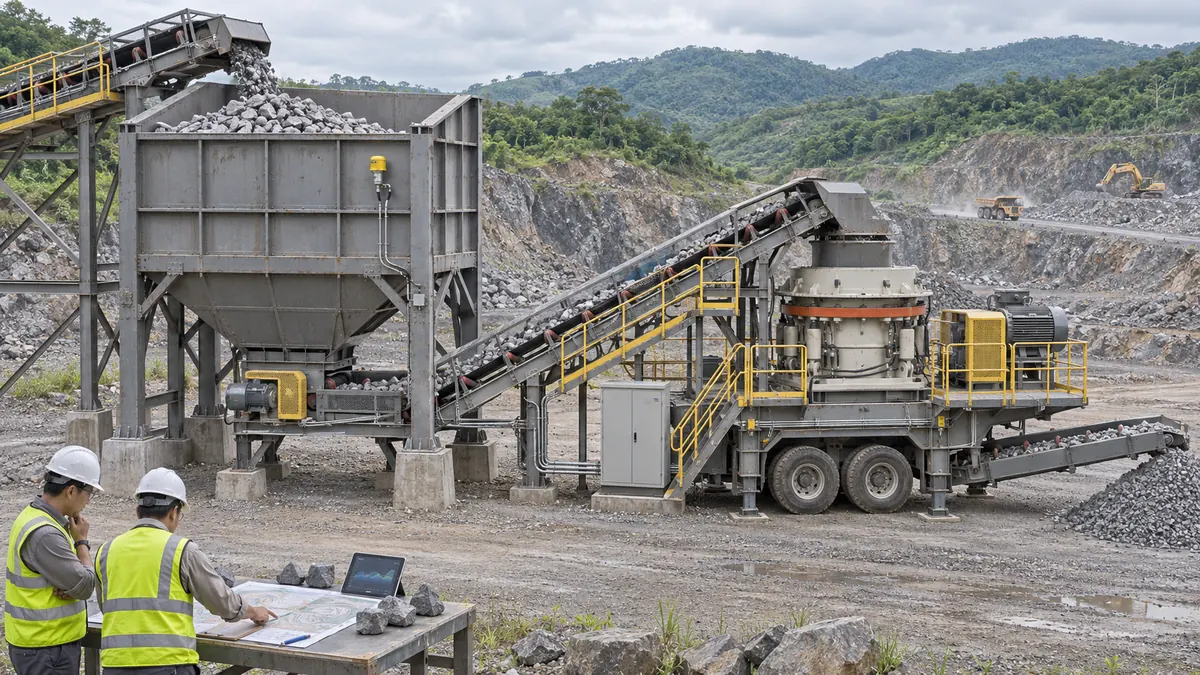
Price the complete installed arrangement, including support works, delivery belts, electrical integration, material-flow provisions and relocation effort. Compare those scope differences with a simpler existing feed arrangement using the cone quotation review checklist. No universal hopper price, payback or output increase follows from the mass balance.
Frequently asked questions
Use these answers to define the feed-package inquiry and the measurements still required.
Does every mobile cone crusher need a separate surge hopper?
No. An existing stockpile, onboard hopper and feeder may already provide sufficient controlled reserve. Compare the complete feed arrangement against the exact cone requirements and measured supply interruptions before adding a separate bin.
Can advertised hopper volume be used as available surge capacity?
Not directly. Establish dischargeable working inventory, operating levels, bulk density and the actual starting inventory. Dead material, poor flow or a partly empty hopper can reduce the reserve available during a gap.
How is the reserve for a complete feed interruption calculated?
For a constant outlet draw, multiply the draw in t/h by interruption seconds and divide by 3,600 to obtain tonnes. This ideal mass balance does not determine vessel geometry, flow reliability, control allowance or a final equipment size.
Why does refill time matter when comparing hoppers?
While the cone keeps drawing, only the difference between inlet and outlet rates restores the reserve. If another gap arrives before recovery, repeated cycles can deplete inventory even though one interruption is covered.
Will a larger hopper fix inadequate average upstream supply?
It can delay depletion but cannot sustain a continuous outlet rate above average inlet supply indefinitely. Investigate the recurring supply deficit or revise the operating basis before purchasing more storage.
What evidence should a surge-hopper quotation contain?
Request the material and timed flow record, usable inventory and starting level, interruption/refill calculation, feeder and control scope, site interfaces and acceptance method. Confirm the exact cone and who supplies and integrates each component.
Choose storage that covers the gap and can recover
Add a surge hopper when measured interruptions exceed the reserve already available and the proposed arrangement can replenish that reserve before the next relevant gap. When average supply is insufficient, fix the supply or operating basis first. Approve the package only after confirming dischargeable inventory, the cone feed requirement and the complete integration scope.
For a mobile-cone feed-package assessment, contact MVSI through its listed WhatsApp or email route. Send raw material, maximum and typical feed size, required output size, capacity in t/h, project country, site photos and budget range. Add time-stamped inlet/outlet flow and interruption records, current hopper/feeder drawings and levels, bulk-density and moisture information, return-stream routing and the available footprint. Identify missing inputs so the proposed reserve and control assumptions remain visible.
Sources and technical references
By MVSI Company. Published 2026-11-13. Sources retrieved 2026-11-13. Other suppliers’ guidance supports general engineering distinctions, not MVSI model ratings, option availability or performance guarantees.
- MVSI Mobile Secondary Crushing Plant, linked above: publicly described mobile-cone family; exact feed package requires written confirmation.
- Sandvik, Optimal feed arrangement, linked above: controlled feed, model-dependent level, distribution and feed-system interlocks.
- Metso, Q&A on GP Secondary cone operation, linked above: stage-specific feed variation and a design-specific intermittent-feed exception.
- Jenike & Johanson, Achieving Reliable Gravity Discharge from Ore Stockpiles, linked above: flow obstructions and reclaimable inventory; no numeric stockpile threshold adopted for a mobile hopper.
- Itavuo, Hulthen and Vilkko, Minerals Engineering 110 (2017),82–95, DOI10.1016/j.mineng.2017.04.010, linked above: buffer versus feed-hopper control objectives. Publicly indexed abstract/excerpt consulted; full paper not reviewed.