Table of Contents
- Which evidence decides whether to buy a distributor?
- Why a full hopper can still leave the wrong feed pattern
- Compare a corrected transfer with a dedicated distributor
- Accept the layout across defined operating states
- Illustrative bid comparison, not a customer project
- Frequently asked questions
- Does every cone crusher need a powered feed distributor?
- Does choke feeding prove that material is evenly distributed?
- Can belt alignment alone solve feed segregation?
- Should recirculated material be included in the review?
- What should a distributor quotation include besides the device?
- Does MVSI confirm a feed distributor on its mobile cone page?
- Choose the arrangement against a documented duty
- Sources and technical references
Does a Cone Crusher Need a Feed Distributor?
A cone crusher needs a feed distribution device when the proposed transfer arrangement cannot deliver material evenly around the chamber without separating coarse and fine particles. A dedicated distributor is one option; belt alignment, a revised chute or a feed box may be sufficient where their performance is demonstrated for the actual duty. Do not order from hopper level or average throughput alone. Compare the complete transfer geometry, fresh and recirculated feed, operating variation and maintenance access. Require the supplier to document the accepted arrangement and its limits before choosing an accessory or releasing the order.
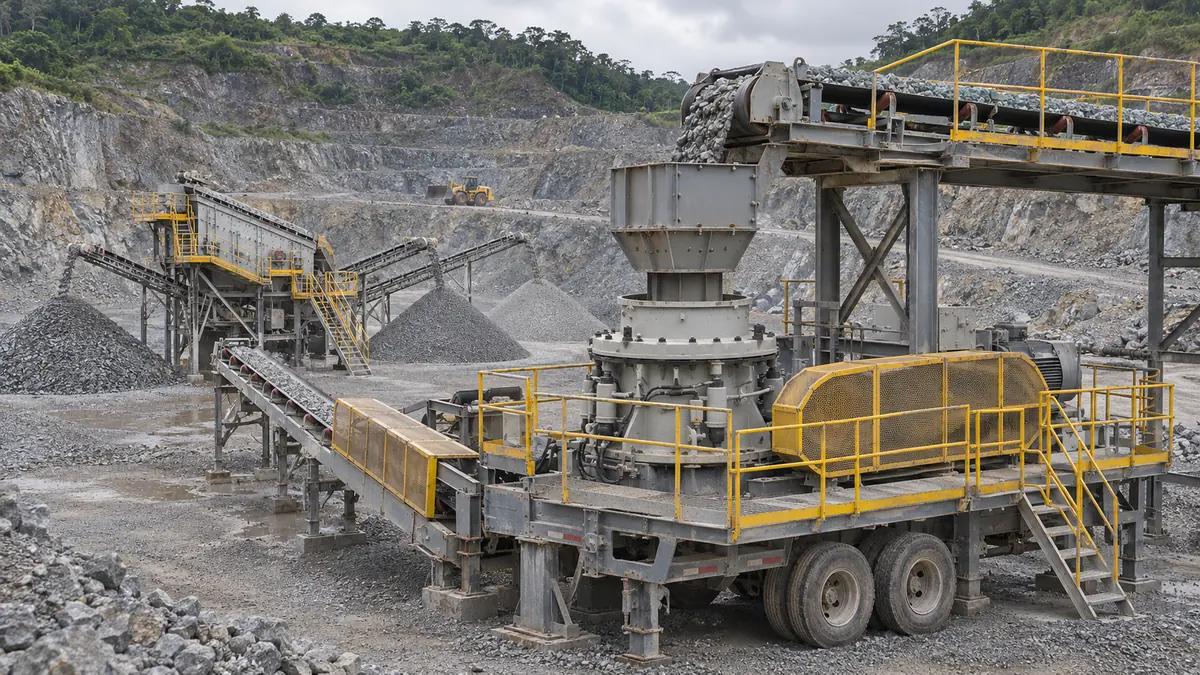
By MVSI Company. Published 2026-11-27.
Which evidence decides whether to buy a distributor?
Buy a demonstrated feed arrangement, with a distributor where it is needed to meet the agreed duty. First separate the amount of feed from where that feed enters the chamber.
| Decision fact | What to establish | Purchase implication |
|---|---|---|
| Feed rate and level | Required operating range and the exact cone/chamber feed condition | A full hopper does not establish an even mixture around its perimeter |
| Spatial distribution | Where material lands and whether coarse and fine fractions separate | Assess alignment and segregation as separate problems |
| Transfer geometry | Belt direction, discharge position, drop, chute/box arrangement and available headroom | Compare an adjusted transfer with a dedicated distribution device |
| Operating variation | Representative low/normal/high feed and fresh/return-stream combinations | One steady demonstration may leave important conditions untested |
| Material behaviour | Measured grading, moisture/clay and evidence of build-up or bridging | A distribution accessory is not proof of suitability for unsuitable feed |
| Installed scope | Support, guards, access, wear parts and controls where applicable | Price the complete arrangement and responsibility boundary |
The MVSI mobile secondary crushing plant page identifies the relevant mobile cone family. It does not establish that a particular feed distributor, retrofit or transfer design is included in a current offer. Ask for the exact cone, chamber and feed-layout proposal; keep any unconfirmed accessory outside the accepted scope.
Why a full hopper can still leave the wrong feed pattern
Level, rate and spatial distribution answer different questions. A satisfactory average rate and one level reading cannot show that all sides of the inlet receive a similar feed mixture.
Metso's crusher guidance lists stable feeding and even, non-segregated distribution around the cone cavity as separate considerations. Sandvik's feed guidance likewise describes choke feeding with non-segregated material, with the appropriate level depending on the model, chamber and crushing stage. Obtain those requirements for the offered machine rather than applying another model's inlet dimensions or level target.
For a buyer, the practical consequence is a separate evidence request: show the transfer layout and the material distribution it is intended to produce. A rate trend can support the supply-rate claim; it cannot, by itself, accept a claim about coarse and fine particles entering different sides of the chamber.
If the problem is repeated loss of supply, use the surge-hopper decision guide to evaluate reserve and refill time. If the proposed feed does not match the cavity, resolve chamber selection against feed grading first. Neither storage nor a different chamber automatically proves adequate distribution.
Compare a corrected transfer with a dedicated distributor
A passive correction is worth considering when the supplier can demonstrate acceptable distribution within the available layout. A dedicated device is worth comparing when the correction leaves a material distribution problem unresolved or the supplier specifies it for the selected cone.
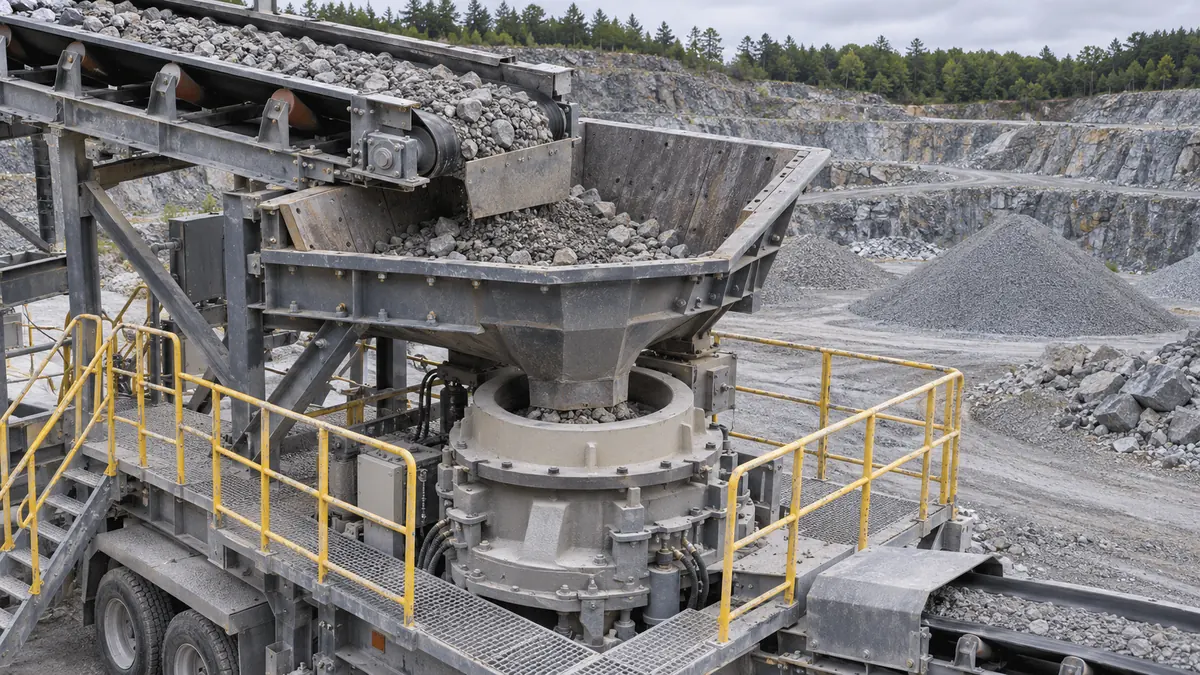
Sandvik's common feed problems guidance distinguishes misalignment from segregation. Material may land predominantly on one side, while coarse and fine particles can also separate during conveying and directional transfers. It identifies several possible interventions, including distribution devices and revised chutes or feed boxes. These are alternatives to assess, not universal interchangeable fixes.
- Request a plan and elevation showing the complete route from the last belt or feeder to the cone inlet, including support and access envelopes.
- Ask the bidder to explain what problem its proposal corrects: landing position, separation by particle size, changing supply, or more than one of these.
- Have fresh feed and the screen-return route identified separately on the drawing. Request evidence for their representative combinations rather than assuming that a combined average grading describes every inlet location.
- For a powered device, request its drive, control and failure-response scope. For a passive device, request its wear surfaces, adjustment and inspection provisions. Neither label proves an acceptable result.
- Require compatibility with the exact cone inlet and manufacturer instructions. Do not transfer another design's splitter orientation, dimensions or clearances.
An accessory is unsuitable as the sole answer to persistent supply shortage, unacceptable oversize, an unsuitable chamber or unresolved sticky-material build-up. Clarify the underlying feed problem before comparing accessory prices. A simple correction is also unsuitable when it cannot meet the required distribution through the agreed operating range.
Accept the layout across defined operating states
Agree what evidence will establish distribution under the project's relevant conditions before the order is released. Do not substitute an arbitrary universal tolerance or a brief demonstration with convenient material.
| Acceptance item | Record to agree with the supplier |
|---|---|
| Machine and material basis | Exact cone/chamber, feed size distribution, moisture/clay, target product and feed range |
| Representative states | Normal operation and relevant changes in rate, feed source and return flow; identify excluded conditions |
| Observation method | Supplier-approved remote observation and safe sampling plan where appropriate; locations and responsibilities |
| Distribution criterion | Documented method for judging landing position and coarse/fine distribution; no invented universal percentage |
| Supporting records | Time-aligned feed/level and product observations; liner-condition records where available, with their limitations |
| Installation and ownership | Headroom, support loads, removal space, wear parts, guards and controls if applicable; named supply boundaries |
| Commercial release | Included equipment, installation and acceptance support; exclusions and agreed action if evidence is insufficient |
These are proposed procurement checks, not a machine operating procedure. Inspection and sampling must follow the supplier's instructions and the site's approved arrangements; do not approach an operating inlet or remove guards to obtain evidence. Request drawings and existing records first.
For broader bid normalization, the cone quotation checklist covers the rest of the circuit and commercial scope. Here the narrower release condition is that the feed arrangement has an agreed basis for acceptance, including who supplies and verifies each interface.
Illustrative bid comparison, not a customer project
Suppose Bid A offers a revised feed box and shows a steady hopper-level trend. Bid B offers a powered distributor but provides no transfer drawing or defined return-feed condition. Neither description yet settles the decision: A has not established spatial distribution, and B has not established installed fit or the duty covered by its claim.
Ask both bidders for the same layout and operating-state evidence. A passive arrangement that satisfies that basis remains a candidate. If it does not, compare a suitable dedicated device on the same basis. There is no assumed capacity, price, wear-life improvement or payback in this example.
Frequently asked questions
Resolve these points when reviewing the cone feed package.
Does every cone crusher need a powered feed distributor?
No universal requirement follows from the equipment name alone. Compare the exact cone requirements and transfer arrangement. A passive correction remains a candidate when supported by evidence for the agreed duty; confirm any manufacturer requirement for a particular device.
Does choke feeding prove that material is evenly distributed?
No. A maintained level and even distribution are separate acceptance questions. Ask how the proposal avoids both uneven landing and coarse/fine segregation, rather than relying only on a level indication.
Can belt alignment alone solve feed segregation?
Alignment can address where material lands, but it does not by itself demonstrate that coarse and fine particles remain mixed. Review the transfer path and distribution evidence before accepting alignment as the complete correction.
Should recirculated material be included in the review?
Yes, where the screen-return stream enters the cone feed. Identify its route and representative operating combinations with fresh feed so the accepted arrangement covers the actual circuit.
What should a distributor quotation include besides the device?
Request the transfer drawing, compatibility basis, support and headroom, wear parts, access and removal provision, guards and applicable controls. State who supplies installation and acceptance support, including exclusions.
Does MVSI confirm a feed distributor on its mobile cone page?
The linked page establishes the mobile cone product family, not a particular current distributor or retrofit option. Request written confirmation of the exact proposed feed package, interfaces and acceptance scope.
Choose the arrangement against a documented duty
Retain a corrected transfer when its evidence satisfies the agreed distribution basis. Specify a dedicated device when the unresolved problem or exact cone requirement justifies it, and confirm the complete installed scope before ordering.
Send MVSI your project information: raw material, maximum and typical feed size, output size, capacity in t/h, project country, site photos and budget range. Include the cone/chamber identity, feed grading and moisture, conveyor plan and elevation, available headroom, return-feed route and representative operating records. Use the listed WhatsApp or email route to request a written feed-package review.
Sources and technical references
These sources support general feed principles and the product-family context. The acceptance schedule and hypothetical comparison are editorial buyer tools; no performance improvement or accessory availability is guaranteed.
- MVSI Mobile Secondary Crushing Plant: relevant cone family; exact feed-package scope needs confirmation.
- Sandvik, Common feed arrangement problems: segregation, misalignment and possible transfer corrections.
- Sandvik, Optimal feed arrangement: non-segregated choke feeding and distribution provisions.
- Metso, Crushers: stable feeding and distribution as distinct cone-crushing considerations.