Table of Contents
- Which rating should a production quotation identify?
- Why is a standby-labelled offer difficult to compare?
- How should buyers document hours and average load?
- Does the right duty rating prove the crusher will start?
- What belongs in a like-for-like package comparison?
- Frequently asked questions
- Can I use standby kVA as the production rating?
- Does prime power mean full rated output at all times?
- Is continuous power always the right choice for a quarry?
- Can I convert standby power to prime power with one percentage?
- Will a larger generator rating guarantee the crusher starts?
- What should I send before requesting a generator package?
- Approve the duty before comparing the price
- Sources and technical references
Can You Size a Crusher Generator by Standby kVA?
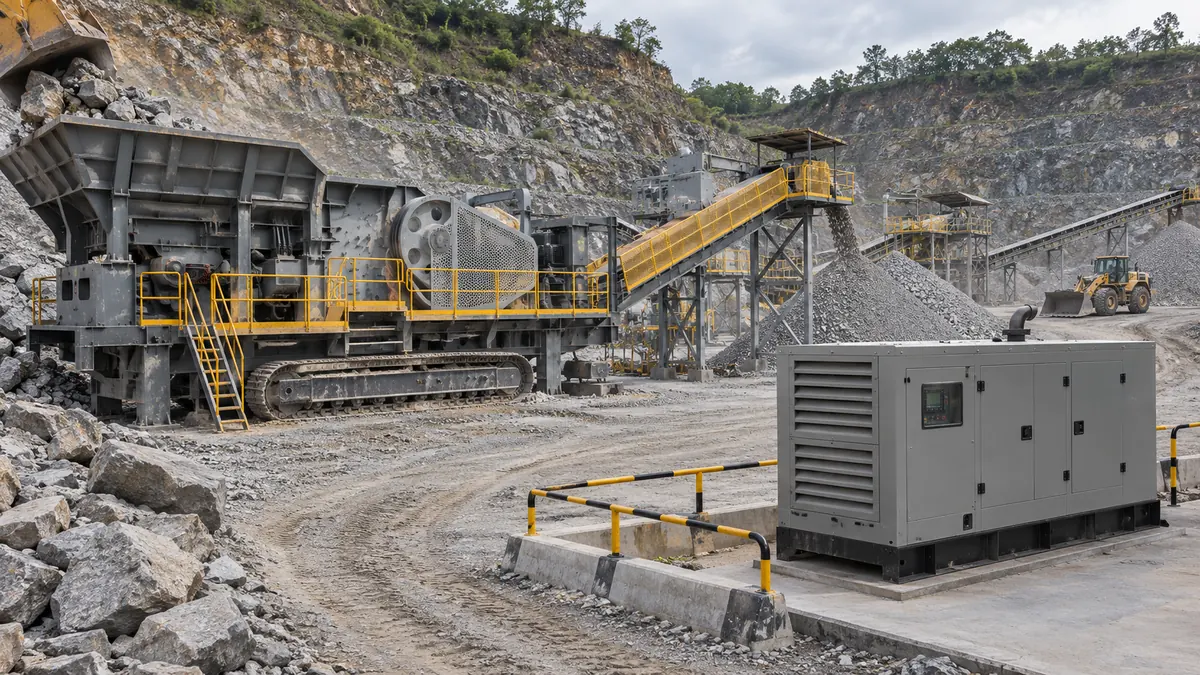
Do not size a generator for daily crusher production from its advertised standby rating in kilovolt-amperes (kVA) alone. First confirm that the exact crusher configuration accepts the proposed electrical supply, then require a generator rating matched to the operating hours and load profile. A larger standby number does not establish usable production power. Compare the applicable duty rating at the project site, its average-load conditions and the complete plant load schedule. Check motor starting separately. Keep the generator package provisional until the crusher supplier and generator supplier document both the intended running duty and startup acceptance.
By MVSI Company. Published 2026-11-23.
Which rating should a production quotation identify?
Require the rating class and its conditions alongside the quoted kilowatts (kW) and kVA. Daily production and occasional backup are different duties even when the enclosure and advertised headline power look similar.
| Rating in the Cummins overview | Load profile / annual hours | Purchase implication |
|---|---|---|
| Emergency standby power (ESP) | Variable / up to 200 hours | Do not price as unrestricted production power |
| Prime rated power (PRP) | Variable / unlimited hours | Check the actual model’s average-load and other conditions |
| Limited-time prime (LTP) | Constant / up to 500 hours | A limited-hours rating needs a matching operating plan |
| Continuous operating power (COP) | Constant / unlimited hours | Confirm the applicable constant-load duty and supported output |
This is the rating overview in Cummins’ generator selection presentation, pages 10–11. It is a comparison aid, not approval of a particular generator. Unlimited operating hours do not mean unlimited loading; obtain the manufacturer’s complete rating conditions and load-factor definition for the offered set.
The MVSI mobile primary jaw crusher family is the relevant equipment starting point for a primary crushing enquiry. Its public electricity/diesel description does not specify an external generator interface. Confirm the exact offered drive and supply arrangement before asking a generator supplier to size the package; the family name alone is insufficient.
Why is a standby-labelled offer difficult to compare?
A standby headline can conceal a different allowable operating duty from the one the quarry needs. Request the supported production rating rather than converting the advertised number with a fixed percentage.
Caterpillar’s rating explanation distinguishes application ratings and the capabilities of the complete generator set. An alternator designation or a sales label alone does not establish the engine, cooling and assembled-set duty. Ask each bidder to identify the model and the rating document that governs its offer.
Make the comparison record explicit: quoted duty class, usable electrical output, voltage, frequency, power factor, site basis and excluded loads. If a bidder supplies only a standby figure, leave its production-duty field unconfirmed. Do not label the offer equivalent to a documented prime or continuous proposal merely because the headline kVA is higher.
The broader diesel-versus-grid mobile crusher guide addresses which power route to purchase. This article addresses the narrower next decision: whether the generator quotation supports the production duty already proposed.
How should buyers document hours and average load?
Give bidders an operating schedule and ask them to state how it fits their rating conditions. Neither peak power nor average shift consumption alone describes the full purchase requirement.
Illustrative planning scenario, not a customer case: assume crushing is scheduled for 8 hours per day over 250 days. That is 2,000 operating hours per year before additional generator running is considered. The schedule is inconsistent with treating the 200-hour emergency-standby overview as an unrestricted production allowance. It does not, by itself, determine a suitable generator size or prove that any prime-rated model is adequate.
- Separate planned production, startup, waiting with auxiliaries running and backup use; identify which periods count under the offered rating.
- Request the expected load over time, not just installed motor totals. Identify which machines and site services share the generator.
- Ask the generator supplier to show its applicable averaging period, allowed average load, permitted peaks and treatment of stopped time.
- Have the supplier state usable output for the project altitude, ambient conditions and proposed enclosure arrangement, with assumptions listed.
- Record the required service regime and who provides it. A longer maintenance interval or unrestricted operating allowance must not be assumed from the rating name.
Use a project schedule that can be revised as the line is defined. If the supplier cannot reconcile the intended hours and load profile with the model’s rating document, keep that offer outside the final price comparison until the exception is resolved.
Does the right duty rating prove the crusher will start?
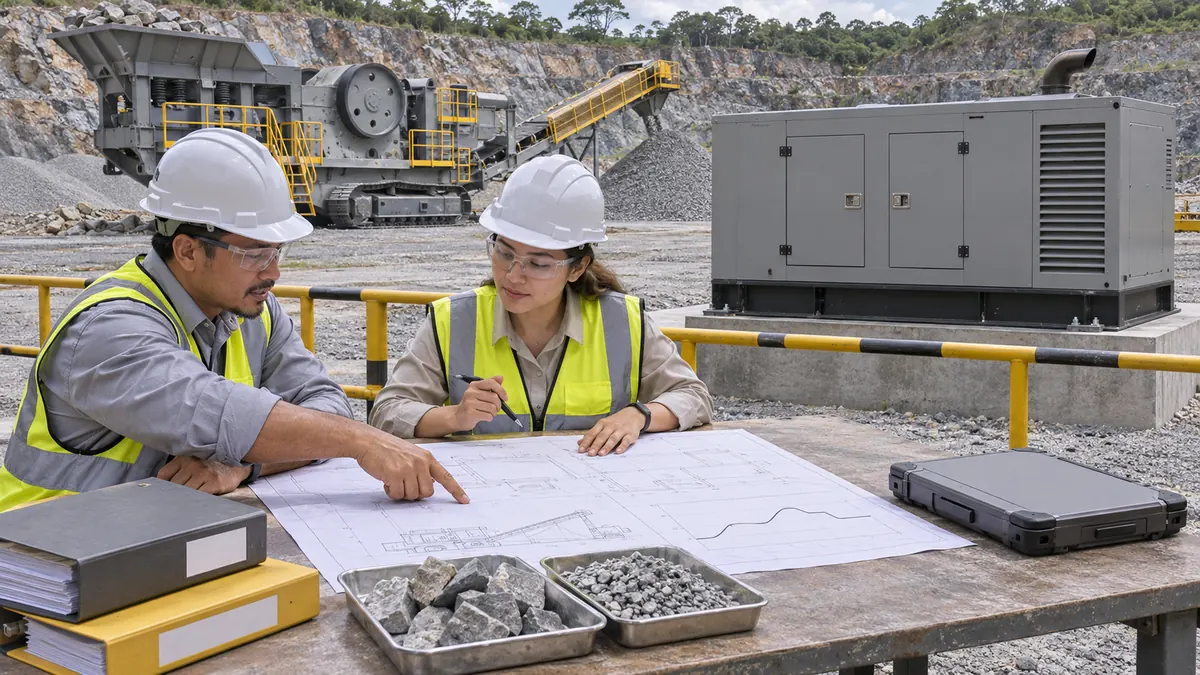
No. Annual-duty eligibility and motor-starting capability require separate evidence. A generator can have a suitable operating-hours classification while still needing a different configuration for the actual load steps.
Cummins’ motor-starting white paper explains that starting performance involves the alternator, regulator, engine, motor and driven load together. Review voltage and frequency recovery through acceleration, with other running equipment included. A continuous or prime label does not replace that application review.
Ask for the crusher and auxiliary motor list, starting methods, approved sequence and permitted supply disturbances from the equipment documentation. Record the response to an interruption with material in the line. A no-load run cannot establish all of those loaded conditions; agree a project acceptance plan with the responsible suppliers and electrical designer.
This is a purchase-scope checklist. It does not provide cable sizing, protection settings, wiring instructions or permission to restart loaded equipment.
What belongs in a like-for-like package comparison?
Compare complete documented offers on the same operating and responsibility boundary. A lower generator price is not meaningful if its accepted production duty or necessary integration remains undefined.
| Quotation item | Evidence or allocation to request |
|---|---|
| Crusher supply compatibility | Exact machine, supported supply mode and approved electrical requirements |
| Generator production duty | Model, applicable rating document, operating hours and load-profile review |
| At-site usable output | kW and kVA on the stated voltage, frequency, power-factor and site basis |
| Startup and recovery | Load steps, existing loads, acceptance criteria and supporting application review |
| Integration scope | Responsibility for distribution, cables, protection, installation and commissioning |
| Operating support | Fuel/service scope, documentation, exclusions and unresolved assumptions |
A suitable candidate has a documented supply interface, a supported running-duty assessment and a separate startup review. An offer is incomplete when it substitutes an alternator label, brochure kVA or unloaded demonstration for one of those records. If the generator is only backup, assess that actual backup schedule rather than assuming a daily-production duty class is necessary.
Include missing power-package and installation items in the mobile plant operating-cost comparison. For the wider machine purchase, the hard-rock jaw quotation guide helps define the material, production and commercial scope. No generator price, fuel saving or cost-per-ton outcome is implied here.
Frequently asked questions
These answers concern accepting a generator package for a crusher duty; exact model documentation remains necessary.
Can I use standby kVA as the production rating?
Only if the generator supplier explicitly documents that the applicable rating and its conditions cover the intended duty. A standby headline alone is insufficient for planned daily production.
Does prime power mean full rated output at all times?
No. Obtain the offered model’s average-load, peak-load, site and service conditions. An unlimited-hours description does not remove its loading restrictions.
Is continuous power always the right choice for a quarry?
No. Select the rating from the actual load profile and operating schedule. Ask the supplier to justify the applicable duty rather than choosing a label because it sounds stronger.
Can I convert standby power to prime power with one percentage?
Do not use a universal conversion to approve a purchase. Request the complete set’s documented rating for the proposed duty and site conditions.
Will a larger generator rating guarantee the crusher starts?
No. Require an application review for the actual motor starting method, load sequence, other running loads and acceptable recovery. Running-duty documentation and starting evidence answer different questions.
What should I send before requesting a generator package?
Provide the exact crusher supply requirements, complete load list, operating schedule, starting methods and sequence, project altitude and temperature range. Add the material and production requirements so the plant duty is defined.
Approve the duty before comparing the price
Keep offers that support the actual operating schedule and load profile, then compare their complete integration scope and startup evidence. Hold an offer with only standby kVA until its usable production rating is documented. Do not select a generator size from the crusher’s product family or a universal multiplier.
For a matched equipment enquiry, contact MVSI through its listed WhatsApp or email route. Send raw material, maximum and typical feed size, output size, capacity in t/h, project country, site photos and budget range. Add the proposed electrical supply mode, full motor list, starting methods, daily and annual operating hours, load profile, altitude and ambient temperature range, plus any generator quotation already received.
Sources and technical references
Retrieved 2026-11-23. Generator OEM documents explain general selection boundaries; they do not establish an offered MVSI generator package or model-specific electrical compatibility.
- MVSI Mobile Primary Jaw Crusher, linked above: relevant mobile primary crushing family and public drive-description scope.
- Cummins Considerations for Generator Set Selection, linked above, pages 10–11: rating classes, load profiles and annual-hours overview.
- Caterpillar Demystifying Generator Set Ratings, linked above: application ratings and complete-set capability distinctions.
- Cummins Specifying & Validating Motor Starting Capability, linked above: system-level startup and recovery assessment.