Table of Contents
- Quick decision facts for turning or replacement
- What should be measured before deciding?
- When is turning a suitable option?
- Does lower output prove that the plates need replacement?
- What must a turn-or-replace quotation include?
- An illustrative decision before placing the order
- Frequently asked questions
- How many operating hours should jaw plates last?
- Can every mobile jaw crusher plate be turned end for end?
- Can the fixed and moving jaw plates be swapped?
- Is tooth height the same as remaining plate thickness?
- Does reduced production mean new jaw plates are required?
- What should be sent with a replacement-plate inquiry?
- Choose the action supported by the exact plate record
- Sources and technical references
When Should You Turn or Replace Mobile Jaw Crusher Plates?
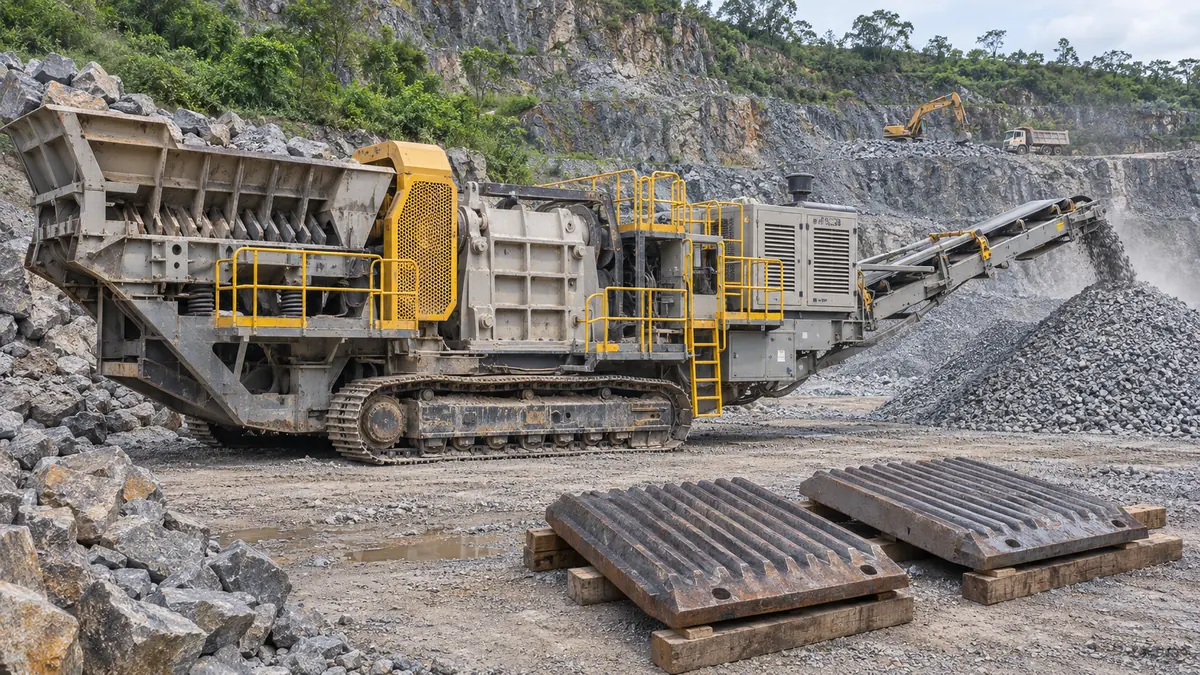
Turn a mobile jaw crusher’s plates only when the exact design permits end-for-end rotation and inspection confirms useful profile remains within the manufacturer’s limits. Order replacement plates when those limits are reached, the approved turning sequence is exhausted, or damage prevents acceptable service. Operating hours and a worn-looking tooth alone cannot settle the decision. Record each plate’s identity, position, wear profile and previous turns, then compare that record with the correct manual. Before buying parts, confirm the complete fixed-and-moving plate arrangement, retention hardware and lifting provisions for the actual crusher.
By MVSI Company. Published 2026-11-12.
Quick decision facts for turning or replacement
Turning is an option for an approved plate arrangement with remaining usable wear material. Replacement becomes the purchasing decision when the documented limits or condition exclude further service.
| Decision fact | Evidence to obtain | Buying implication |
|---|---|---|
| Plate identity | Crusher serial/model, fixed or moving position, part number and drawing revision | A similar-looking plate is not a confirmed replacement |
| Construction | One-piece or split design, installed orientation and retention arrangement | Do not assume the same turning sequence for different constructions |
| Measured condition | Tooth relief and wear distribution; remaining plate thickness where the manual specifies it | Tooth height and body thickness answer different questions |
| Turning eligibility | Written permitted sequence, previous turns and inspection against the correct limits | Useful teeth at one end do not alone authorize turning |
| Supply boundary | Exact plates, required hardware, approved handling provisions and installation responsibility | Compare a complete intervention rather than two loose casting prices |
What should be measured before deciding?
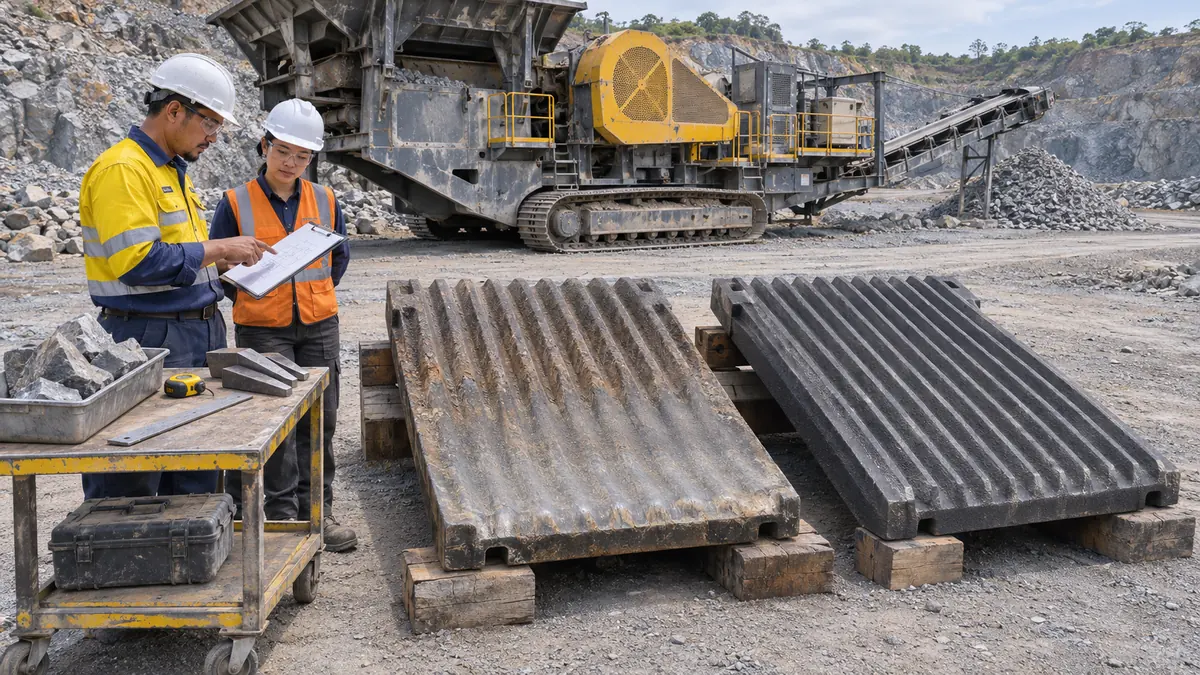
Use a repeatable wear record tied to the exact plate and its installed position. A photograph without orientation or a measurement definition is insufficient to decide whether the plate can be turned.
Distinguish the height between tooth peaks and valleys from the plate’s remaining thickness. Record the locations required by the manufacturer and compare them with the new-part drawing or approved reference. Preserve the units, measurement method and date; do not compare a tooth-height percentage with a body-thickness limit.
McLanahan’s jaw-crusher support guidance describes variable die life and the need to act before the tooth peak wears down to the valley. It does not provide a universal operating-hour replacement interval. Use this as a reason to inspect condition, not as an MVSI model-specific rejection dimension.
Record the upper and lower wear pattern on both the fixed and moving sides, previous turn dates, processed tonnage where known, and the material campaign. Keep the discharge-setting record with these observations. For the wider line inspection, use the daily crusher-plant maintenance checklist; the exact machine manual still controls the plate limits and procedure.
When is turning a suitable option?
Consider turning only after the manufacturer has confirmed that the actual plate design and current condition permit it. End-for-end turning, moving split sections and swapping fixed and moving positions are different actions.
The Metso C-Series wear-parts application guide, printed pages 10 and 12–14, distinguishes one-piece and two-piece arrangements, retention-dependent wear limits and specific handling tools. Its examples show why a turning rule belongs to a defined design. Do not transfer its percentages, thicknesses or turning sequence to another crusher.
Turning is unsuitable as a purchasing shortcut when the part identity, approved orientation or previous-turn history is unknown, or the inspection does not establish compliance with the correct limits. Damage or an unacceptable seating or retention condition requires assessment before further service; retaining visible teeth is not sufficient clearance.
Terex MPS’s jaw-resource page distinguishes fixed and swing dies and identifies a heavy-duty profile for the fixed side only. That is a concrete reason to avoid assuming interchangeability. A reversible part is not automatically suitable for every position or tooth-profile pairing.
Plan the work with the machine-specific isolation and approved handling procedure and competent personnel. This article defines the decision and order record; it does not prescribe a lifting method, fastening torque or maintenance sequence.
Does lower output prove that the plates need replacement?
Lower output warrants investigation, but does not by itself prove that the wear limit has been reached. Compare the wear record with feed, settings and interruptions before attributing a production change to the plates.
Metso’s jaw-performance guidance identifies bridging, profile choice and jaw condition as separate influences on production. Its model-specific percentage and revenue examples are not forecasts for this decision. Record comparable material, feed presentation, closed-side setting (CSS), interruptions and output rather than treating one low-output shift as a wear-life test.
CSS is the discharge gap at the closest part of the crushing stroke; it is a setting, not a measurement of remaining plate thickness. Record it using the method prescribed for the actual tooth arrangement. A smaller setting cannot establish that a worn plate remains acceptable.
If the immediate problem is repeated oversize or slab bridging, assess feed preparation with the larger-jaw versus rock-breaker decision guide. Ordering new plates without identifying the changed feed leaves that different problem unresolved.
What must a turn-or-replace quotation include?
Request a written scope for the exact inspection finding and crusher identity. A plate quotation is incomplete when it omits the required retention parts, approved handling provisions or the basis for confirming fit.
| Order or service item | Record to request |
|---|---|
| Identity and arrangement | Crusher serial/model, fixed and moving part numbers, drawing revision, one/split construction and installed positions |
| Condition and decision | Dated wear measurements/photos with scale and orientation, prior turns, applicable manual limits and the proposed action |
| New parts if needed | Plate quantities and matching profiles, material specification, dimensional/identity evidence and written fit confirmation |
| Associated items | Inspection/reuse or replacement criteria for wedges, fasteners, cheek plates and seating-related items as applicable |
| Work and handling scope | Who inspects, isolates, installs and verifies the work; correct part-handling provisions and access requirements |
| Commercial boundary | Included/excluded hardware, freight, site labour, confirmed availability and delivery terms; identify assumptions |
For a new-machine purchase, use the MVSI mobile primary jaw crusher family as the relevant product route and ask for the proposed wear-part and maintenance package in writing. The public page establishes a mobile-jaw offering; it does not confirm a particular reversible plate, replacement dimension, spare-stock level, service response or third-party-machine compatibility.
Keep that record with the machine proposal. The hard-rock jaw quotation guide explains how to align the wider supply boundary. For an existing crusher, obtain the serial-specific parts reference before comparing an aftermarket proposal or assuming a new casting matches the worn sample.
An illustrative decision before placing the order
Compare documented eligibility before comparing the intervention price. The following is a hypothetical review, not a customer case, measured trial or statement of MVSI spare-part availability.
A quarry has a lower-end wear pattern and retained teeth at the upper end. One proposal offers to turn the existing plate; another quotes a new plate. If the first proposal includes the correct part identity, permitted sequence and measurements within the applicable limits, turning can remain a candidate. If it relies only on a photograph and a percentage borrowed from another model, it has not established eligibility. The new-part offer also needs exact fit and associated-hardware confirmation before approval.
Compare the complete planned intervention, including inspection, installation, associated parts and the outage. Do not assume that turning doubles life, that new plates restore a specific output, or that the cheaper casting gives the lower total cost. Establish what evidence is missing before releasing either order.
Frequently asked questions
Use these answers to prepare a model-specific review. They do not replace the actual plate drawing, limits or maintenance instructions.
How many operating hours should jaw plates last?
There is no universal interval. Material and operating conditions affect wear. Use the correct manufacturer limits and a traceable condition record; operating hours and processed tonnes help interpret that record but do not replace it.
Can every mobile jaw crusher plate be turned end for end?
No. The exact plate construction, orientation, retention arrangement and condition must permit it. Obtain the model-specific approved sequence and check previous turns before planning the work.
Can the fixed and moving jaw plates be swapped?
Do not assume so. Fixed and moving profiles can differ, and some designs are position-specific. Confirm the exact part numbers and approved arrangement with the responsible manufacturer.
Is tooth height the same as remaining plate thickness?
No. Tooth relief describes the peak-to-valley profile, while remaining plate thickness concerns a different dimension. Apply each measurement and limit only as defined for the exact plate design.
Does reduced production mean new jaw plates are required?
Not by itself. Review wear together with feed changes, bridging, settings and interruptions. A new-part decision requires the condition and fit evidence; one lower-output shift is not proof of the wear limit.
What should be sent with a replacement-plate inquiry?
Send the crusher serial/model, fixed and moving part identities, drawings, oriented wear photos with scale, measurements and previous-turn history. Include the material duty and ask for fit confirmation, required hardware and the complete work and delivery scope.
Choose the action supported by the exact plate record
Retain turning as an option only when its eligibility is documented. Buy replacement plates when the approved condition or sequence requires them, and settle identity, fit and associated scope before ordering. Neither a generic wear percentage nor the remaining appearance of one end is an adequate decision record.
For a mobile-jaw purchase or wear-scope review, contact MVSI through its listed WhatsApp or email route. Send raw material, maximum and typical feed size, required output size, capacity in t/h, project country, site photos and budget range. Add crusher serial/model, plate part numbers and drawings, fixed/moving positions, dated wear measurements/photos, previous-turn history and the required shutdown window. Mark missing information so the proposal states what still needs verification.
Sources and technical references
Retrieved 2026-11-12. These sources support family identification and general design distinctions; other OEM guidance does not establish MVSI wear limits, part compatibility or service commitments.
- MVSI Mobile Primary Jaw Crusher, linked above: public mobile-jaw product family; exact wear-part package requires confirmation.
- McLanahan Jaw Crushers Support, linked above: variable wear life, tooth condition and operating records.
- Metso Nordberg C-Series jaw-crusher wear-parts application guide, printed pages 10 and 12–14, linked above: construction, retention, turning and handling distinctions specific to that range.
- Terex MPS Jaw Crusher Resources, linked above: fixed/swing identity, retention wedges and position-specific profiles.
- Metso How to improve jaw crusher performance and productivity, linked above: feed, profile and condition as separate production influences.