Table of Contents
- Why Mobile Crusher Plants Are Practical in the Philippines
- Common Materials: Basalt and River Stone
- Recommended Mobile Crusher Plant Configurations
- Configuration 1: Mobile Jaw Crusher + Mobile Cone Crusher + Mobile Screen
- Configuration 2: Mobile Jaw Crusher + Mobile Cone Crusher + Mobile VSI + Screen
- Configuration 3: Mobile Jaw Crusher + Mobile Screen for Smaller Contract Work
- Capacity Planning for Philippines Projects
- Output Sizes and Product Quality
- Track-Mounted or Tire-Mounted?
- Cost Factors Buyers Should Compare
- Common Buyer Mistakes
- What to Send Before Asking for a Quote
- Conclusion
- FAQ
- What is the best mobile crusher plant for basalt in the Philippines?
- Is river stone better crushed by cone crusher or impact crusher?
- What capacity mobile crusher plant should I choose?
- Do I need a mobile screen plant after the crusher?
- Is a mobile VSI necessary for basalt and river stone?
- Track-mounted or tire-mounted mobile crusher: which is better in the Philippines?
- How much does a mobile crusher plant in the Philippines cost?
- What information should I provide before asking for a quotation?
Mobile Crusher Plant in the Philippines: Equipment for Basalt and River Stone
A mobile crusher plant in the Philippines should be chosen according to the rock type, maximum feed size, target aggregate sizes, required tons per hour, site access, transport limits, and whether the project moves between islands or road jobs. For basalt, a mobile jaw crusher plus mobile cone crusher plus mobile screen is usually the safer configuration because the rock is hard and abrasive. For river stone, jaw plus cone is also common, while a mobile VSI can be added when the buyer needs better particle shape or manufactured sand. The best choice is the mobile plant that matches the local material, output demand, and operating conditions instead of the cheapest chassis on paper.
Why Mobile Crusher Plants Are Practical in the Philippines
The Philippines has strong demand for aggregate for roads, bridges, concrete batching plants, ports, housing, and industrial construction. Many projects are in mountain areas, coastal zones, river sites, or islands where transport and installation are more difficult than in a fixed inland quarry. That is why many buyers look at mobile crushing first.
A mobile plant can reduce foundation work, shorten installation time, and move more easily when the quarry face changes or when one contract ends and another begins. For contractors, the real question is not only machine price, but whether the plant can be shipped, set up, and kept running with the available loaders, trucks, power, and operators.
If you are still comparing general plant planning, see our mobile crushing plant buying guide and our article on 200 TPH mobile crusher plant for road construction aggregates.
Common Materials: Basalt and River Stone
Basalt and river stone are two common materials in Philippines aggregate projects, but they do not behave exactly the same inside the plant.
- Basalt is hard, abrasive, and often selected for high-strength road base, asphalt aggregate, and concrete aggregate.
- River stone is rounded, dense, and also abrasive, so it often needs stable compression crushing after primary reduction.
- Both materials can create high wear if the wrong crusher type or chamber is selected.
- Both materials may require shaping when the buyer wants better cubical aggregate or 0-5 mm manufactured sand.
For this reason, a mobile impact crusher is not usually the first choice for long-term basalt or river stone production. It may work in some cases, but wear cost can climb quickly. A mobile jaw crusher for primary crushing and a mobile cone crusher for secondary crushing are usually more practical for these harder materials.
Recommended Mobile Crusher Plant Configurations
Configuration 1: Mobile Jaw Crusher + Mobile Cone Crusher + Mobile Screen
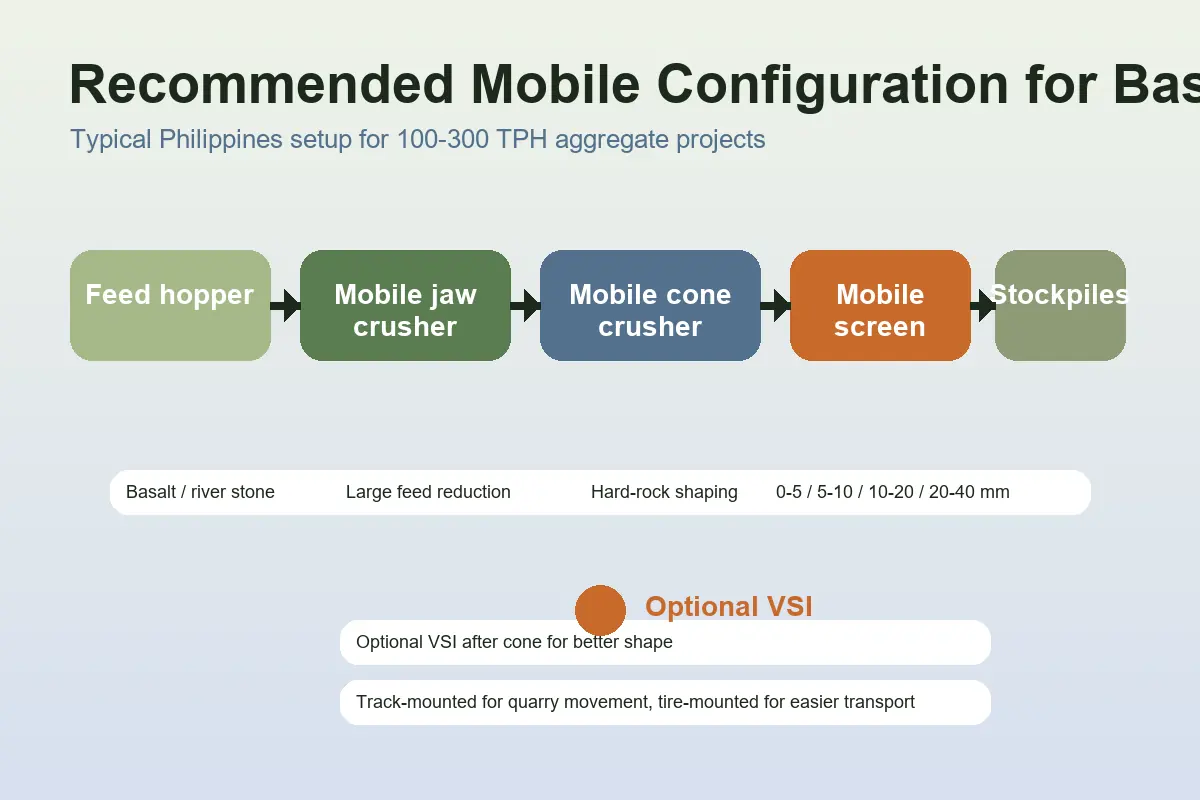
This is the most common configuration for basalt and river stone. The mobile jaw crusher handles large feed, the mobile cone crusher reduces the material to final aggregate range, and the mobile screen separates several sellable products such as 0-5 mm, 5-10 mm, 10-20 mm, and 20-40 mm.
This setup is a strong choice for commercial quarries, road contractors, and concrete aggregate suppliers that need reliable hard-rock production and reasonable wear control.
Configuration 2: Mobile Jaw Crusher + Mobile Cone Crusher + Mobile VSI + Screen
When the buyer needs higher shape quality, more cubical chips, or manufactured sand, a mobile VSI can be added after cone crushing. This is more suitable for projects supplying asphalt plants, higher-spec concrete aggregate, or manufactured sand.
If you need more detail on shaping, read how to improve cubical shape in manufactured sand with a VSI crusher and is a mobile VSI crusher better than a stationary sand making plant.
Configuration 3: Mobile Jaw Crusher + Mobile Screen for Smaller Contract Work
For smaller temporary projects where the goal is simple size reduction rather than several premium aggregate products, a mobile jaw crusher plus screen may be enough at the beginning. However, this is usually less flexible if the buyer later needs stricter final sizes or better shape.
Capacity Planning for Philippines Projects
Capacity should be based on real market demand, working hours, stockpile space, and transport plan rather than only nameplate capacity. Many buyers ask for 100 TPH or 200 TPH, but the practical answer depends on how many finished sizes are needed and how difficult the material is.
| Capacity Range | Typical Use in the Philippines | Common Mobile Setup |
|---|---|---|
| 50-100 TPH | small contractor job, local road base, island project | mobile jaw crusher with screen or small cone |
| 100-200 TPH | commercial aggregate supply, municipal road work, batching plant support | mobile jaw + cone + screen |
| 200-300 TPH | larger quarry, long-term road contract, infrastructure supply | heavy mobile jaw + cone + multi-deck screen |
| 300+ TPH | major quarry or multiple-customer aggregate business | staged mobile train with optional VSI and extra screen |
For a buyer serving a batching plant or road contractor, 100-200 TPH is often the practical range. For a quarry supplying several customers continuously, 200 TPH or more may be more suitable if feed, trucks, and stockpile area can support it.
Output Sizes and Product Quality
Common finished products for Philippines projects include:
- 0-5 mm manufactured sand or fines
- 5-10 mm chips
- 10-20 mm concrete aggregate
- 20-40 mm road base and drainage aggregate
If the project needs better shape for asphalt or concrete, compression crushing alone may not be enough. In that case, a mobile VSI or an additional shaping stage can improve cubical output. If the buyer mainly sells sub-base or general road stone, jaw plus cone plus screen may already be sufficient.
Track-Mounted or Tire-Mounted?
The best chassis type depends on where the plant will move.
Track-mounted mobile crushers are usually better when the machine needs to move inside rough quarry ground, along the working face, or across uneven mining areas. Tire-mounted plants are often easier for road transport between contractor sites if local transport conditions allow them.
| Factor | Track-Mounted | Tire-Mounted |
|---|---|---|
| Quarry movement | Strong | Moderate |
| Inter-site transport | Usually trailer-based | Often easier by road |
| Uneven terrain | Better | Depends on road condition |
| Typical use | Quarry, mining, hard-rock projects | Contractors, temporary road jobs |
The choice should be based on relocation frequency, island shipping arrangement, road permits, and whether the plant will mostly move inside one site or between several sites.
Cost Factors Buyers Should Compare
The cost of a mobile crusher plant in the Philippines includes much more than the main crusher price. Buyers should compare the complete delivered solution.
- Rock hardness and abrasiveness
- Capacity in tons per hour
- Number of final products
- Chassis type and mobility level
- Crusher, screen, and conveyor size
- Diesel, electric, or hybrid power arrangement
- Spare parts package
- Shipping, inland transport, and lifting plan
- Installation guidance and operator training
Two quotes may show similar crusher models, but one may include screen, return conveyor, control cabinet, walkways, and spare parts while the other does not. Compare scope line by line before deciding.
Common Buyer Mistakes
One common mistake is asking for a “mobile crusher Philippines price” without giving the material, feed size, or output requirement. That leads to rough quotations that often change after technical review.
Another mistake is choosing impact crushing for abrasive basalt or river stone without checking wear cost. Buyers also underestimate transport width, machine weight, road access, and stockpile space. In island projects, loading and unloading logistics can change the chassis choice and module quantity.
What to Send Before Asking for a Quote
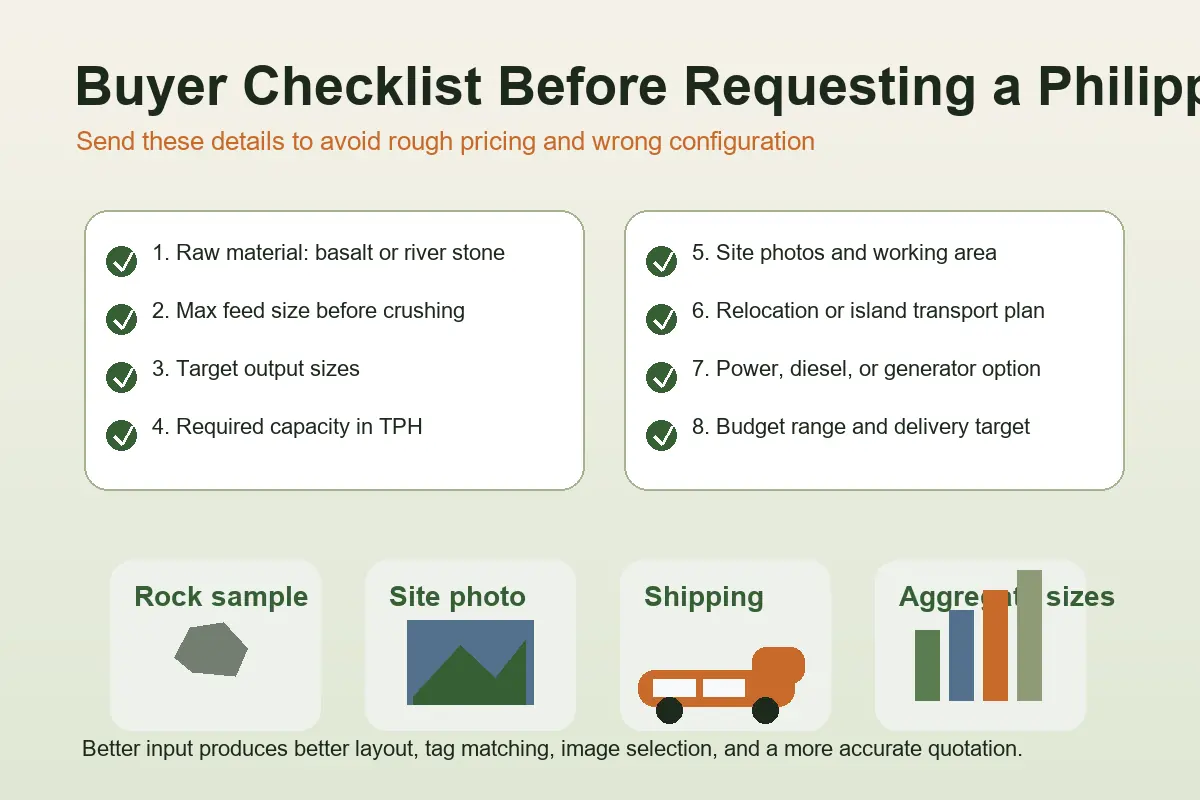
To get a useful mobile crusher plant quotation for the Philippines, prepare:
- Raw material name, such as basalt or river stone.
- Maximum feed size before crushing.
- Required output size range, such as 0-5 mm, 5-10 mm, 10-20 mm, or 20-40 mm.
- Required capacity in tons per hour.
- Site photos and available working area.
- Whether the plant should move inside the site or between different projects.
- Power condition, diesel plan, or generator arrangement.
- Budget range and target delivery time.
These details allow MVSI to recommend a more accurate jaw, cone, screen, and optional VSI combination for the project.
Conclusion
For basalt and river stone projects in the Philippines, the most practical mobile crusher plant is usually a mobile jaw crusher plus mobile cone crusher plus mobile screen, with a mobile VSI added when better particle shape or manufactured sand is required. The final selection should be based on material hardness, feed size, output size, capacity, site mobility, and transport conditions rather than headline price alone.
If you are planning a mobile crusher plant in the Philippines, send us your raw material, feed size, output size, capacity, site photos, and budget range. MVSI can review the application and recommend a practical mobile crushing solution for quarry, road, and concrete aggregate work.
FAQ
What is the best mobile crusher plant for basalt in the Philippines?
For basalt, a mobile jaw crusher plus mobile cone crusher plus mobile screen is usually the safest starting point because basalt is hard and abrasive. A mobile VSI can be added if the buyer needs better particle shape or sand.
Is river stone better crushed by cone crusher or impact crusher?
River stone is commonly processed with jaw plus cone crushing because the material is dense and abrasive. Impact crushing may give shape benefits, but wear cost is often less favorable for long-term river stone production.
What capacity mobile crusher plant should I choose?
Choose capacity according to your saleable output demand, feed size, working hours, and number of final products. Many contractors start around 100-200 TPH, while larger quarry operations may need 200 TPH or more.
Do I need a mobile screen plant after the crusher?
Yes, in most cases. A mobile screen plant is needed to separate finished products accurately and return oversize material for re-crushing when a closed circuit is required.
Is a mobile VSI necessary for basalt and river stone?
Not always. A mobile VSI is more useful when you need manufactured sand, better cubical aggregate, or stricter asphalt and concrete shape requirements.
Track-mounted or tire-mounted mobile crusher: which is better in the Philippines?
Track-mounted plants are usually better for rough quarry ground and movement inside the site. Tire-mounted plants can be practical when road transport between projects is the bigger priority.
How much does a mobile crusher plant in the Philippines cost?
The price depends on capacity, crusher configuration, screen size, chassis type, power arrangement, spare parts, shipping, and service scope. A complete quote should always list what is included beyond the main crusher.
What information should I provide before asking for a quotation?
Provide raw material, feed size, output size, capacity, site photos, transport conditions, power plan, and budget range so the supplier can prepare a more accurate configuration and price.