Table of Contents
- Information Gain: Start With an Acceptance Gate, Not the Crusher Brochure
- Define What the Mobile Impact Crusher Is Allowed to Receive
- Show the Full Material and Metal-Removal Route
- Verify Dust, Safety, Access, and Work-Area Boundaries
- Compare Quotations on One Responsibility Map
- Buyer Checklist Before Ordering
- Send a Concrete-Recycling Project Brief Before Requesting a Proposal
- Frequently Asked Questions
- Is a mobile impact crusher suitable for concrete recycling?
- Can reinforced concrete go directly into a mobile impact crusher?
- Do I need a magnet for concrete recycling?
- What information should I send for a mobile impact crusher quotation?
- Does a mobile impact crusher quotation include a screen and conveyors?
- How should recycled aggregate be specified?
- What dust-control items should be checked before buying?
- What should be agreed before commissioning a mobile recycling plant?
A mobile impact crusher can be a sensible concrete-recycling purchase when the incoming material is genuinely suitable for the proposed feed system, metal-removal arrangement, product specification, dust controls, maintenance access, and commercial scope. It should not be selected simply because a demolition project has concrete. Construction and demolition loads can also contain steel, wood, asphalt, gypsum, soil, plastics, or regulated materials, so the buyer must define what the plant may accept and what must be removed first. Before comparing offers, give every bidder the same material record, maximum feed size, target output sizes, capacity basis, site constraints, safety requirements, and acceptance method.
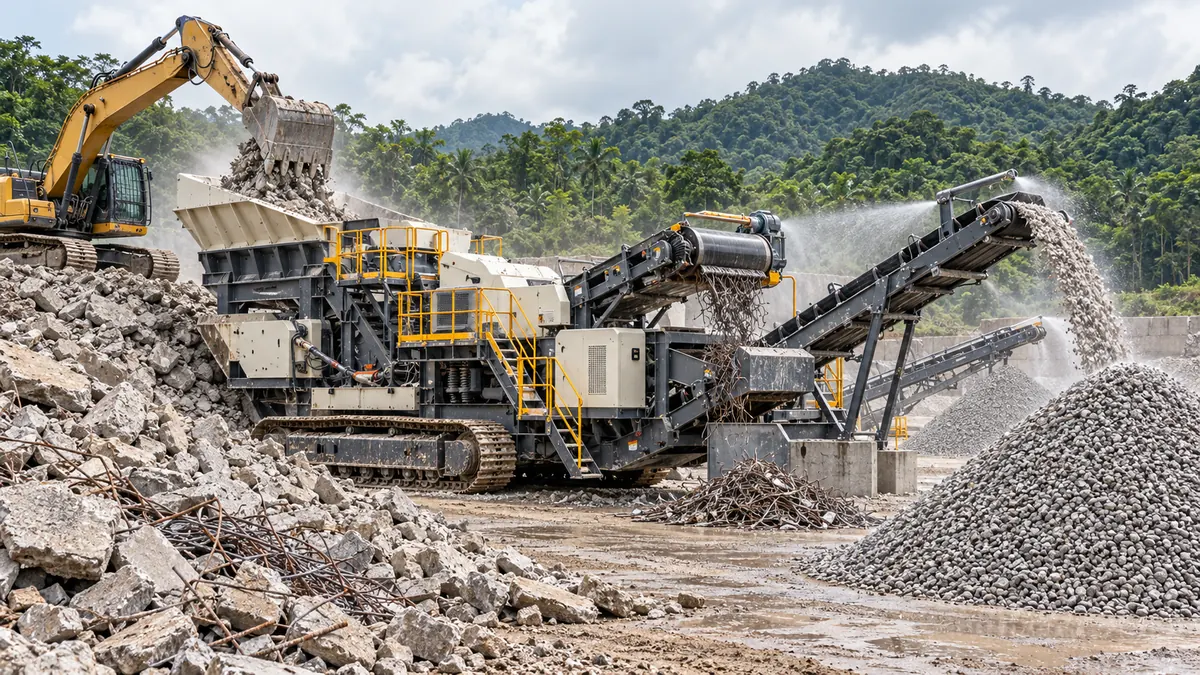
Information Gain: Start With an Acceptance Gate, Not the Crusher Brochure
Many mobile-impact-crusher pages begin with horsepower, transport dimensions, or a headline capacity. Those details do not tell a buyer whether the proposed unit can safely receive the actual demolition stream or whether the quoted package includes the work needed to turn it into a recycled product.
The decisive boundary is an acceptance gate. It names the material allowed into the hopper, the pre-sorting that occurs before feeding, the path for rebar and rejected material, the target aggregate products, and the site controls that make the operation workable. The mobile crushing and screening plant for concrete recycling guide explains the wider process; this page focuses on the buyer’s pre-order verification record.
Define What the Mobile Impact Crusher Is Allowed to Receive
A demolition load is not one material. The U.S. Environmental Protection Agency lists concrete, asphalt, metals, wood, gypsum, and other materials within construction and demolition streams, and its recycling guidance emphasizes segregation before processing. That context is useful because a supplier cannot responsibly evaluate a crusher duty from the phrase “demolition waste” alone.
Create a written feed-acceptance sheet before requesting a quotation. It does not need to invent laboratory results. It does need to state what is known, what is uncertain, and who controls the material before it reaches the hopper.
| Acceptance item | What the buyer should record | Why it changes the proposal |
|---|---|---|
| Concrete source | Building, bridge, road, precast, mixed yard stock, or another source; photos and sample identity | Helps distinguish a defined concrete stream from an unknown mixed load |
| Size and reinforcement | Typical and maximum piece size, slab thickness, rebar condition, mesh, and oversize-handling method | Determines feed preparation, excavator work, magnet duty, and safe reject handling |
| Contamination | Visible wood, plastics, soil, asphalt, gypsum, glass, coatings, or material requiring a separate evaluation | Identifies what must be segregated or excluded before crushing |
| Material moisture and fines | Wet weather exposure, mud, soil carryover, and fines content | Affects scalping, transfer behavior, dust-control planning, and product cleanliness |
| Product route | Required output sizes, intended use, stockpile separation, and any applicable local specification | Defines screen duty, recirculation, and the test method that a buyer will use |
| Operating basis | Target capacity, operating hours, loader or excavator availability, relocation frequency, and site photos | Keeps a brochure figure from becoming an unstated site commitment |
Do not use this table to decide whether any material is legally acceptable at a particular site. Local waste, environmental, product, and safety rules remain project-specific and should be checked with the responsible authorities and qualified local parties.
Show the Full Material and Metal-Removal Route
A mobile impact crusher is only one part of a concrete-recycling route. A workable proposal should show where material is inspected, where oversize is reduced or rejected, where ferrous metal is removed, how products are screened, and where each stream is placed. An overband magnet can be part of the arrangement, but the buyer should verify the complete metal-handling method, not assume that a single word in a quotation covers every rebar condition.
The mobile jaw crusher versus mobile impact crusher comparison is helpful when the starting material or primary-duty question is still open. Where an impact route is proposed, ask the bidder to trace the path in writing.
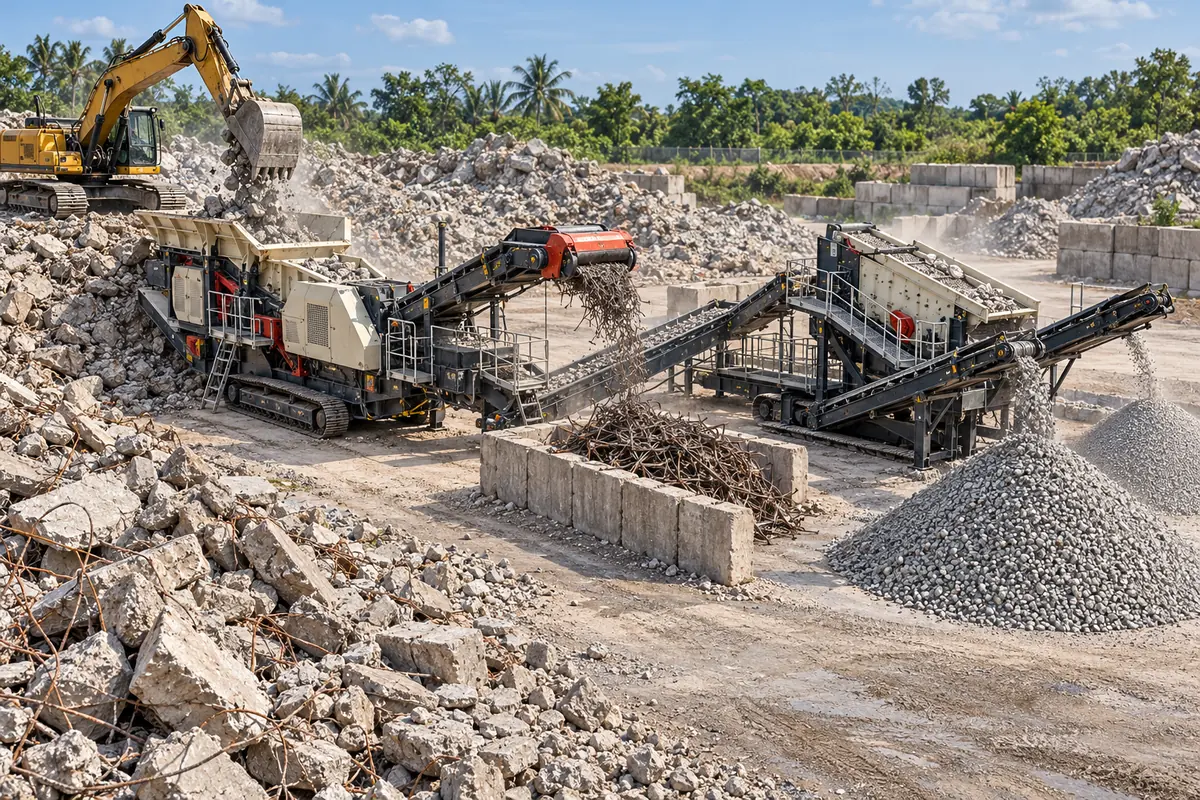
| Process boundary | Question to ask | Evidence to request |
|---|---|---|
| Pre-sorting | Which materials are allowed, removed, or routed elsewhere before feeding? | Feed-acceptance list, yard-process description, and stated exclusions |
| Hopper and feed | What maximum feed size, reinforcement condition, moisture, and operating method does the hopper assume? | Technical offer that repeats the submitted input record, not just a catalogue range |
| Metal removal | Where does ferrous metal leave the stream, how is it collected, and who removes or manages it safely? | Layout showing magnet position, steel discharge area, and access/housekeeping boundary |
| Crushing and screening | Is a screen included, what products are planned, and how is oversize or off-spec material handled? | General arrangement with conveyors, screen decks, product piles, and any return path |
| Rejected material | Where do non-conforming or non-ferrous materials go, and is that work in the quote? | Responsibility matrix for sorting, containers, loading, removal, and disposal or recovery |
| Product verification | Which samples, sizes, cleanliness checks, and project requirements define an acceptable recycled aggregate? | Written test and acceptance basis tied to the buyer’s intended product route |
The feeder, crusher, screen, and conveyor selection guide can help identify interfaces that a machine-only offer may omit. Use it as a checklist, not as a substitute for the actual recycled-material record.
Verify Dust, Safety, Access, and Work-Area Boundaries
Concrete and construction rubble can create a dust-control and safe-work planning requirement. OSHA’s Crushing Machines fact sheet notes the potential for respirable crystalline silica when crushing rock, concrete, or rubble and says operating and maintenance instructions matter; it also identifies wet-spray methods as one possible exposure-control measure. That is not a machine selection formula or a site-specific safety plan. It is a reason to make dust, guarding, traffic, maintenance, and lockout responsibilities explicit before order.
| Site interface | Verify before award | Risk if it remains vague |
|---|---|---|
| Dust control | Water source, spray points, drainage, cold-weather or water-quality constraints, and the responsible party | The plant may arrive without an agreed workable dust-control arrangement |
| Safe material handling | Excavator loading zone, exclusion areas, metal-recovery location, product stockpiles, traffic route, and spotter practices | A compact mobile layout can become congested or unsafe |
| Guarding and energy isolation | Delivered guards, emergency stops, interlocks, isolation points, and the applicable local procedure | Staff may face unclear responsibilities during clearing, inspection, or maintenance |
| Maintenance access | Clearance, lifting points, safe access to impact wear parts, screen, magnet, and conveyors | Wear work can be delayed or planned around unsafe improvisation |
| Utilities and civil work | Power or fuel arrangement, water, lighting, drainage, ground bearing, and local permits | A nominally mobile unit can still need significant site preparation |
| Documents and training | Manuals, parts identification, commissioning conditions, operator training, and handover records | The buyer may receive equipment without the information needed for safe startup |
The stone crusher plant maintenance checklist is a useful general framework for daily records. It must be adapted to the selected supplier’s current instructions and the site’s approved procedures.
Compare Quotations on One Responsibility Map
An impact crusher price, a mobile crusher package price, and a ready-to-run recycling line price are different offers. Compare quotations only after each bidder has answered the same material record and named every interface. A lower amount is not a like-for-like comparison when it excludes the screen, magnet, water system, access platform, initial spares, local installation work, training, or product verification method.
| Scope line | Supplier A | Supplier B | Buyer action before comparison |
|---|---|---|---|
| Mobile impact crusher and standard equipment | State included model/configuration and exclusions | State included model/configuration and exclusions | Match the feed and product assumptions line by line |
| Screen, magnet, and conveyors | List each included stream and discharge | List each included stream and discharge | Confirm all material and metal paths are shown |
| Initial wear and critical spares | Itemize parts, tools, and quantity | Itemize parts, tools, and quantity | Compare identities and operating assumptions, not a lump sum |
| Dust, water, and site works | Assign equipment and local connections | Assign equipment and local connections | Mark each outside-party responsibility |
| Transport and placement | State delivery term, packing, lifting, and site-move boundary | State delivery term, packing, lifting, and site-move boundary | Confirm who bears each transport and handling risk |
| Commissioning and training | Name preconditions, duration, personnel, and records | Name preconditions, duration, personnel, and records | Agree an acceptance procedure before work begins |
| Post-handover support | Identify manuals, parts path, response process, and warranty boundary | Identify manuals, parts path, response process, and warranty boundary | Do not infer local support from an unverified label |
The Chinese manufacturer versus local dealer comparison provides a related method for assigning commercial responsibilities. It does not establish a local dealer or service presence for any particular project.
Buyer Checklist Before Ordering

- Defined permitted feed, prohibited or uncertain material, maximum feed size, reinforcement condition, and who pre-sorts each load.
- Sent the same raw material record, output sizes, capacity basis, operating hours, and site photos to every bidder.
- Asked for a real material path from inspection and hopper feed through metal removal, screening, product stockpiling, and rejected material.
- Identified water, dust-control, drainage, traffic, guard, lockout, maintenance-access, and lifting interfaces.
- Requested an itemized list of the crusher, screen, magnet, conveyors, wear parts, critical spares, tools, controls, and excluded work.
- Written the delivery, placement, commissioning, training, documentation, acceptance, warranty, and post-handover responsibilities beside each quotation.
- Agreed how recycled aggregate will be sampled and checked for the intended use before treating a product claim as an acceptance commitment.
Send a Concrete-Recycling Project Brief Before Requesting a Proposal
MVSI can review the project inputs needed to compare a mobile impact-crusher route on a like-for-like basis. Send the raw material description and photos, typical and maximum feed size, reinforcement and contamination condition, required output sizes and intended use, target capacity and operating hours, site photos and layout constraints, water and dust-control conditions, delivery boundary, and budget range. Those inputs make the technical and commercial assumptions visible before a proposal is evaluated.
Frequently Asked Questions
Is a mobile impact crusher suitable for concrete recycling?
A mobile impact crusher can be suitable when the concrete stream, feed preparation, reinforcement condition, metal-removal route, target output, site controls, and operating basis fit the proposed arrangement. A demolition-material label alone cannot confirm a machine or a complete circuit.
Can reinforced concrete go directly into a mobile impact crusher?
That depends on the piece size, rebar and mesh condition, proposed hopper and feed arrangement, metal-removal method, and safe operating procedure. The buyer should define those conditions and request a written acceptance boundary rather than assume every reinforced load is suitable.
Do I need a magnet for concrete recycling?
Where ferrous metal is expected, the metal path should be defined. The proposal should show the magnet or other separation method, steel discharge and collection area, maintenance access, and the responsibilities for safely managing recovered metal and rejected material.
What information should I send for a mobile impact crusher quotation?
Send raw material and concrete-source details, typical and maximum feed size, reinforcement and contamination condition, target output sizes, capacity and operating-hour basis, site photos, site constraints, water and dust-control conditions, delivery boundary, and budget range.
Does a mobile impact crusher quotation include a screen and conveyors?
Not necessarily. Some offers cover a crusher only, while others include screening, magnets, conveyors, or a broader plant. Require a flow layout and inclusion/exclusion matrix that shows every stream before comparing prices.
How should recycled aggregate be specified?
State the intended use, requested output sizes, stockpile separation, and the applicable project or local requirements. Then agree how samples will be taken and checked. Do not treat a generic product description as proof that a specific job requirement will be met.
What dust-control items should be checked before buying?
Verify the water source, spray points, drainage, site conditions, operating limits, maintenance needs, and who supplies each component. Local exposure, environmental, and safety requirements should be checked for the actual project.
What should be agreed before commissioning a mobile recycling plant?
Agree completed installation and site readiness, permitted test material, guards and safety checks, utilities and dust controls, commissioning tasks, training, documentation, product sampling, acceptance criteria, exceptions handling, and the responsibility of each party.