Table of Contents
- Information Gain: Commission the Circuit, Not a Standalone Cone Crusher
- Agree What the Commissioning Scope Starts and Ends With
- Release Safety and Site Readiness Before a Functional Test
- Use a Staged Test Instead of Jumping Straight to a Capacity Claim
- Check the Cone Crusher at Its Interfaces
- Define What the Test Can and Cannot Accept
- Handover Should Include Documents, Parts, and Responsibilities
- Buyer Checklist for a Granite Cone-Circuit Commissioning
- Send a Commissioning Brief Before the Site Test
- Frequently Asked Questions
- What should be checked before starting a cone crusher for commissioning?
- Can a cone crusher be commissioned without the screen and return conveyor?
- What granite information is needed for a cone-crusher commissioning test?
- Does a successful start-up prove the plant’s guaranteed capacity?
- Why should the buyer record screen and return-flow behavior?
- Who should own open commissioning items?
- Does this article mean MVSI has a granite quarry project or local commissioning team?
What Should a Buyer Verify Before Commissioning a Cone Crusher Circuit for a Granite Quarry?
Before commissioning a cone crusher circuit for a granite quarry, verify the complete material path and handover plan—not simply that the crusher rotates. The buyer should confirm the representative granite feed, feeder and belt direction, cone feed limit, screen apertures, return route, product stockpiles, control interlocks, guards, utilities, lubrication, access, spare parts, and a written test procedure. Start only when these items have named owners and the circuit is safe to run under the agreed site rules. Commissioning cannot prove an unconditional capacity or product-quality result: output depends on actual granite, feed grading, moisture, closed-side setting, screen performance, recirculating load, operator practice, and the defined acceptance window.

Information Gain: Commission the Circuit, Not a Standalone Cone Crusher
Many cone-crusher pages explain chamber selection or catalogue output, while a start-up checklist may stop after motors turn in the correct direction. Neither answer tells a quarry buyer what must be true before the supplier, site team, and contractor can fairly call a connected circuit commissioned.
The useful decision boundary is a commissioning gate matrix. It joins safety release, mechanical readiness, utilities, controls, feed preparation, screen and return-flow behavior, product handover, documents, and a site test record. It makes open interfaces visible before a production claim or final payment discussion. The related hard-rock jaw and cone circuit guide helps define the upstream duty; this article focuses on proving the installed circuit is ready for a controlled start.
Agree What the Commissioning Scope Starts and Ends With
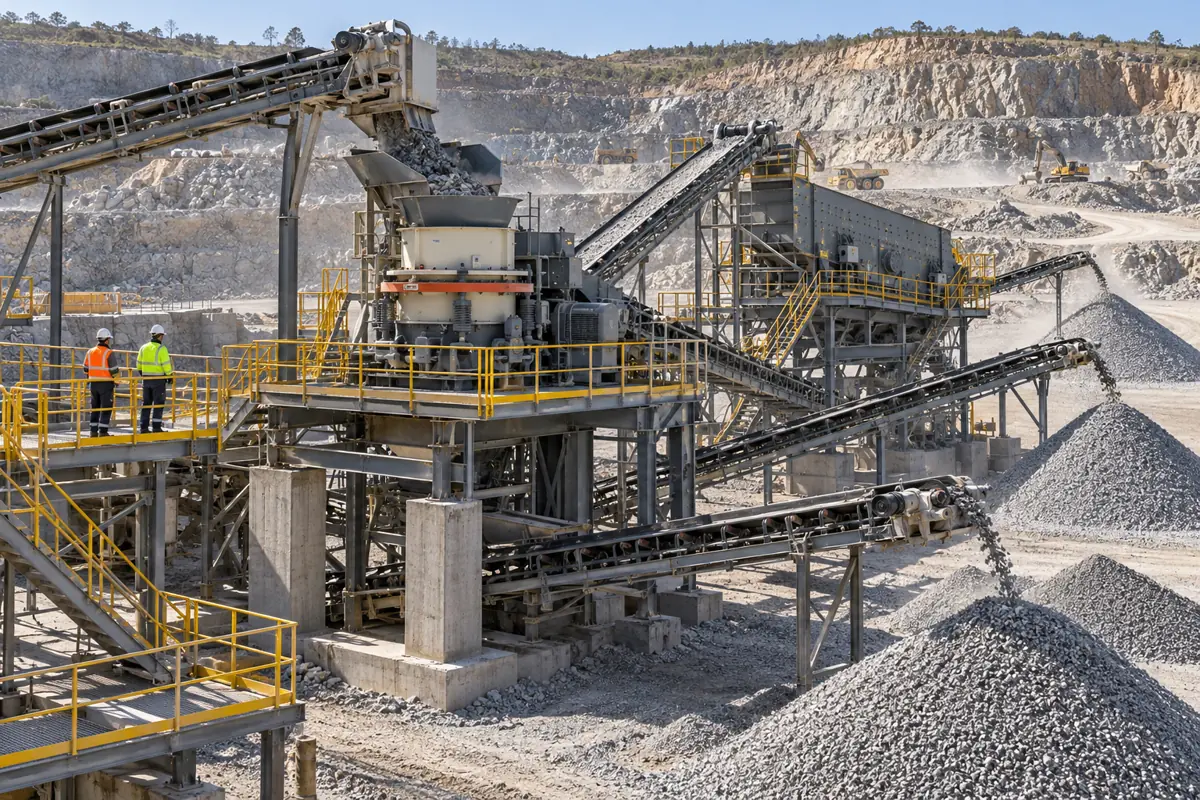
A cone crusher may be only one reduction stage. In a granite aggregate circuit, its result can be governed by the upstream feeder, the feed-size distribution, the screen, oversize return belt, product belts, transfer chutes, stockpile space, and the control sequence. Write the exact physical start and end of the test before power is applied.
The U.S. EPA’s taconite processing description is not a granite design standard, but it is a useful public process example: it describes cone crushers with intermediate screens and closed-circuit return flow. The transferable lesson is that a crusher, a screen, and the material returning to the crusher must be checked as one system. A granite circuit still needs its own representative feed record, product specification, and site-specific engineering.
| Commissioning boundary | Buyer should define | Why it prevents a dispute |
|---|---|---|
| Test material | Source area, representative granite condition, typical and maximum feed, visible fines, moisture, and any contamination | A test on unusually clean, uniform material is not the same duty as normal quarry feed. |
| Circuit start | Hopper, feeder, scalper if present, or named upstream handover | States who owns feed control and protects the cone from unsuitable top-size or tramp material. |
| Circuit end | Product belts, stockpiles, downstream screen, or named process handover | Stops a crusher-only result from being treated as a whole-plant result. |
| Product requirement | Required sizes, permitted oversize or fines, sampling location, and product segregation method | Aligns the screen, return flow, and stockpile handling with the actual saleable products. |
| Operating basis | Planned throughput window, operating-hours basis, start-up limitations, and allowable adjustment period | Separates a controlled commissioning observation from an unconditional availability promise. |
| Acceptance record | Named measurements, instruments, people, exceptions process, and signatures | Leaves a traceable record of what was observed and what remains open. |
For a full plant interface list, use the feeder, crusher, screen, and conveyor selection guide alongside the order-specific drawings. A public guide cannot replace the accepted layout, manuals, risk assessment, and local legal requirements for the actual site.
Release Safety and Site Readiness Before a Functional Test
A commissioning plan should not use production pressure to bypass guarding, energy isolation, access, or cleanup controls. OSHA notes that unexpected release of electrical, mechanical, hydraulic, pneumatic, and other stored energy can seriously injure workers during servicing; its control of hazardous energy overview and machine-guarding overview are useful general references. The site must apply its own applicable rules, authorised procedures, and manufacturer instructions.
Before the first controlled movement, assign a competent site owner for every readiness line below. “Supplier checked it” or “contractor will finish it later” is not a release condition unless the responsible party, remaining work, and temporary control are written down.
| Readiness area | Practical verification before energising | Evidence to retain |
|---|---|---|
| Mechanical installation | Foundations or supports accepted as required, fasteners and guards checked, access platforms and handrails complete, lifting and maintenance clearances available | Installation or inspection record, outstanding-items log, approved drawing revision |
| Lubrication and fluids | Correct specified fluids, filtration, levels, lines, alarms, and cooling connections checked under the manufacturer procedure | Commissioning checklist, fluid record, alarm or instrument check |
| Electrical and controls | Cable terminations, earthing, rotation check procedure, emergency stops, interlocks, start sequence, and alarm responses assigned and tested safely | Control test sheet, electrical test record, cause-and-effect or interlock record where supplied |
| Material handling | Belt tracking, pull cords, chute guards, discharge clearance, spillage plan, screen access, and return-conveyor route checked | Pre-start inspection record and marked layout or walkdown notes |
| People and work control | Authorized operators, communication method, exclusion zones, lockout/tagout procedure, and stop-work authority established | Toolbox or permit record, attendance, and nominated contacts |
| Utilities and environment | Stable power arrangement, water or dust-control boundary where needed, drainage, lighting, dust housekeeping, and safe vehicle/pedestrian separation | Site readiness record, unresolved interface list |
Do not treat this table as a universal legal checklist. It is a buyer’s way to make scope visible; the final sequence must follow the equipment manuals, project risk assessment, and local regulations.
Use a Staged Test Instead of Jumping Straight to a Capacity Claim
A defensible commissioning sequence progresses from safe static checks to controlled material flow. It allows a team to discover a belt-direction error, unresponsive interlock, blocked chute, screen issue, or missing access control before normal quarry feed amplifies the problem.
| Test stage | What the team should observe | What the stage cannot prove by itself |
|---|---|---|
| Static walkdown | Guards, access, fasteners, fluid systems, instruments, signage, cleanup, and open interfaces | That motors, controls, material flow, grading, or output are correct under load |
| No-load functional check | Permitted rotation and sequence checks, emergency-stop response, alarms, belt tracking, and interlocks under the approved procedure | That actual granite will feed, screen, recirculate, or segregate correctly |
| Controlled loaded start | Feed introduction at the agreed low, stable rate; chute behavior; crusher feed distribution; screen response; oversize return; product discharge | A sustained production result outside the stated material and operating window |
| Defined observation run | Feed, operating setting, electrical or hydraulic indicators where applicable, product samples, screen performance, return flow, and exceptions | A guarantee for another granite bench, wetter season, different operator, or incomplete circuit |
| Handover review | Remaining punch-list items, spares, drawings, training, operating limits, and named follow-up responsibility | That uncompleted work has disappeared merely because the plant was run |
The test is more useful when the buyer records the starting material condition and every adjustment. A change in closed-side setting, feed rate, screen aperture, return conveyor speed, or stockpile handling can change the observed outcome. The cone crusher versus VSI guide gives a related reminder: final aggregate quality is a circuit decision, not proof supplied by one machine name.
Check the Cone Crusher at Its Interfaces
The cone itself needs a manufacturer-led check, but a buyer should ask to see how its stated limits connect to the real installation. For granite, do not substitute the word “hard” for the actual feed record. Granularity, shape, fines, moisture, abrasiveness, fragmentation, and feed distribution all influence the duty presented to the chamber.
- The largest expected and typical feed after upstream preparation, the stated feed distribution, and the device that prevents unsuitable material reaching the cone.
- The proposed chamber, permitted setting range, lubrication/cooling requirements, overload or tramp-protection arrangement, and maintenance access needed for the selected equipment.
- The screen deck arrangement, aperture basis, feed distribution, access, and route that returns oversize without interfering with safe cleanup or observation.
- The physical conveyor and chute interfaces, including transfer sealing, clearance, spillage handling, belt protection, guards, pull cords, and the space available to inspect them.
- The control and trip logic, normal and abnormal stop sequences, restart prerequisites, alarms, and who may alter settings during the test.
- The product sampling point, stockpile segregation method, truck-loader route, and the distinction between temporary start-up piles and accepted saleable stock.
The complete stone crusher plant setup guide is useful when these interfaces show that a “cone package” is actually part of a larger civil, electrical, conveying, and dust-control scope. It should be read as planning guidance, not an installed-plant guarantee.
Define What the Test Can and Cannot Accept
Commissioning should be an evidence event, not a vague promise that the circuit will “meet capacity.” Agree the observable record before the run: material source, feed range, equipment configuration, operating adjustments, observation window, sampling method, product limits, and action for a failed or interrupted run.
| Acceptance question | A usable written answer | A risky vague answer |
|---|---|---|
| Which granite is being tested? | Source, representative condition, sample or truck record, maximum and typical feed, fines/moisture note | “Granite” with no record of the actual test material |
| What scope is live? | Named hopper/feeder, cone, screen, belts, stockpiles, utilities, and any excluded component | “The crusher is running” |
| What is measured? | Agreed feed and product observation method, screen/return-flow review, named indicators, and exceptions log | An isolated model capacity or a single brief visual check |
| What conditions apply? | Setting, feed arrangement, test period, operators, operating restrictions, and any permitted adjustment | A result treated as valid after material or configuration changes |
| Who closes exceptions? | Each punch-list item has an owner, evidence of completion, and a due date | Unnamed promises of support after handover |
The buyer should distinguish a commissioning run from a contractual performance guarantee. A later guarantee, if any, needs its own exact contract terms, material basis, complete-scope boundary, test method, remedies, and exclusions. No page can create those commitments after the fact.
Handover Should Include Documents, Parts, and Responsibilities
The commissioning meeting is the right time to close gaps between factory supply, freight delivery, site assembly, and operating ownership. A lower equipment price can conceal an incomplete handover if it omits start-up consumables, special tools, inspection documents, serial-number parts identification, a training record, or a clear escalation route.
Use the same responsibility matrix for every contracting route. Whether a buyer purchases from a manufacturer, dealer, EPC contractor, or another seller, the relevant question is what that named party has contracted to supply and support. The cone crusher supplier comparison for basalt offers a related quotation framework; it does not document a local dealer or service provider for any other project.
| Handover item | Buyer should receive or confirm | Open risk if omitted |
|---|---|---|
| Final scope record | Equipment list, drawings, exclusions, deviations, and site interfaces | A later dispute over what was actually supplied |
| Operations material | Manuals, settings guidance, alarm list, maintenance schedule, and safe work instructions from the responsible supplier | Operators lack the basis to run or maintain the installed configuration |
| Parts and tools | Recommended critical spares, part identification, special tools, consumables, storage conditions, and current lead-time contact | A small failure extends downtime while parts are identified or sourced |
| Training and support | Attendees, topics, remaining training, escalation route, remote/on-site scope if contracted, and response conditions | “Support” is assumed but not defined |
| Punch list | Item, severity, temporary control, owner, due date, evidence required, and closure sign-off | Known defects are lost after the team leaves site |
Buyer Checklist for a Granite Cone-Circuit Commissioning

- Defined representative raw material, maximum and typical feed size, fines/moisture condition, output size schedule, target capacity basis, and the permitted test window.
- Marked the supply and operating boundary from feeder or upstream handover through cone, screen, return route, conveyors, stockpiles, and downstream handover.
- Completed the required safety release under the site’s applicable procedures, with guards, controlled energy, emergency stops, access, communications, and exclusion zones addressed.
- Checked the installed mechanical, lubrication, electrical, controls, and utility items against the applicable drawings and manufacturer instructions.
- Completed safe no-load and controlled loaded checks before attempting a longer observation run.
- Recorded feed condition, operating settings, screen and return-flow observations, product sampling method, interruptions, adjustments, and exceptions.
- Separated a stated commissioning observation from any separate contractual capacity, grading, availability, warranty, or service commitment.
- Received the agreed documents, parts list, training record, punch list, and named owner for every open action.
Send a Commissioning Brief Before the Site Test
MVSI can review the inputs needed to scope a granite cone-crusher commissioning discussion. Send the raw material description and representative photos or samples, maximum and typical feed size, required output sizes, target capacity and operating-hours basis, existing layout and site photos, screen and return-flow details, available power and water, proposed commissioning boundary, and budget range. Those inputs let the technical and commercial responsibilities be defined before the team is mobilized.
Frequently Asked Questions
What should be checked before starting a cone crusher for commissioning?
Check the named material path, installation condition, guards, access, lubrication, utilities, controls, emergency stops, interlocks, belt and chute readiness, operator roles, energy-control procedure, and the written test basis. The exact sequence must follow the manufacturer instructions, project risk assessment, and local requirements.
Can a cone crusher be commissioned without the screen and return conveyor?
Only if the agreed scope and safe test method make that limited test meaningful. A crusher-only run cannot demonstrate the behavior of a closed-circuit granite plant where screen cuts, recirculation, and product belts govern the final result.
What granite information is needed for a cone-crusher commissioning test?
Provide the source, representative condition, maximum and typical feed size, feed grading, visible fines, moisture, fragmentation, abrasiveness data if available, expected output sizes, target capacity, and any material variation known between quarry areas.
Does a successful start-up prove the plant’s guaranteed capacity?
No. A successful start-up shows only what was observed under the stated material, equipment, settings, scope, and operating window. Any capacity or product guarantee requires separately agreed contractual terms and a defined acceptance method.
Why should the buyer record screen and return-flow behavior?
The screen and return flow influence crusher feed, circulating load, product size, and stability. Without that record, a cone-crusher observation can be confused with the performance of the complete circuit.
Who should own open commissioning items?
Each open item needs a named owner, due date, temporary safety or operating control, evidence required for closure, and a sign-off method. Do not rely on an unassigned statement that someone will address it later.
Does this article mean MVSI has a granite quarry project or local commissioning team?
No. This is general buyer guidance. It does not claim an MVSI customer project, local office, dealer, stockholding, service base, delivery route, commissioning team, or performance result.