Table of Contents
- What ROI Means for a Crusher Plant
- Quick Decision Table
- When a Stationary Stone Crusher Plant Has Better ROI
- When a Mobile Crusher Plant Has Better ROI
- Equipment Configuration Differences
- Typical Stationary Plant
- Typical Mobile Plant
- Cost Factors That Change ROI
- Simple ROI Calculation Method
- Common Buyer Mistakes
- What to Send Before Asking for a Quote
- Conclusion
- FAQ
- Is a stationary crusher plant cheaper than a mobile crusher plant?
- Which crusher plant has better ROI for a quarry?
- Which crusher plant has better ROI for road construction?
- Can a mobile crusher plant produce the same aggregate sizes as a stationary plant?
- What capacity is better for stationary and mobile plants?
- Does a mobile crusher plant need a foundation?
- How do I calculate crusher plant ROI?
- What information should I provide before requesting a quotation?
Stationary vs Mobile Stone Crusher Plant: Which Has Better ROI?
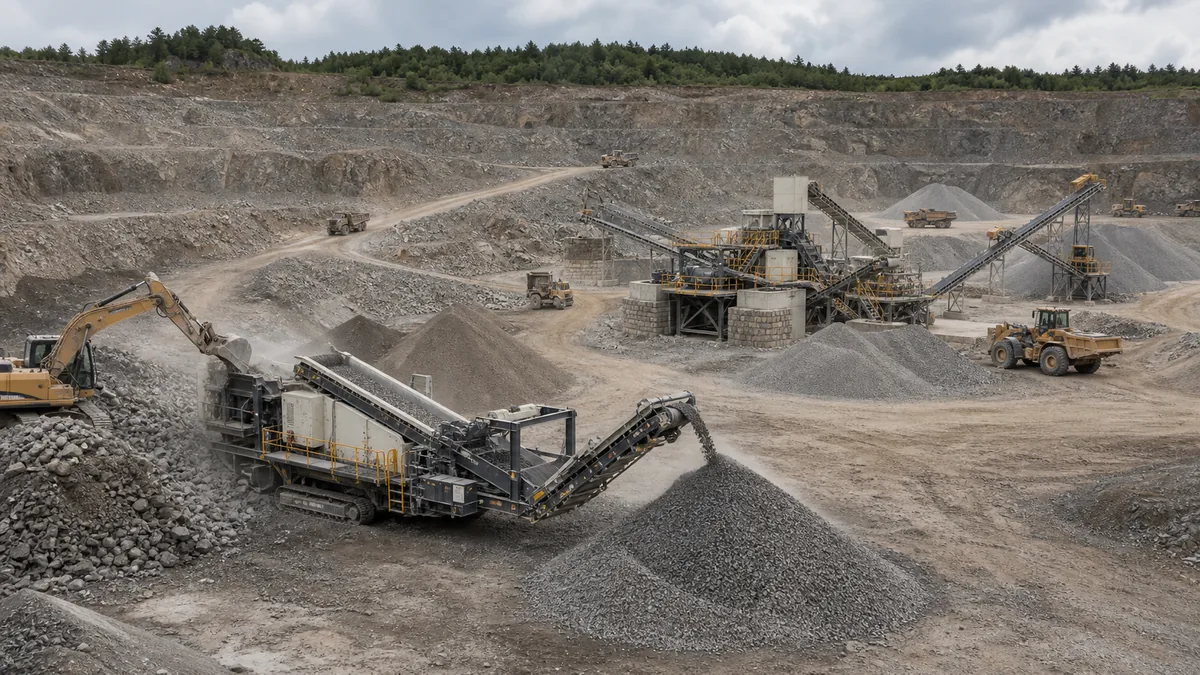
A stationary stone crusher plant usually has better ROI for a long-term quarry with stable reserves, high annual output, reliable power, and enough land for foundations, stockpiles, and conveyors. A mobile stone crusher plant often has better ROI for road projects, temporary aggregate supply, contract crushing, demolition recycling, and sites that must move quickly. The best choice is not only the lowest purchase price. Buyers should compare installed cost, production tons per year, relocation frequency, labor, fuel or electricity, maintenance access, spare parts, resale value, and project delay risk before choosing stationary or mobile crushing equipment.
What ROI Means for a Crusher Plant
ROI for a crusher plant is the relationship between the money invested and the economic value produced over time. In quarry and aggregate projects, it is usually driven by tons sold, margin per ton, equipment availability, operating cost, service life, and the ability to keep customers supplied.
Many buyers compare only the machine quotation. That is too narrow. A stationary plant may need more civil work, more installation time, longer conveyors, and more site preparation, but it can run at a lower cost per ton for many years. A mobile plant may cost more per ton of installed capacity, but it can start faster, move with a road contract, and reduce wasted foundation work when the project life is short.
If you are still defining the full plant scope, review our guide to complete stone crusher plant setup and the article on stone crusher plant cost factors.
Quick Decision Table
| Project Condition | Better ROI Choice | Why It Matters |
|---|---|---|
| Long-term quarry with 5+ years of reserves | Stationary plant | Lower cost per ton and stronger layout flexibility |
| Road contractor moving between sites | Mobile plant | Fast relocation and less repeated civil work |
| High output demand above 250-300 TPH | Stationary plant | Easier to build large feed, screening, and stockpile capacity |
| Temporary project under 12-24 months | Mobile plant | Faster payback and lower sunk foundation cost |
| Limited land or difficult foundation work | Mobile plant | Compact setup and less fixed structure |
| Stable land, power, loaders, and trucks | Stationary plant | Better support for continuous production |
| Contract crushing for several customers | Mobile plant | One fleet can serve multiple jobs |
| Strict final product sizes and multiple stockpiles | Stationary plant | More room for screens, return conveyors, and product bins |
This table is a starting point. The final answer depends on feed size, rock hardness, abrasiveness, final aggregate sizes, required capacity, power supply, permit conditions, and local labor cost.
When a Stationary Stone Crusher Plant Has Better ROI
A stationary plant is usually the stronger investment when the quarry has enough reserves and the owner expects continuous aggregate production. The main advantage is not simply higher capacity. It is the ability to build a complete, efficient process around the deposit.
Stationary plants can use larger feeders, heavier jaw crushers, cone crushers, impact crushers, VSI sand making machines, multi-deck screens, longer conveyors, return conveyors, dust control systems, and larger stockpile areas. The layout can be optimized for truck loading, maintenance access, electrical control, water spraying, and future expansion.
For hard rock such as granite, basalt, and river stone, a stationary jaw crusher plus cone crusher plus screen circuit often gives stable wear cost and good capacity. If the final product must include manufactured sand or improved particle shape, a VSI crusher can be added after cone crushing. For limestone, a jaw crusher plus impact crusher plus screen may be more economical if the material is not highly abrasive.
Stationary ROI becomes attractive when:
- The quarry life is long enough to recover foundation and installation cost.
- Annual production volume is high.
- The site has stable grid power or a permanent generator plan.
- The owner needs several final sizes such as 0-5 mm, 5-10 mm, 10-20 mm, and 20-30 mm.
- There is enough space for feeders, crushers, screens, conveyors, stockpiles, roads, and workshops.
- Maintenance teams can work on the plant without frequent relocation.
For aggregate gradation planning, see our guide on designing a crushing plant for 0-5 mm, 5-10 mm, and 10-20 mm products.
When a Mobile Crusher Plant Has Better ROI
A mobile crusher plant can produce better ROI when mobility has real economic value. This is common for road contractors, temporary quarry operations, bridge and railway projects, construction waste recycling, open job sites, and buyers who need to start production before a permanent quarry layout is ready.
Mobile crushers reduce foundation work and can be moved by trailer or crawler system depending on the model. A mobile jaw crusher can handle primary crushing near the raw material. A mobile cone, impact, VSI, or screen plant can complete secondary crushing, shaping, screening, and stockpiling. This shortens commissioning time and reduces the risk of building fixed foundations at a site that may not be used for long.
Mobile ROI becomes attractive when:
- The project moves often or has several scattered raw material points.
- The buyer needs to start production quickly.
- Civil foundation work is expensive, slow, or uncertain.
- The same equipment can serve several contracts.
- The site has limited space or difficult access roads.
- Resale or redeployment value matters after the first project ends.
For mobile configuration choices, read our mobile crushing plant buying guide and the comparison of track-mounted vs tire-mounted mobile crushers.
Equipment Configuration Differences
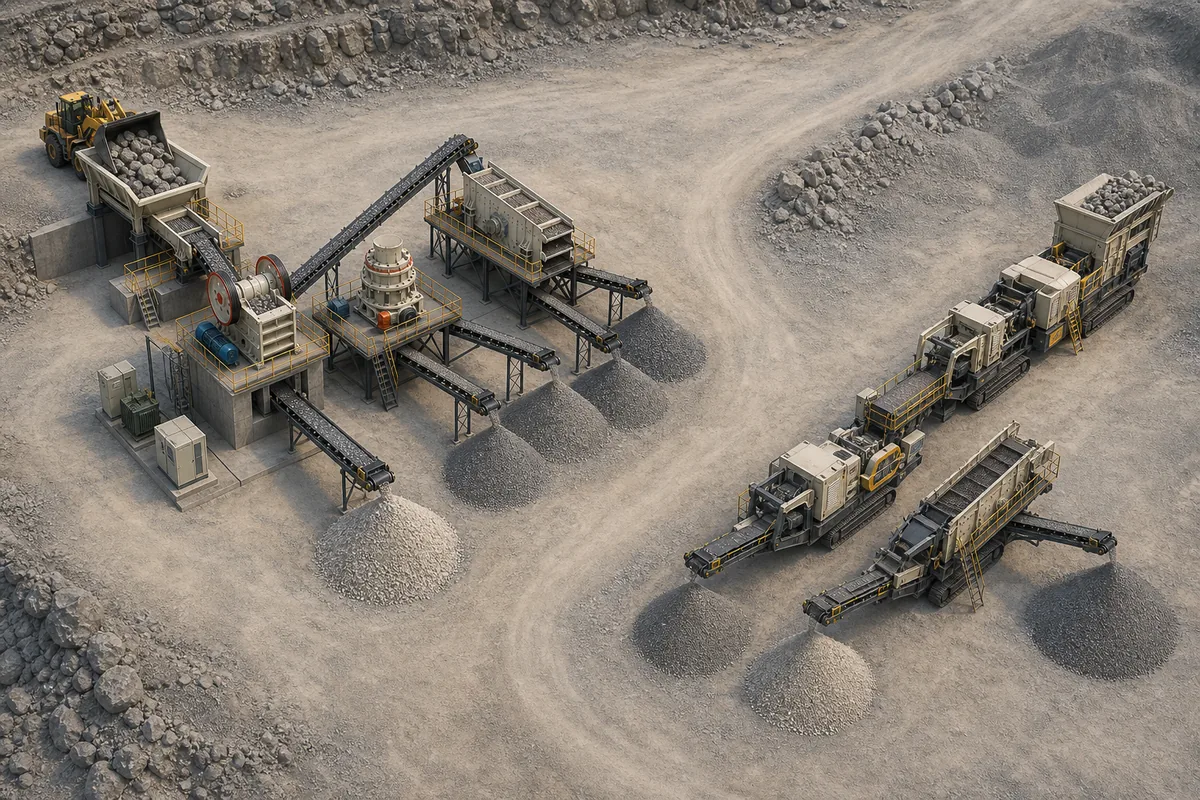
The equipment list may look similar, but the engineering logic is different.
Typical Stationary Plant
A stationary aggregate plant normally includes a vibrating feeder, jaw crusher, secondary cone or impact crusher, vibrating screen, return conveyor, product conveyors, support steel, electrical control cabinet, dust control, and stockpile area. For high-quality sand or cubical aggregate, a VSI crusher may be added after secondary crushing.
This layout is stronger for high tonnage, long service life, and strict final size control. It also allows easier access around each machine, which can reduce downtime during liner replacement, screen media change, lubrication, and belt maintenance.
Typical Mobile Plant
A mobile plant may include a mobile jaw crusher, mobile cone crusher, mobile impact crusher, mobile screen, mobile VSI plant, or a combined crushing and screening unit. The plant is compact and can be arranged quickly, but it has less layout flexibility than a fixed site.
Mobile equipment is often selected by module: primary crushing first, then secondary crushing or screening depending on output demand. A buyer can start with one mobile jaw crusher for basic road base, then add a mobile screen or mobile cone crusher when customer specifications become stricter.
Cost Factors That Change ROI
The purchase price is only one part of ROI. A realistic comparison should include both capital cost and operating cost.
- Main crusher, screen, feeder, conveyor, and control system price.
- Steel structure, civil foundation, installation, and commissioning.
- Diesel, electricity, hydraulic system, and generator cost.
- Wear parts for jaw plates, cone liners, blow bars, rotor tips, screen mesh, belts, and rollers.
- Loader and truck cycle distance.
- Labor, operator training, and maintenance access.
- Relocation, dismantling, reinstallation, and transport cost.
- Downtime risk during rainy season, permit delays, or site change.
- Spare parts inventory and service response.
- Resale value or redeployment value after the project.
Stationary plants often win on long-term cost per ton. Mobile plants often win when fast production or relocation avoids lost revenue. A higher machine price can still be better ROI if it starts earlier or serves more projects.
Simple ROI Calculation Method
Buyers can compare options with a simple model before asking for a detailed quotation.
- Estimate annual sellable tons.
- Estimate gross margin per ton after loading, hauling, labor, fuel, power, wear parts, and maintenance.
- Estimate total investment, including equipment, freight, foundation, installation, spare parts, and site preparation.
- Estimate downtime and relocation cost.
- Estimate resale or remaining value at the end of the project.
A practical formula is:
| Step | Question to Ask |
|---|---|
| Annual value | How many sellable tons can the plant produce each year? |
| Cost per ton | What are the real energy, wear, labor, and maintenance costs? |
| Payback time | How many months of production are needed to recover the investment? |
| Risk adjustment | What happens if the site moves, permits are delayed, or feed quality changes? |
| End value | Can the plant be reused, expanded, sold, or moved to another project? |
For example, a stationary plant may have higher up-front site work but lower long-term cost per ton. A mobile plant may have higher equipment cost per ton of rated capacity but recover faster if it avoids three months of civil work or can move to the next contract immediately.
Common Buyer Mistakes
The first mistake is comparing stationary and mobile plants only by crusher model. ROI depends on the full system, not one machine. A jaw crusher, cone crusher, vibrating screen, conveyors, stockpile design, and power system must work together.
The second mistake is ignoring real production days. A 200 TPH plant running eight hours per day for 220 days is very different from the same plant running 12 hours per day for 300 days. ROI should be based on sellable annual tons, not nameplate capacity alone.
The third mistake is underestimating site work. A stationary plant needs foundations, steel supports, cable routing, roads, drainage, dust control, and stockpile planning. A mobile plant needs access roads, level working pads, fuel or power planning, and safe relocation routes.
The fourth mistake is buying a mobile plant for a stable quarry only because it looks flexible. If the plant will never move and annual output is high, a stationary layout may produce lower cost per ton.
The fifth mistake is building a stationary plant for a short-term contract. If the project ends before the installation cost is recovered, the ROI may be weak even when the machine price looks attractive.
What to Send Before Asking for a Quote
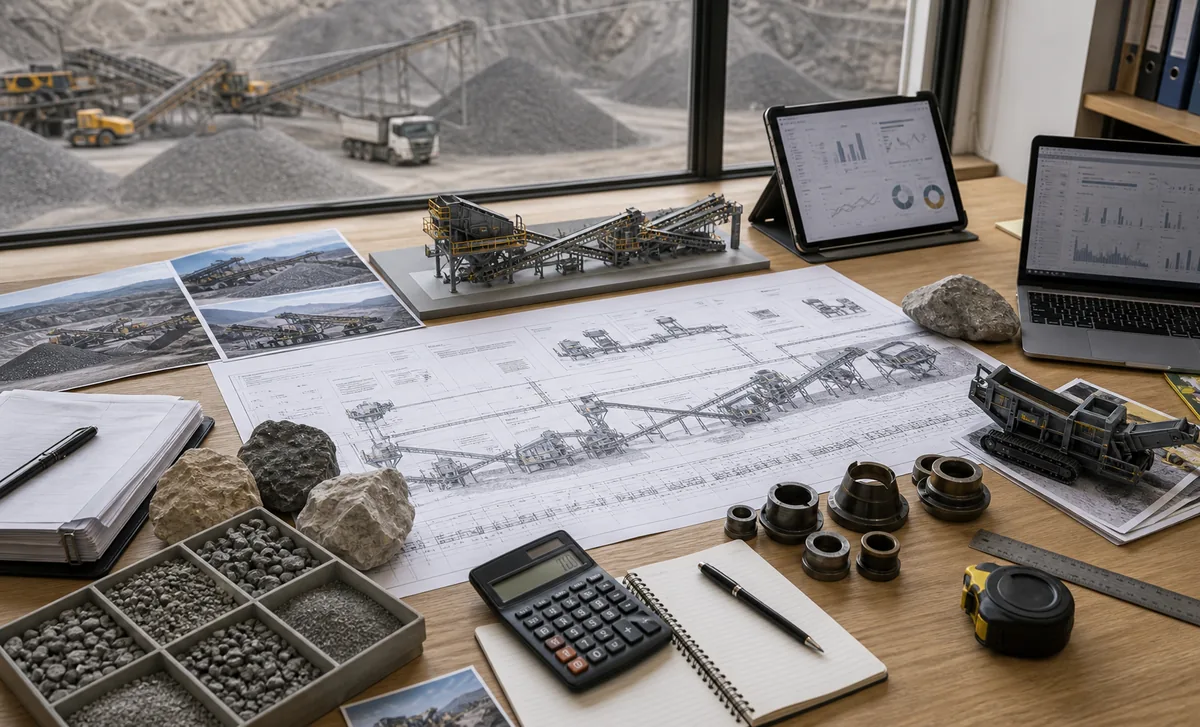
To compare stationary and mobile crusher plant ROI accurately, send the supplier practical project information, not only a capacity target.
- Raw material name, hardness, abrasiveness, moisture, and clay content if known.
- Maximum feed size before primary crushing.
- Required output size range, such as 0-5 mm, 5-10 mm, 10-20 mm, and 20-30 mm.
- Target capacity in tons per hour and expected working hours per day.
- Estimated project life, annual production target, and whether the site will move.
- Site photos, land size, foundation condition, access roads, and stockpile area.
- Local power condition, diesel preference, generator plan, and fuel cost.
- Budget range, delivery schedule, and whether future expansion is expected.
With this information, MVSI can compare stationary and mobile options on the same basis and suggest a configuration that fits production, operating cost, and project risk.
Conclusion
Stationary stone crusher plants usually deliver better ROI for long-term quarry production, high annual tonnage, stable raw material, and strict aggregate size control. Mobile crusher plants usually deliver better ROI when the project is temporary, relocation is frequent, commissioning speed matters, or the same equipment can serve several jobs.
The right decision should be based on total installed cost, cost per ton, production schedule, relocation value, downtime risk, spare parts support, and future use. If you are comparing stationary and mobile stone crusher plant options, send us your raw material, feed size, output size, capacity, site photos, project life, and budget range. MVSI can help review the application and recommend a practical crushing and screening configuration.
FAQ
Is a stationary crusher plant cheaper than a mobile crusher plant?
A stationary plant is often cheaper per ton of installed capacity for long-term quarry production, but it may need more foundation, steel structure, conveyor, and installation work. A mobile plant may cost more as equipment, but it can reduce setup time and relocation cost.
Which crusher plant has better ROI for a quarry?
For a stable quarry with enough reserves, high annual production, and permanent land, a stationary plant usually has better ROI because it can provide lower cost per ton and more layout flexibility.
Which crusher plant has better ROI for road construction?
For road construction projects that move along the route or operate for a limited time, a mobile crusher plant often has better ROI because it can relocate quickly and avoid repeated fixed foundations.
Can a mobile crusher plant produce the same aggregate sizes as a stationary plant?
Yes, if the mobile plant includes the right crusher and screening modules. A mobile jaw crusher, mobile cone or impact crusher, and mobile screen can produce several aggregate sizes, but stockpile space and recirculation options may be more limited than a stationary site.
What capacity is better for stationary and mobile plants?
Small and medium projects may use 50-200 TPH mobile or stationary configurations. For high continuous output above 250-300 TPH, a stationary plant often becomes more efficient because larger screens, conveyors, and stockpiles are easier to arrange.
Does a mobile crusher plant need a foundation?
A mobile crusher plant usually needs a stable working pad, drainage, access road, and safe stockpile area, but it normally requires less permanent civil foundation work than a stationary crushing plant.
How do I calculate crusher plant ROI?
Estimate annual sellable tons, margin per ton, total installed investment, operating cost, downtime, relocation cost, and resale or reuse value. Compare payback time and project risk, not only the purchase price.
What information should I provide before requesting a quotation?
Provide raw material, maximum feed size, final output sizes, target capacity, working hours, site photos, project life, mobility requirement, local power condition, and budget range. These details make the stationary vs mobile ROI comparison more accurate.