Table of Contents
- The Short Answer: Reduction First, Shaping Where It Adds Value
- Cone Crusher vs VSI Crusher at the Final Stage
- When a Cone Crusher Is the Better Final-Stage Choice
- Hard, abrasive feed needs efficient reduction
- The product plan emphasizes coarse and mid-size aggregate
- Feed variation makes a precise VSI feed hard to maintain
- When a VSI Crusher Adds More Value
- Cubical shape is an explicit product requirement
- Manufactured sand is part of the sales plan
- A small controlled fraction needs polishing, not bulk reduction
- Recommended Final-Stage Configurations
- Configuration A: Cone crusher plus screen for general aggregate
- Configuration B: Cone crusher, screen, and VSI for shaped aggregate
- Configuration C: VSI in a dedicated manufactured-sand circuit
- What to Compare in Supplier Proposals
- Common Buying Mistakes
- Choosing by crusher type instead of final product
- Sending unclassified feed directly to the VSI
- Ignoring the return conveyor and screen capacity
- Comparing only the initial crusher price
- FAQ
- Is a cone crusher or VSI crusher better for final-stage crushing?
- Can a VSI crusher replace a cone crusher?
- Does a VSI crusher make more fines than a cone crusher?
- What feed size should go into a VSI crusher?
- Is cone-crusher product suitable for concrete aggregate?
- Should I use rock-on-rock or rock-on-iron in a VSI?
- What information is needed for a cone versus VSI quotation?
- Why is the screen important after a cone or VSI crusher?
- Get a Final-Stage Crushing Circuit Matched to Your Product Plan
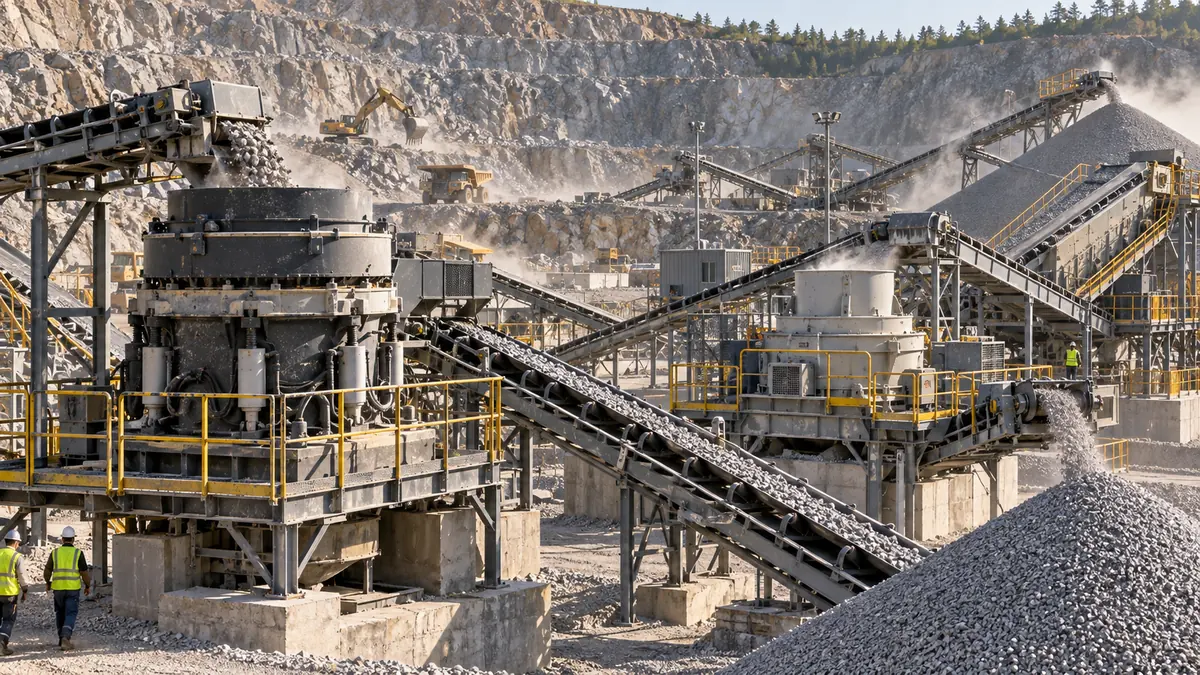
For final-stage aggregate crushing, choose a cone crusher when you need dependable reduction of hard, abrasive, well-graded feed at relatively high throughput; choose a VSI crusher when the commercial priority is particle shape, a controlled fine aggregate fraction, or manufactured sand. In many hard-rock plants, the best answer is not cone or VSI: a cone crusher reduces the screened material efficiently, then a VSI shapes a controlled fraction in closed circuit. The decision depends on the feed after secondary crushing, target product gradations, shape specification, allowable fines, recirculating load, wear budget, and the screening layout—not on maximum rated capacity alone.
The Short Answer: Reduction First, Shaping Where It Adds Value
A cone crusher compresses rock between a mantle and concave liner. It is a strong final-reduction machine for hard, abrasive material when the feed is reasonably uniform and within the chamber’s design range. Its product can be suitable for many base, concrete, and general aggregate uses, particularly when a screen controls the final sizes.
A vertical shaft impact (VSI) crusher accelerates material in a rotor and breaks it by rock-on-rock or rock-on-iron impact. That action is especially useful for improving cubical shape and producing controlled fine aggregate. It normally needs a smaller, well-controlled feed than a cone crusher and should be selected with the screen, return conveyor, and fines balance in mind. Our VSI crusher versus cone crusher guide for manufactured sand covers the broader sand-making decision; this article focuses on the final crushing stage in a complete quarry circuit.
Cone Crusher vs VSI Crusher at the Final Stage
| Decision point | Cone crusher | VSI crusher |
|---|---|---|
| Main crushing action | Compression between mantle and concave | High-speed impact from a rotor, using rock-on-rock or rock-on-iron configuration |
| Best feed condition | Hard, abrasive, consistently graded feed within the chamber range | Controlled, screened feed with a restricted top size and limited tramp material |
| Primary benefit | Efficient reduction and throughput for final aggregate preparation | Better particle shape and useful fine aggregate or manufactured-sand production |
| Product tendency | Can produce acceptable graded aggregate; shape depends on chamber, setting, feed, and circuit | Generally increases cubicality and fines; result depends on rotor setup and feed grading |
| Key wear areas | Mantle, concaves, feed cone, bushings and bearings | Rotor tips, anvils or rock shelf, cavity liners, feed tube and distributor |
| Circuit role | Final reduction machine or feed conditioner before a VSI | Dedicated shaping/fine-crushing stage, commonly after cone reduction and screening |
These are selection tendencies, not guaranteed production figures. Rock strength, abrasiveness, moisture, flakiness, closed-side setting, rotor speed, feed grading, screen cuts, and recirculating load can change both product and operating cost. Compare supplier proposals using the same representative material and the same final product specification.
When a Cone Crusher Is the Better Final-Stage Choice
Hard, abrasive feed needs efficient reduction
For granite, basalt, hard river stone, and similar material, a cone crusher is often the practical workhorse before final screening. It accepts a broader range of screened secondary-crusher product than a VSI and can reduce the coarse fraction while keeping a stable plant throughput. The correct chamber and closed-side setting matter: a crusher selected only for a headline capacity can choke, produce too much oversize, or pass an unsuitable feed onward.
The product plan emphasizes coarse and mid-size aggregate
If the sales plan is dominated by 10-20 mm, 10-14 mm, or other coarse-to-mid-size products, a cone-and-screen circuit may be enough. A VSI should not be added by habit. First examine the delivered gradation, flakiness or shape requirement, percentage of crushed faces, and the value of any extra fine fraction. If the market accepts the cone product and the screen is meeting the specification, a separate shaping stage may not improve the business case.
Feed variation makes a precise VSI feed hard to maintain
A VSI gives its best result when it receives material within a controlled size band. A cone can be more forgiving in the preceding reduction role when the feed varies within normal design limits. That does not remove the need for good feed control: use a correctly sized screen, stable conveyor loading, and an enclosure or dust-control system that does not obstruct maintenance access. For a full circuit check, see our quarry feeder, crusher, screen, and conveyor selection guide.
When a VSI Crusher Adds More Value
Cubical shape is an explicit product requirement
The VSI is normally worth considering when concrete, asphalt, or high-specification aggregate buyers require more cubical particles and tighter control of the fine fraction. Its impact action can break elongated or flaky particles differently from compression crushing. But shape must be checked on the actual rock and at the final screen cuts; using a VSI does not automatically make every stockpile compliant.
Manufactured sand is part of the sales plan
When 0-5 mm manufactured sand has defined commercial value, a VSI can turn a controlled crushed aggregate feed into a more suitable shaping and sand-making product. The plant must also manage the fines that are created. Consider classification, washing, air separation, moisture, and the permitted percentage passing the relevant sieve before deciding that more fines are a benefit. Our guide to improving cubical shape in manufactured sand explains the operational levers around the crusher itself.
A small controlled fraction needs polishing, not bulk reduction
A common mistake is to send the entire final-crushing load through a VSI when only part of the material needs additional shaping. A more controllable layout screens the cone product, sends the suitable fraction to the VSI, returns oversize as needed, and bypasses sizes already meeting the product plan. This reduces unnecessary rotor wear and prevents a shaping machine from becoming the plant bottleneck.
Recommended Final-Stage Configurations
Configuration A: Cone crusher plus screen for general aggregate
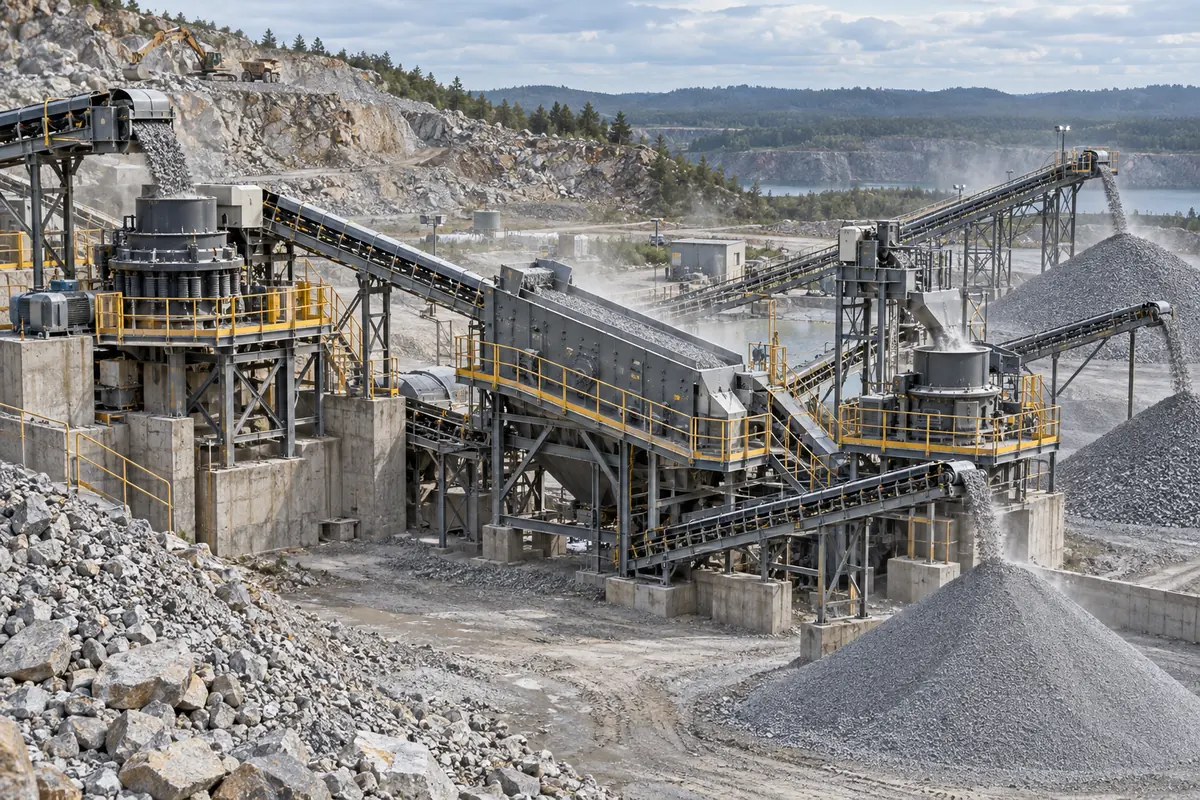
Use a cone crusher followed by a multi-deck screen and return conveyor. This works where final aggregate shape is accepted, the feed is hard or abrasive, and the commercial focus is controlled coarse and mid-size products. Size the screen for peak recirculating load, not only nominal crusher feed. A screen that blinds or carries too much oversize will limit a properly selected cone.
Configuration B: Cone crusher, screen, and VSI for shaped aggregate
Use a cone crusher for reduction, a screen to make the feed band, a VSI for the fraction that benefits from shaping, then a final screen and product conveyors. The screen defines the job of the VSI. Ask the bidder to show the feed to each machine, all bypasses, nominal and maximum return load, and the expected product balance. This is a common arrangement when the same quarry sells both standard aggregate and higher-shape material.
Configuration C: VSI in a dedicated manufactured-sand circuit
Use a screened, controlled fine aggregate feed to the VSI, followed by classification or washing where the product specification requires it. Keep the cone crusher upstream if it is needed to make the correct feed size. This layout is appropriate only after the quarry has defined a market for the sand, its grading envelope, moisture handling, and disposal or use of excess fines. Review the product bins and returns with our aggregate crushing plant design guide.
What to Compare in Supplier Proposals
Ask every supplier to base the proposal on the same raw material, top size and feed-size distribution, bulk density, moisture, abrasiveness, required output sizes, and operating hours. Then require a circuit-level answer, rather than isolated crusher capacities.
| Buyer check | Why it matters |
|---|---|
| Feed distribution to each crusher | Both machines perform differently when the feed contains too much fine material or oversized rock. |
| Product gradation and particle-shape target | Confirms whether a VSI’s added shaping value is actually needed. |
| Screen area, deck arrangement, and recirculation | Determines the usable product split and may limit plant capacity. |
| Wear-part package and expected duty | Converts a nominal equipment price into a realistic operating comparison. |
| Access, lifting plan, and opening spares | Affects downtime for liner, rotor-tip, and screen-media change-outs. |
| Power, dust control, conveyors, and civil scope | Prevents a low crusher quote from excluding essential plant cost. |
Wear should be compared per operating hour or per tonne under stated assumptions, not as a generic claim that one machine is cheaper. Cone liner life changes with chamber selection, feed distribution, setting, and rock abrasiveness. VSI rotor tips and cavity parts change with rock characteristics, rotor configuration, and how much material is unnecessarily recirculated. Ask for the bill of wear parts, materials, expected replacement triggers, part lead times, and recommended opening spares.
Common Buying Mistakes
Choosing by crusher type instead of final product
“Cone” and “VSI” are not product specifications. Start with the saleable gradations, particle-shape limits, fines requirements, and expected mix of orders. Then work backward through screens and crushers to build the circuit.
Sending unclassified feed directly to the VSI
An uncontrolled feed puts reduction duty, shape correction, and fines generation into one machine. Screen and regulate the feed first so the VSI handles the fraction it was selected to process.
Ignoring the return conveyor and screen capacity
Closed circuits are only productive when the screen, return conveyor, chutes, and surge capacity are sized for the actual circulating load. A bottleneck outside the crusher can make a high-rated machine underperform.
Comparing only the initial crusher price
Include liners, rotor parts, screen media, electrical supply, dust suppression, steelwork, foundations, commissioning, installation, and service response. Our stone crusher plant cost guide provides a practical scope checklist for a like-for-like comparison.
FAQ
Is a cone crusher or VSI crusher better for final-stage crushing?
A cone crusher is usually better for efficient reduction of hard, abrasive feed. A VSI crusher is usually better when cubical shape or manufactured-sand production is the primary goal. Many plants use a cone first and a VSI on a screened fraction.
Can a VSI crusher replace a cone crusher?
Sometimes, for a controlled fine feed and a shaping-focused product plan. It is not automatically a replacement for cone reduction on hard, variable, or relatively coarse feed. Confirm the VSI feed range and expected wear duty before making that change.
Does a VSI crusher make more fines than a cone crusher?
Often it does, because impact crushing can create a finer, more shaped product. Whether that is useful depends on the value of manufactured sand, the allowed fines content, and the plant’s classification or washing arrangement.
What feed size should go into a VSI crusher?
Use a screened, controlled feed within the selected VSI’s stated maximum and preferred grading range. The exact range depends on the machine and rotor setup, so provide the supplier with the full feed-size distribution instead of one maximum-size figure.
Is cone-crusher product suitable for concrete aggregate?
It can be, provided the delivered gradation, shape, cleanliness, and applicable specification are met. Test the actual product. If shape is marginal, a VSI shaping stage may be considered for the relevant fraction.
Should I use rock-on-rock or rock-on-iron in a VSI?
That choice depends on the feed, desired product, and wear economics. Rock-on-rock is often used where particle shape and self-lining action are valuable; rock-on-iron can suit specific reduction and capacity needs. Select it with the equipment supplier using representative material.
What information is needed for a cone versus VSI quotation?
Send the raw material, feed-size distribution, hardness and abrasiveness information, output sizes, shape or fines specification, target capacity, operating hours, site photos, available power, layout constraints, and budget range.
Why is the screen important after a cone or VSI crusher?
The screen separates saleable sizes, creates a controlled feed for the VSI, and returns oversize for further reduction. Its deck arrangement and area directly affect product quality, circulating load, and real plant capacity.
Get a Final-Stage Crushing Circuit Matched to Your Product Plan
Send MVSI Crusher your raw material, feed-size distribution and largest feed, required output sizes, particle-shape or fines target, target capacity, site photos, available power, operating hours, layout limits, and budget range. We can help compare a cone-only circuit, a cone-plus-VSI circuit, and the screening and conveying equipment each option needs.