Table of Contents
- The Short Answer: Buy the Risk Profile You Can Support
- New Crusher vs Used Crusher: What Is Actually Being Compared?
- Where a New Crusher Usually Has the Advantage
- Defined capacity and process responsibility
- Warranty, documentation, and compliance
- Predictable commissioning and support
- When a Used Crusher Can Be the Better Buy
- Inspection Checklist for Used Crushing Equipment
- Compare Installed Cost and Cost per Tonne
- A Practical Decision Rule for Quarry Startups
- Common Mistakes When Buying New or Used
- Comparing headline capacity instead of a documented duty
- Buying a bare used crusher without pricing its interfaces
- Ignoring the parts route
- Assuming new equipment removes all buyer work
- Spending all available cash on the purchase
- FAQ
- Is a new crusher always better than a used crusher?
- How much should I budget to refurbish a used crusher?
- What should I inspect before buying a used jaw or cone crusher?
- Is a used crusher suitable for a first quarry project?
- Does a new crusher plant cost more per tonne than used equipment?
- Can I combine new and used equipment in one crushing line?
- What information should I send for a crusher quotation?
- How do I reduce the risk of downtime after purchase?
- Get a New-vs-Used Crusher Comparison for Your Site
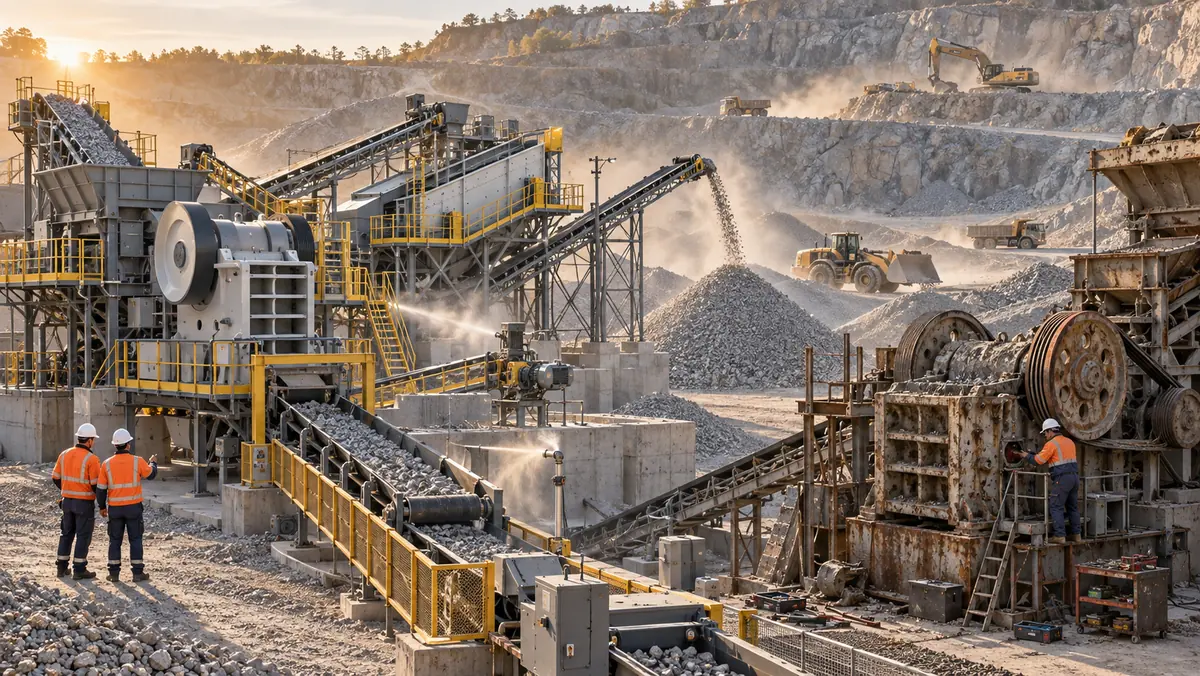
A new crusher is usually the safer choice for a quarry startup when production targets, finance, utilities, and support need to be predictable from day one. A used crusher can lower the purchase price and shorten delivery if its condition, wear parts, documents, and supply scope are independently verified. The decision should not be made from the machine price alone. Compare the same operating duty: rock type, feed size, target products, tonnes per hour, operating hours, site layout, installation scope, critical spares, commissioning support, and likely downtime. The better purchase is the option that delivers reliable saleable aggregate at an acceptable cost per tonne with risks the owner can manage.
The Short Answer: Buy the Risk Profile You Can Support
A startup with limited in-house maintenance depth, a tight product-delivery commitment, or a project-finance schedule should normally favor a new, correctly engineered plant. New equipment gives the buyer a defined duty, a warranty boundary, current drawings, an opening-spares recommendation, and a clearer route for commissioning responsibility. It also makes it easier to specify guards, controls, dust suppression, electrical interfaces, and foundation loads as one package.
Used equipment can be a good commercial decision when the machine is a known model, the ownership and maintenance records are available, wear condition is measured, critical parts can be obtained locally, and the buyer has budget and capability for refurbishment. A low-priced used crusher is not automatically a low-cost project. The savings can disappear if the machine needs a new motor, bearings, liners, screen media, conveyors, controls, foundations, or long-delivery spare parts before it can make product.
Start by defining the whole plant duty. Our complete stone crusher plant setup guide explains the systems that belong in a quarry line, while the crusher plant cost guide helps separate machine price from installed project cost.
New Crusher vs Used Crusher: What Is Actually Being Compared?
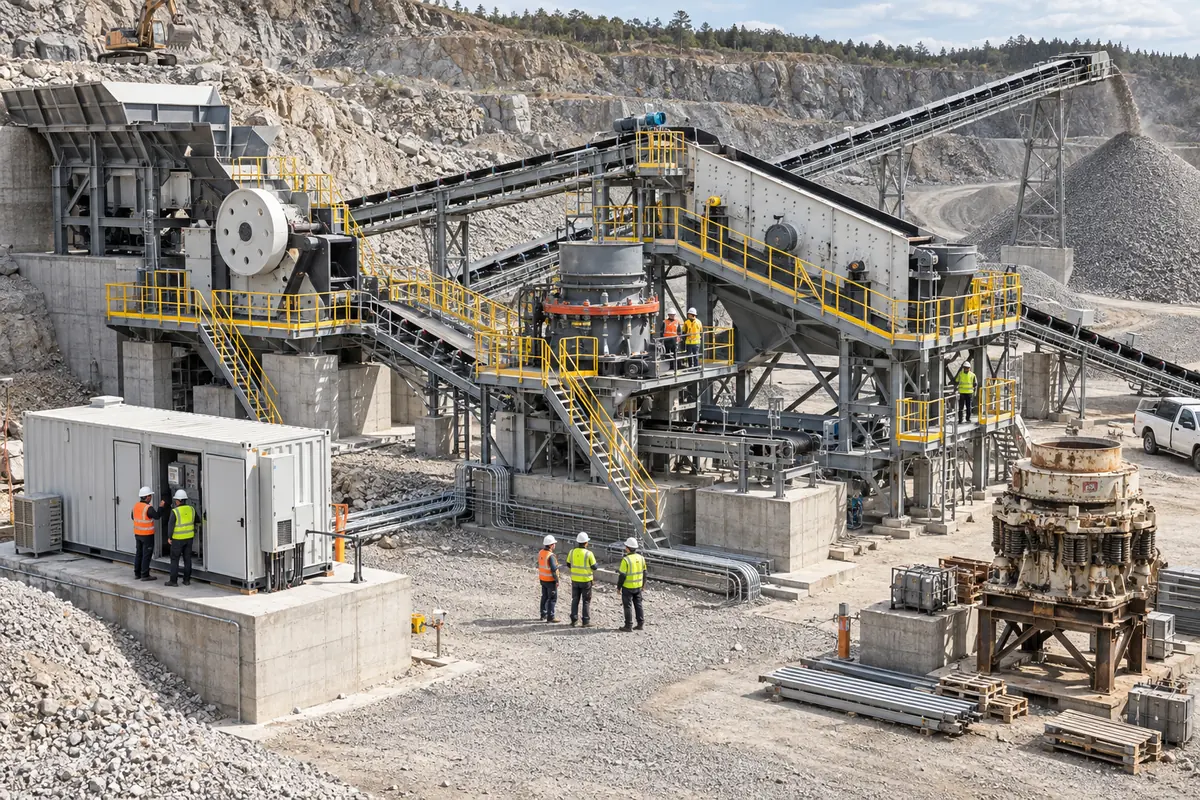
The comparison is rarely just one jaw crusher against another. A quarry needs a connected system: feed hopper and feeder, primary crusher, secondary or tertiary crushing where required, screen, conveyors, stockpile arrangement, electrical supply, controls, guarding, dust control, access platforms, and a plan for startup and service.
A new-plant quotation can define these interfaces as one engineered scope. The buyer can require a process flow, general arrangement, equipment list, motor list, foundation loads, cable responsibility, manuals, and acceptance conditions. Used equipment is often sold with an incomplete boundary. A crusher may be available, but the feeder, support steel, electrics, discharge conveyor, lubrication system, or matching screen may be missing or unsuitable.
Before comparing prices, give every seller the same design basis:
- Raw material, including rock type, hardness, abrasiveness, moisture, clay, and any contamination.
- Maximum and typical feed sizes, plus the feed-size distribution rather than one headline number.
- Required aggregate products, shape requirement, allowable fines, and expected gradation.
- Capacity in tonnes per hour at a stated operating basis, not a brochure maximum.
- Available power, fuel or grid constraints, transport access, elevation, climate, and site footprint.
- Supply boundary for civil work, steelwork, electrical work, installation, dust control, guarding, training, and commissioning.
For a practical breakdown of the machine chain, see how to choose a feeder, crusher, screen, and conveyor for a quarry.
Where a New Crusher Usually Has the Advantage
Defined capacity and process responsibility
With a qualified new-equipment supplier, the buyer can ask the seller to select the chamber, screen area, conveyor widths, drive power, and recirculating-load arrangement for the stated rock and product duty. That does not remove the need to verify assumptions, but it gives the project a documented design point.
Used equipment may have operated successfully in a different circuit, yet be wrong for the new duty. A cone crusher that performed well on dry, consistent feed can disappoint with a different feed distribution, high clay, or a target that requires more reduction or better particle shape. Ask how the quoted machine will work inside the full proposed circuit, not whether it once achieved a high capacity elsewhere.
Warranty, documentation, and compliance
New equipment normally arrives with serial records, manuals, parts lists, electrical documents, lubrication requirements, safety guards, and an agreed warranty. Modern controls can also provide clearer interlocks, protection, and operating data. These items reduce handover uncertainty, especially for a first-time owner building a new operating team.
Used machines can have incomplete manuals, unknown modifications, older electrical architecture, or guards that do not match the proposed installation. These are solvable issues, but they must be priced and assigned before purchase. Treat safety upgrades, control replacement, and missing documentation as project work—not optional extras.
Predictable commissioning and support
For a new complete line, a supplier can be contractually responsible for factory inspection, packing, installation guidance, commissioning, training, and performance testing under defined site conditions. A startup gains value from one party coordinating the equipment interfaces.
The support route matters more than a brand claim. Ask who will attend the site, which parts they hold, how they escalate a failure, and what is included during the first production weeks. The same discipline is necessary for any supplier; see our Chinese crusher manufacturer versus local dealer comparison for questions that turn “support” into evidence.
When a Used Crusher Can Be the Better Buy
A used crusher can make sense when the quarry has a clear technical need, a trustworthy inspection result, and the ability to manage refurbishment. It is particularly attractive where an established operator already knows the machine family, carries compatible spares, has skilled maintenance staff, or needs to add capacity to an existing circuit.
The best used opportunity is usually not the cheapest listing. It is a machine with a traceable operating history, a known serial number, accessible wear and service points, available parts, and enough remaining life in its structural and mechanical components. A complete used plant with drawings, motors, conveyors, support steel, and controls can be easier to evaluate than a bare crusher offered at a low price.
Used equipment may also shorten the route to operation if it is physically available and suitable for the site. But delivery speed should include dismantling, condition assessment, repair, transport, foundations, reassembly, electrical work, trial running, and any missing interfaces. A machine on a seller’s yard is not necessarily a production-ready plant.
Inspection Checklist for Used Crushing Equipment
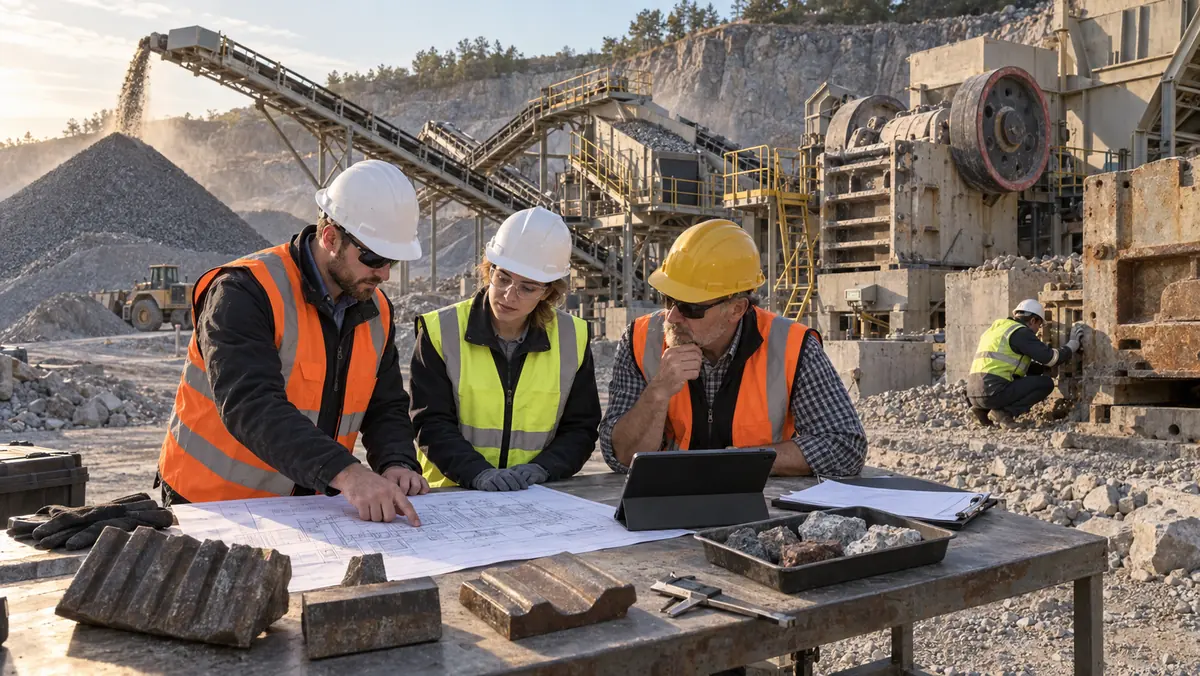
Do not rely only on photographs, a running video, or a seller’s capacity statement. Use an independent technician or a maintenance manager who knows the relevant crusher type. The inspection should record measurements, photographs, serial numbers, and a list of repairs with estimated parts and labor.
- Identity and history: serial number, year, ownership, hours where meaningful, original data sheets, service records, and reason for sale.
- Structure and frame: cracks, repairs, corrosion, damaged threads, worn support points, and evidence of poor transport or lifting.
- Main mechanical condition: bearings, shaft play, gears, eccentric or rotor assembly, hydraulic systems, lubrication, drives, couplings, belts, and motors.
- Wear components: jaw plates, cheek plates, cone liners, mantle, concaves, impact parts, screen media, chutes, and liners. Measure remaining thickness instead of accepting “recently replaced.”
- Electrical and controls: motor nameplates, starter or VFD condition, wiring, safety interlocks, control panel, emergency stops, sensors, and required local compliance upgrades.
- Ancillary equipment: feeder, screen, conveyors, magnets, dust suppression, pumps, hydraulic packs, platforms, guards, and spare-parts inventory.
- Test run: vibration, bearing temperature, oil pressure, noise, leaks, belt tracking, no-load behavior, and—where possible—operation on representative material.
A used crusher with a clean inspection can still need a planned refurbishment package. Put the work into the purchase decision: parts, shipping, labor, downtime, contingency, and the date when the unit will actually be ready to feed rock.
Compare Installed Cost and Cost per Tonne
The purchase price is the first line of a comparison, not the conclusion. A fair owner-side budget separates each item below:
| Cost area | New crusher or new plant | Used crusher or used plant |
|---|---|---|
| Equipment purchase | Higher initial outlay, defined supply scope | Lower or variable price, scope may be incomplete |
| Engineering and drawings | Usually included or available from the supplier | May need new surveys, drawings, and interface design |
| Refurbishment | Limited at startup if equipment is correctly supplied | Often material; budget after measured inspection |
| Civil and installation | Required for both options | Required for both; may rise when old layouts do not fit |
| Electrical and controls | Often current and matched to motors | May need replacement, conversion, or protection upgrades |
| Critical spares | Planned opening stock | May include obsolete or long-lead items |
| Commissioning risk | Clearer if one supplier owns the complete line | Higher when multiple sellers and contractors share interfaces |
| Early downtime | Lower expectation, subject to duty and support | Depends heavily on condition, repairs, and parts availability |
Translate these inputs into expected cost per tonne. Include energy or fuel, labor, wear, planned maintenance, unplanned downtime, finance cost, and lost margin when product cannot be supplied. The mobile crusher operating-cost guide provides a useful model for turning utilization and downtime into an operating comparison.
A Practical Decision Rule for Quarry Startups
Choose a new crusher or complete new line when most of the following are true:
- The quarry has contracted volumes or a strict opening date.
- The owner needs predictable commissioning, warranty, and documented performance assumptions.
- The plant must satisfy defined safety, electrical, environmental, or lender requirements.
- The team has limited capacity for major mechanical refurbishment.
- A single point of responsibility for the connected process is valuable.
Choose a used crusher only when most of these conditions are met:
- A qualified inspection confirms acceptable remaining condition.
- The machine genuinely matches the material, capacity, and product duty.
- Critical parts, technical information, and service support are obtainable.
- The full refurbishment and installation budget still creates worthwhile savings.
- The owner has contingency funds and maintenance capability for early corrective work.
There is also a middle path: buy a new primary crusher, screen, controls, and conveyors for the critical process, then use inspected second-hand equipment only where the risk is well understood. The right mix depends on the bottleneck equipment and the consequence of its failure.
Common Mistakes When Buying New or Used
Comparing headline capacity instead of a documented duty
Capacity depends on material behavior, feed grading, closed-side setting, screen efficiency, recirculating load, and operating practice. Require each option to state the same conditions. For hard feed, review the selection principles in how to choose a crusher for hard ore and abrasive rock.
Buying a bare used crusher without pricing its interfaces
A bare machine needs a feed arrangement, discharge path, supports, electrics, control logic, guards, dust control, and maintenance access. Price those interfaces before treating the listing as a bargain.
Ignoring the parts route
Liners, bearings, hydraulic parts, belts, screen media, and electrical components matter during the first year. Confirm part numbers, stock location, delivery lead times, and price. An unavailable low-cost machine is expensive downtime.
Assuming new equipment removes all buyer work
New equipment still needs correct site data, foundations, power, access, installation supervision, operator training, and feed discipline. A supplier cannot guarantee a plant against undeclared feed changes or excluded site scope.
Spending all available cash on the purchase
Keep a commissioning and contingency reserve. It should cover opening spares, installation changes, field labor, testing, and early adjustments. That reserve is especially important for used-equipment projects.
FAQ
Is a new crusher always better than a used crusher?
No. A new crusher usually offers clearer warranty, engineering, documentation, and startup support. A used crusher can be better value when it is inspected, fits the duty, has available parts, and its full refurbishment cost is still attractive.
How much should I budget to refurbish a used crusher?
The amount depends on the machine type, wear condition, missing ancillaries, motor and controls condition, and local labor cost. Do not choose a percentage before inspection. Create a measured repair scope, quote critical parts, and add a realistic contingency.
What should I inspect before buying a used jaw or cone crusher?
Verify the serial number and history, inspect the frame and main mechanical assemblies, measure wear parts, check lubrication and hydraulics, review motors and controls, and run the equipment on representative material where possible. Also inspect conveyors, screens, guards, and the spare-parts package.
Is a used crusher suitable for a first quarry project?
It can be, but it carries more interface and condition risk. A first-time quarry owner should use an independent inspection, budget all missing plant systems, confirm the parts route, and retain commissioning contingency before relying on used equipment.
Does a new crusher plant cost more per tonne than used equipment?
Not necessarily. New equipment costs more upfront but may reduce early repairs, downtime, and commissioning uncertainty. Used equipment can lower capital cost but may increase repair, parts, labor, and lost-production cost. Compare expected life-cycle cost and utilization, not purchase price alone.
Can I combine new and used equipment in one crushing line?
Yes, if the capacity, controls, physical layout, power, guarding, and maintenance responsibilities are engineered as one system. Use new equipment for critical bottlenecks when predictability is essential, and use inspected used equipment only with compatible parts and support.
What information should I send for a crusher quotation?
Send your raw material, maximum and typical feed size, required output sizes, target capacity, operating hours, available power, site photos, site constraints, and budget range. Add any drawings, aggregate specifications, or existing-equipment details.
How do I reduce the risk of downtime after purchase?
Specify an opening and critical-spares package, check maintenance access, train operators, document commissioning settings, and set a preventive-maintenance routine. For used equipment, complete the priority repairs before it becomes the production bottleneck.
Get a New-vs-Used Crusher Comparison for Your Site
MVSI Crusher can help buyers compare a new plant, a used-equipment opportunity, or a mixed solution against the same operating duty. Send your raw material, maximum and typical feed size, required output size, target capacity, site photos, and budget range. We can review the process scope, identify missing interfaces, and recommend a practical equipment configuration, inspection focus, and spares plan.