Table of Contents
- Why Product Size Controls Crushing Plant Design
- Start with Raw Material and Feed Size
- Recommended Flow for 0-5mm, 5-10mm, and 10-20mm Aggregates
- Screen Decks, Closed-Side Settings, and Recirculation
- Crusher Selection by Material and Product Requirement
- Capacity Planning and Product Split
- When to Add a VSI Crusher
- Plant Layout, Stockpiles, and Site Conditions
- Dust, Washing, and Aggregate Cleanliness
- Common Buyer Mistakes
- What to Send Before Asking for a Quote
- Conclusion
- FAQ
- What equipment is needed for a 0-5mm, 5-10mm, and 10-20mm aggregate plant?
- Which crusher is best for making 10-20mm aggregate?
- Do I need a VSI crusher to make 0-5mm sand?
- How do I choose screen sizes for 5-10mm and 10-20mm aggregate?
- Why is my crushing plant producing too much fine material?
- Is a mobile crushing plant suitable for multi-size aggregate production?
- What information should I provide before requesting a crushing plant quotation?
How to Design a Crushing Plant for 0-5mm, 5-10mm, 10-20mm Aggregates
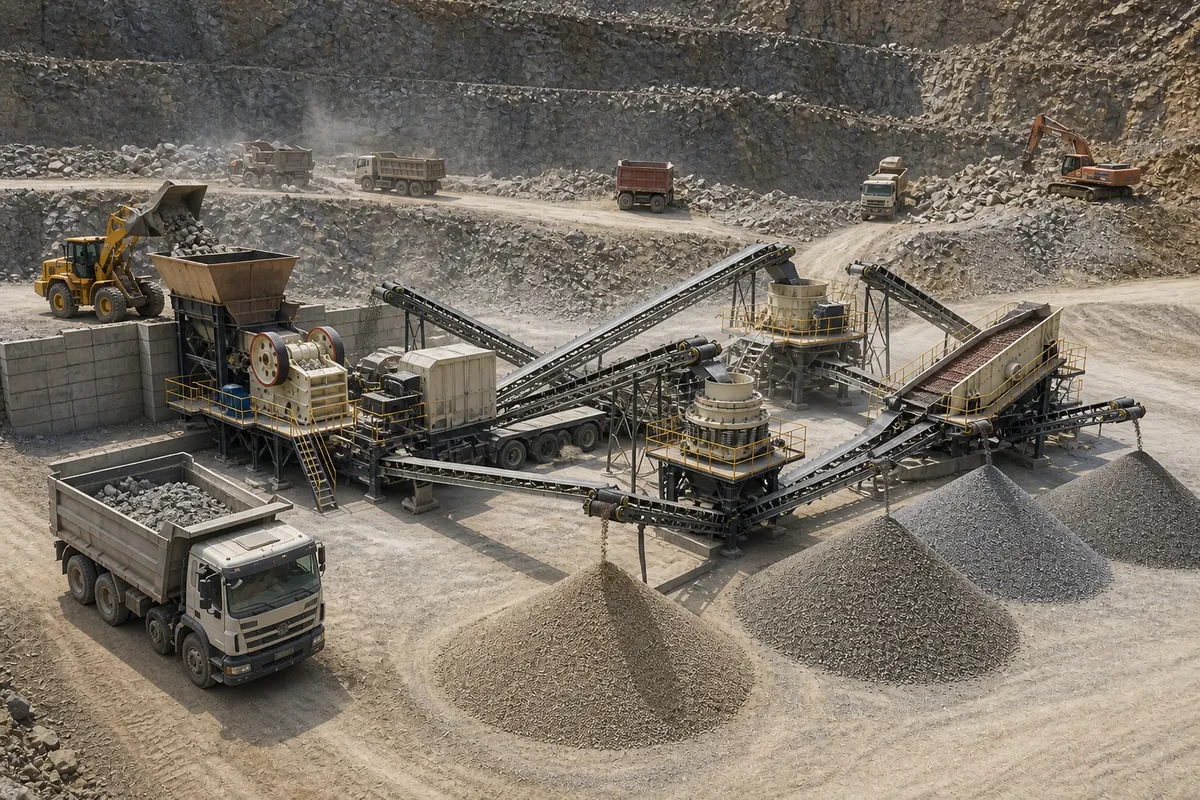
To design a crushing plant for 0-5 mm, 5-10 mm, and 10-20 mm aggregates, start from the required product split, raw material hardness, maximum feed size, capacity, and local specification for sand and concrete aggregate. A typical hard-rock plant uses a vibrating feeder, jaw crusher, cone crusher, vibrating screen, return conveyor, and sometimes a VSI crusher for better sand shape. The screen deck openings, crusher closed-side settings, recirculation load, and stockpile conveyors must be matched together. The goal is not only to crush stone, but to keep each product size stable, clean, and saleable.
Why Product Size Controls Crushing Plant Design
Many buyers first ask for a 100 TPH, 200 TPH, or 300 TPH stone crusher plant. Capacity is important, but the final product sizes often control the real plant design. A plant that only makes 20-40 mm base material is different from a plant that must produce 0-5 mm sand, 5-10 mm chips, and 10-20 mm concrete aggregate at the same time.
The three common products have different operating requirements:
- 0-5 mm material needs good shape, controlled fines, and often a VSI crusher or sand washing step.
- 5-10 mm aggregate needs stable screening and enough middle-size production from the crusher circuit.
- 10-20 mm aggregate needs controlled top size, clean separation, and enough stockpile capacity for truck loading.
If the screen, crusher settings, and recirculation conveyor are not matched, one product may be oversupplied while another product is always short. That is why aggregate plant design should begin with the sales plan or project specification, not only with the crusher model.
For a wider view of plant layout, see our guide to complete stone crusher plant setup. If the main concern is investment planning, compare the cost factors in Stone Crusher Plant Cost: What Determines the Final Price?.
Start with Raw Material and Feed Size
The same product sizes can require very different equipment when the raw material changes. Granite, basalt, and river stone usually need stronger crushing, better wear protection, and careful cone crusher selection. Limestone and medium-hard rock may allow a simpler jaw crusher plus impact crusher flow. Recycled concrete may need metal removal and extra screening before final products are sold.
Before designing the flow, collect the following information:
- Raw material name, such as granite, basalt, limestone, river stone, andesite, dolomite, or concrete waste.
- Maximum feed size before primary crushing.
- Estimated hardness and abrasiveness, or at least a clear rock photo and local quarry information.
- Clay, soil, moisture, or weathered material content in the feed.
- Required final output sizes and the percentage needed for each product.
- Target capacity in tons per hour and working hours per day.
- Whether manufactured sand must meet concrete, asphalt, plastering, or road base standards.
These details decide the feeder opening, jaw crusher size, secondary crusher type, screen area, conveyor width, motor power, and dust or washing system.
Recommended Flow for 0-5mm, 5-10mm, and 10-20mm Aggregates
A practical aggregate crushing plant should be designed as one continuous material flow, not as separate machines selected one by one.
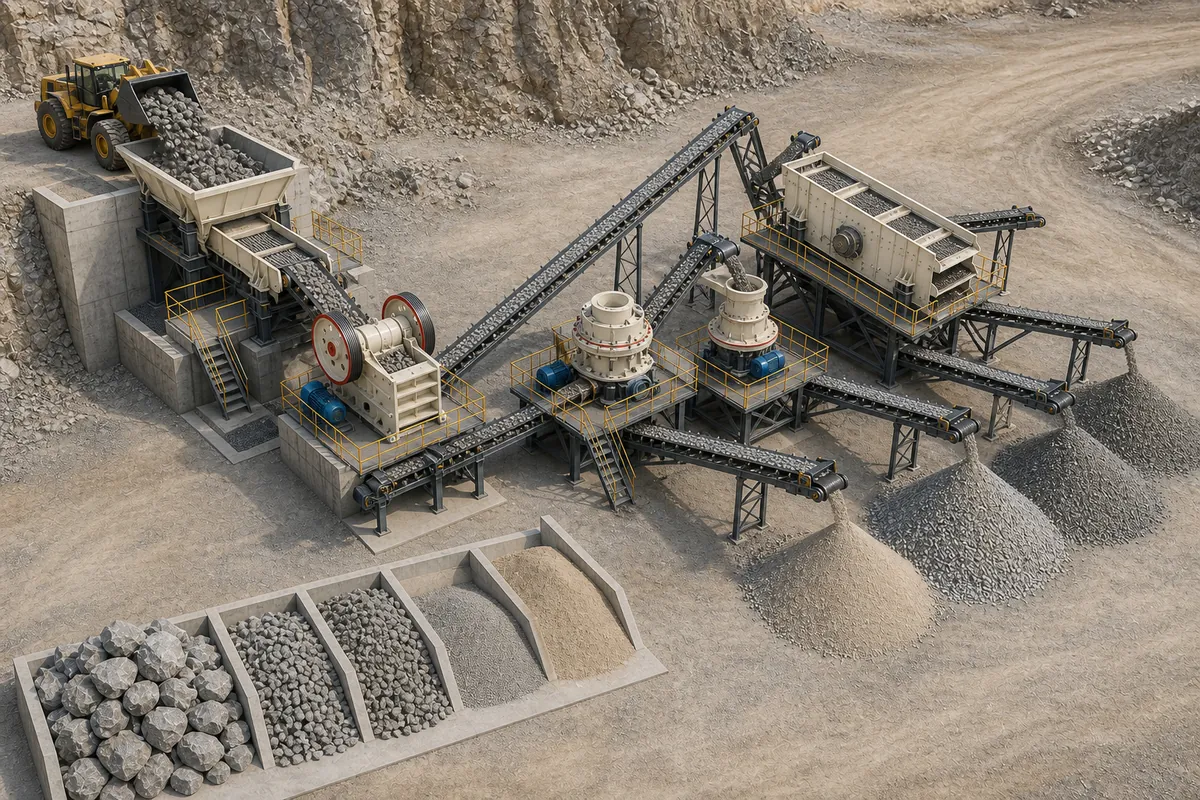
For hard rock, a common flow is:
- Loader or excavator feeds blasted stone into a vibrating feeder.
- The feeder removes some fines and sends oversized stone into the jaw crusher.
- Jaw crusher discharge moves by belt conveyor to a secondary cone crusher.
- The cone crusher reduces material to a size suitable for screening and shaping.
- A vibrating screen separates 0-5 mm, 5-10 mm, and 10-20 mm products.
- Oversized material returns to the cone crusher or enters a tertiary crusher.
- If sand shape is important, part of the material enters a VSI crusher before final screening.
- Finished products move to separate stockpiles with enough space for loading and quality control.
For limestone, the secondary stage may use an impact crusher instead of a cone crusher. For high-quality manufactured sand, a VSI sand making machine is usually added after cone crushing or impact crushing. The VSI does not simply make the material smaller; it improves particle shape and can help increase the usable 0-5 mm product when the feed grading is suitable.
Screen Decks, Closed-Side Settings, and Recirculation
The vibrating screen is the control center of a multi-size aggregate plant. A crusher can only reduce stone; the screen decides which particles become final products and which particles return for more crushing.
Screen deck openings should be selected according to actual product specification, material moisture, screen angle, screen type, and expected near-size particles. A nominal 10 mm product does not always use a 10 mm screen opening in every site. Wet or flaky material may need a different opening, stronger vibration, or pre-screening.
| Design Item | Practical Role | Key Design Question |
|---|---|---|
| Primary crusher CSS | Controls jaw crusher discharge size | Is the discharge small enough for secondary crushing without overloading conveyors? |
| Secondary crusher CSS | Controls feed to screen and return load | Can the cone or impact crusher make enough 5-10 mm and 10-20 mm material? |
| Screen deck area | Controls separation capacity | Can the screen handle total feed plus recirculating material? |
| Return conveyor | Sends oversize back to crushing | Is the return load realistic, or will it choke the secondary crusher? |
| Stockpile conveyors | Separate finished products | Is there enough space for sand, fine aggregate, and coarse aggregate storage? |
High recirculation is a common hidden capacity problem. A 200 TPH crusher may not produce 200 TPH of saleable product if 40 percent of the material keeps returning to the crusher. A good supplier should estimate the circulating load and design the screen and conveyors around total material flow, not only finished product output.
Crusher Selection by Material and Product Requirement
The best crusher combination depends on raw material and final aggregate quality. Selecting the cheapest crusher can create high wear cost, poor product shape, or unstable product size.
| Material or Requirement | Common Configuration | Why It Works |
|---|---|---|
| Granite, basalt, andesite | Jaw crusher plus cone crusher plus screen | Strong compression crushing, better wear control for hard abrasive rock |
| River stone | Jaw crusher plus cone crusher, optional VSI | Handles hard rounded feed and improves final particle shape |
| Limestone and medium-hard rock | Jaw crusher plus impact crusher plus screen | Good reduction ratio and cubical product when abrasiveness is moderate |
| High-quality manufactured sand | Jaw, cone or impact, VSI, screen, optional washer | VSI shaping improves sand particle shape and gradation control |
| Road base with less strict shape | Jaw crusher plus cone or impact crusher plus screen | Focuses on stable capacity and coarse aggregate production |
| Recycled concrete | Jaw or impact crusher, magnet, screen | Handles demolition feed and removes steel before final sizing |
If the plant must make both coarse aggregate and high-quality sand, do not let sand demand control the entire flow without checking the coarse product market. Some quarries make more profit from 10-20 mm aggregate than from 0-5 mm sand. Others need more sand because natural river sand is limited. The right plant balances the product mix.
Capacity Planning and Product Split
Capacity should be calculated from finished saleable products, not only from the maximum crusher nameplate capacity. A plant advertised as 200 TPH may produce different output depending on feed size, rock hardness, moisture, crusher setting, screen efficiency, and product split.
| Target Finished Output | Suitable Project Type | Typical Design Focus |
|---|---|---|
| 50-100 TPH | Small quarry, local road project, startup aggregate business | Simple flow, low civil work, easy operation |
| 100-200 TPH | Commercial quarry, concrete aggregate supplier, contractor plant | Balanced production of sand, 5-10 mm, and 10-20 mm aggregate |
| 200-300 TPH | Medium quarry, road aggregate supply, infrastructure project | Larger screen area, stronger conveyors, controlled return load |
| 300+ TPH | Long-term quarry or large aggregate sales contract | Multi-stage crushing, larger stockpiles, parallel screening or extra crushing stage |
When the buyer requests 150 TPH, the supplier should ask whether that means 150 TPH total finished aggregate or 150 TPH of only 10-20 mm material. The equipment choice can change significantly. A plant designed for 40 percent sand production may require VSI shaping and more screening area, while a plant focused on coarse aggregate may use a different crusher setting and stockpile layout.
When to Add a VSI Crusher
A VSI crusher is useful when the project needs better cubical shape, more manufactured sand, or improved surface texture for concrete and asphalt aggregate. It is often used after cone crushing because cone crushers are efficient for size reduction but may produce flaky particles when the chamber, CSS, or feed grading is not ideal.
Add a VSI crusher when:
- 0-5 mm sand is a main saleable product.
- The market pays for better cubical shape and controlled gradation.
- Cone crusher product contains too many elongated particles.
- The plant needs to improve concrete aggregate shape before final screening.
- Natural sand is expensive, restricted, or inconsistent in the local market.
Do not add VSI only because it sounds advanced. VSI wear cost, feed grading, moisture, rotor speed, and spare parts must be checked. For very abrasive material, the choice between rock-on-rock and rock-on-iron crushing affects operating cost and product shape. For more detail, read How to Choose a VSI Sand Making Machine for Granite, Basalt, and Limestone and Rock-on-Rock vs Rock-on-Iron VSI Crusher: Key Differences.
Plant Layout, Stockpiles, and Site Conditions
Good layout reduces rehandling, truck waiting time, dust problems, and maintenance risk. Even a strong crusher plant can perform poorly if the site layout is too tight or the conveyors are too short.
Important layout checks include:
- Feed hopper position and loader access.
- Safe truck movement around raw material and finished product stockpiles.
- Conveyor length, discharge height, and stockpile volume.
- Space for return conveyors and maintenance platforms.
- Electrical room, control cabinet, cables, water pipe, and dust suppression layout.
- Drainage during rainy season or wet material operation.
- Foundation conditions for stationary plants or leveling area for mobile plants.
If the site changes frequently, a mobile or semi-mobile plant may be more practical than a stationary plant. If the quarry is long-term and has enough land, a stationary plant usually gives stronger stockpile planning, lower operating cost per ton, and easier maintenance access.
Dust, Washing, and Aggregate Cleanliness
The 0-5 mm product is sensitive to dust, clay, and moisture. Some markets accept crusher dust for road base, while concrete sand may need better gradation and lower clay content. If the raw material contains soil or weathered fines, the plant may need pre-screening, water spray, a sand washer, or a more careful feed management plan.
Dust control is also part of design. Use covered conveyors where needed, water spray at transfer points, sealed chutes, and reasonable stockpile distance. A plant with uncontrolled dust may face local permit problems, lower operator comfort, and faster wear around bearings and motors.
Washing is useful when the product specification requires cleaner sand or aggregate. However, it adds water demand, wastewater treatment, fines management, and extra civil work. The decision should be based on final product requirement, not only on visual cleanliness.
Common Buyer Mistakes
The most common mistake is asking for one price before defining product sizes and product percentages. A quote for a plant that makes mostly 20 mm aggregate cannot be compared fairly with a plant that must make high-quality 0-5 mm sand.
Another mistake is ignoring the screen. Buyers often focus on jaw crusher or cone crusher model, but an undersized screen can reduce the whole plant capacity. The screen must handle the total feed, including recirculating material.
Some buyers also forget stockpile space. If three final products are needed, the site must have enough room for separate piles and loader movement. Mixed stockpiles reduce product value and make quality control difficult.
What to Send Before Asking for a Quote
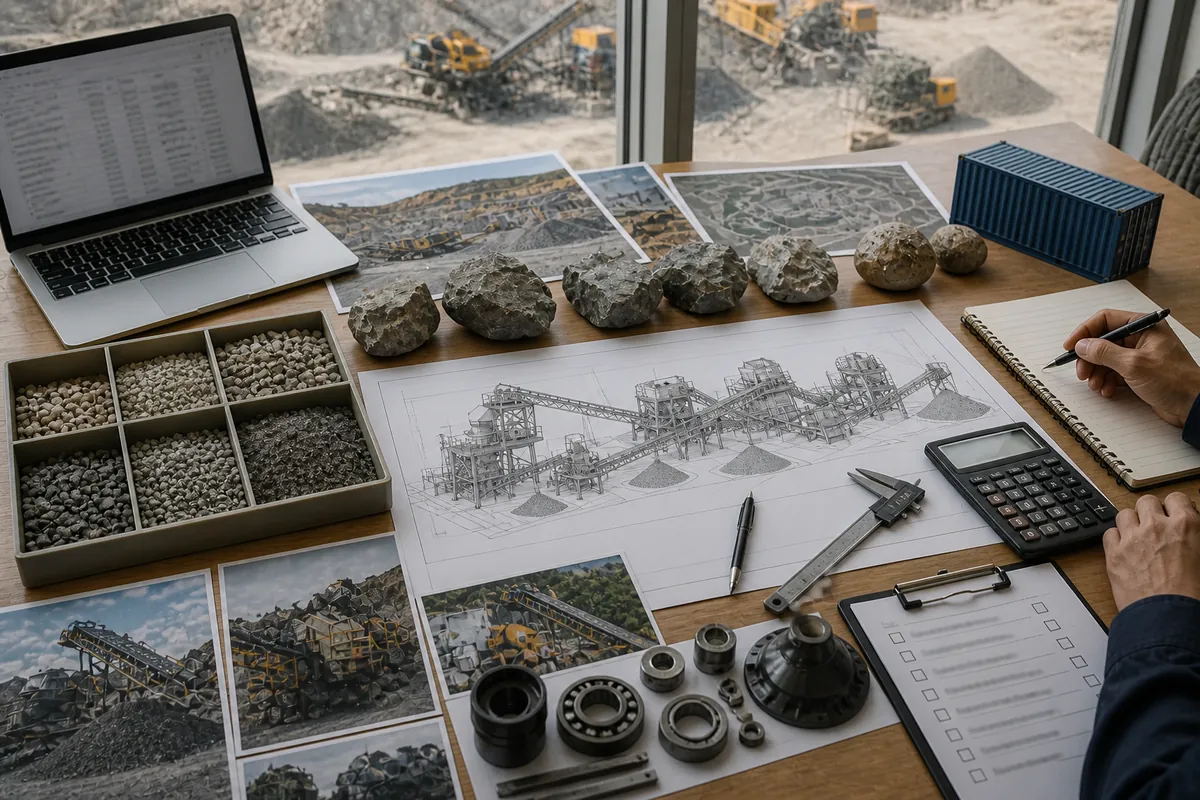
To get a useful aggregate crushing plant design, prepare a clear technical request before asking for price. Send the supplier:
- Raw material name and photos.
- Maximum feed size before crushing.
- Required output size, including 0-5 mm, 5-10 mm, 10-20 mm, or other local specifications.
- Target capacity in tons per hour and the expected product percentage for each size.
- Site photos, available land size, and whether the plant should be stationary, mobile, or semi-mobile.
- Power condition, water availability, dust control requirement, and local climate.
- Budget range, delivery schedule, and whether installation guidance is needed.
With raw material, feed size, output size, capacity, site photos, and budget range, MVSI can review the application and suggest a practical crushing, screening, conveying, and sand-making configuration.
Conclusion
A crushing plant for 0-5 mm, 5-10 mm, and 10-20 mm aggregates should be designed from the required product mix, not only from crusher capacity. Raw material hardness, feed size, crusher selection, screen area, recirculation load, stockpile space, dust control, and optional VSI shaping all affect the final plant.
For hard rock, jaw crusher plus cone crusher plus screen is a stable base flow. For limestone, jaw plus impact crusher may be economical. For high-quality manufactured sand, VSI shaping and careful screening are often needed. If you are planning a new aggregate plant, send MVSI your raw material, feed size, output size, capacity, site photos, and budget range so we can help match the plant design to your market.
FAQ
What equipment is needed for a 0-5mm, 5-10mm, and 10-20mm aggregate plant?
A typical plant needs a vibrating feeder, primary jaw crusher, secondary cone or impact crusher, vibrating screen, return conveyor, finished product conveyors, control system, dust control, and stockpile area. A VSI crusher may be added when 0-5 mm manufactured sand quality is important.
Which crusher is best for making 10-20mm aggregate?
For hard and abrasive rock, a jaw crusher plus cone crusher is commonly used to make 10-20 mm aggregate. For limestone or medium-hard rock, a jaw crusher plus impact crusher may be suitable and can produce a more cubical product.
Do I need a VSI crusher to make 0-5mm sand?
Not always. Some cone or impact crusher circuits can produce 0-5 mm material, but a VSI crusher is often used when the project needs better particle shape, more controlled manufactured sand, or higher concrete and asphalt aggregate quality.
How do I choose screen sizes for 5-10mm and 10-20mm aggregate?
Screen sizes should be selected according to the required product specification, moisture, material shape, screen angle, and expected near-size particles. The supplier should calculate screen capacity and recirculation instead of choosing openings only by the product name.
Why is my crushing plant producing too much fine material?
Excess fines can come from soft material, high crusher speed, tight closed-side setting, too much recirculation, worn liners, or poor feed grading. The solution may include changing crusher settings, adjusting screen flow, improving feed control, or adding washing and fines management.
Is a mobile crushing plant suitable for multi-size aggregate production?
Yes. A mobile crushing and screening plant can produce several sizes if it includes the right crusher, screen decks, conveyors, and stockpile arrangement. Stationary plants usually offer more stockpile space and lower long-term cost, while mobile plants are better for relocation and fast setup.
What information should I provide before requesting a crushing plant quotation?
Provide raw material, maximum feed size, required output sizes, product percentage, target capacity, site photos, power condition, mobility preference, budget range, and delivery schedule. These details make the design and price more accurate.