Table of Contents
- Why Cubical Shape Matters in Manufactured Sand
- How a VSI Crusher Improves Particle Shape
- Start with Correct Feed Size
- Choose the Right Chamber Type
- Rock-on-Rock Chamber
- Rock-on-Iron Chamber
- Adjust Rotor Speed Carefully
- Use Closed Circuit Screening
- Control Cascade Feed
- Keep Wear Parts in Good Condition
- Match the VSI to the Rock Type
- Test Aggregate Shape Regularly
- Recommended Plant Configuration for Better Shape
- Common Mistakes That Reduce Cubical Shape
- What Information Should You Send Before Asking for a VSI Recommendation?
- Conclusion
- FAQ
- Does a VSI crusher improve cubical aggregate shape?
- What feed size is best for VSI shaping?
- Is rock-on-rock or rock-on-iron better for cubical aggregate?
- Does higher rotor speed always improve sand shape?
- Why is closed circuit screening important after a VSI crusher?
- Can a VSI crusher make concrete sand?
- How do I reduce flaky particles in manufactured sand?
- What information should I provide before buying a VSI crusher?
A VSI crusher improves cubical shape in manufactured sand by accelerating rock through a high-speed rotor and forcing particle-on-particle or particle-on-anvil impact. This breaks weak edges, reduces flat and elongated particles, and improves the final shape of 0-5 mm sand and coarse aggregate. To get stable results, the plant must control feed size, feed grading, rotor speed, chamber type, cascade feed, screening efficiency, and wear part condition. A VSI is most effective as a final-stage shaping machine after jaw, cone, or impact crushing has already reduced the material to a suitable feed size.
This guide explains how quarry owners, aggregate producers, and road contractors can use a VSI crusher to improve cubical aggregate shape and manufactured sand quality.
Why Cubical Shape Matters in Manufactured Sand
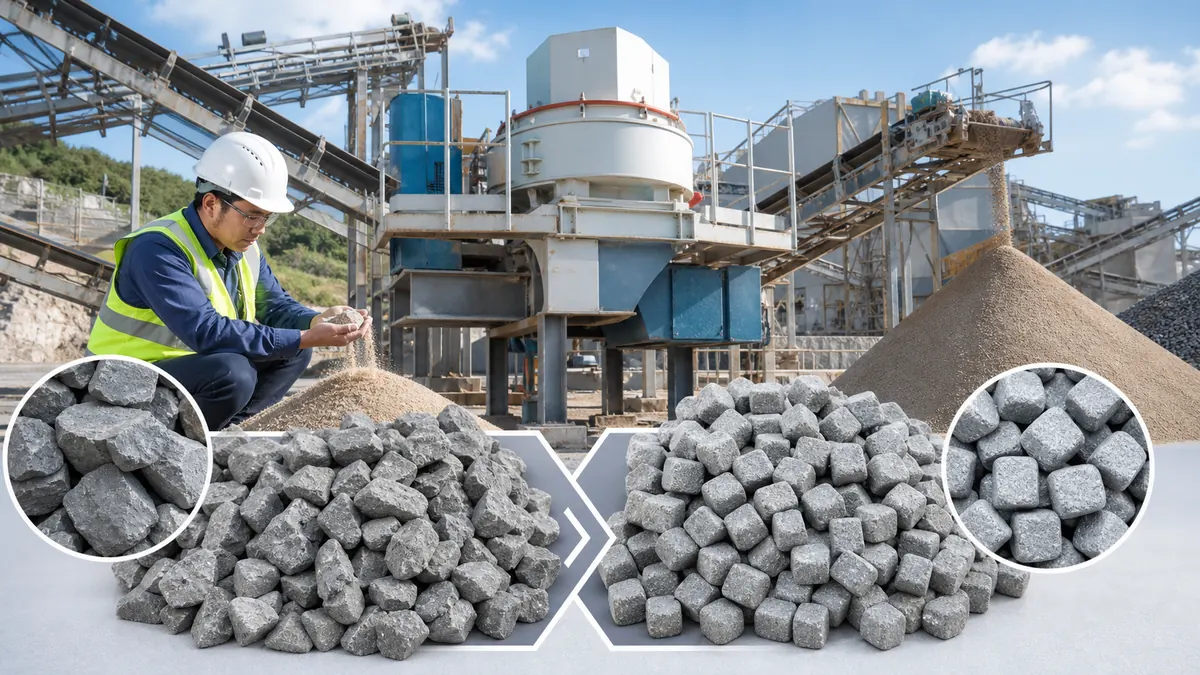
Cubical aggregate has a more balanced particle shape than flaky or elongated aggregate. In concrete, asphalt, road base, and dry-mix mortar, better shape can improve packing density, workability, strength stability, and finish quality.
Poor particle shape can create higher cement or binder consumption, lower concrete workability, poor asphalt compaction, more voids in road base material, unstable gradation after screening, and buyer complaints about flat and elongated particles.
Many quarries can produce enough tons per hour, but still struggle to meet shape requirements. This is where a VSI crusher can add value. It does not only reduce size; it also reshapes particles by impact.
How a VSI Crusher Improves Particle Shape
A VSI crusher feeds material into a rotor rotating at high speed. The rotor throws the material outward into a crushing chamber. Depending on the chamber design, the material may hit a rock bed, anvils, or a combination of both.
During this process, sharp edges and weak flaky sections are broken. The repeated impact and friction can improve cubical shape, especially when the material is recirculated through a screen and returned to the VSI for final shaping.
The shape improvement depends on feed size and feed grading, rotor speed, rock hardness and abrasiveness, moisture and clay content, chamber type, cascade feed ratio, circulating load, and wear part condition.
If these factors are not controlled, even a good VSI crusher may produce too much filler, uneven sand, high wear cost, or unstable capacity.
Start with Correct Feed Size
The VSI crusher should not receive oversized feed. Oversized material increases rotor wear, vibration risk, and power load. It may also reduce shaping efficiency because large particles do not move through the chamber evenly.
For manufactured sand, many plants use jaw and cone crushers before the VSI. The upstream crushers reduce raw stone into a controlled feed size, then the VSI handles final shaping and fine crushing.
- Keep maximum feed size within the VSI model limit.
- Avoid sudden oversized lumps from the upstream crusher.
- Use a screen before the VSI when feed size is unstable.
- Keep feed grading consistent, not only maximum size.
- Remove clay or sticky fines if they block normal flow.
If a plant sends mixed oversized rock directly into the VSI, the result is often high wear cost and poor shape consistency.
Choose the Right Chamber Type

The chamber type has a strong effect on shape, wear cost, and sand grading.
Rock-on-Rock Chamber
In a rock-on-rock chamber, material impacts a rock bed. This design is commonly used for hard and abrasive rock such as granite, basalt, river stone, and quartz-rich stone. It usually gives good particle shape with lower metal wear.
Rock-on-rock is suitable when the material is hard and abrasive, the buyer wants lower wear cost, the plant needs good cubical shape, and the product can tolerate slightly lower crushing force than rock-on-iron.
Rock-on-Iron Chamber
In a rock-on-iron chamber, material impacts metal anvils or impact blocks. This can give stronger breakage force, but wear may be higher, especially with abrasive stone.
Rock-on-iron is suitable when the material is medium-hard or less abrasive, more crushing force is needed, the plant wants more fine material, and wear cost is acceptable for the application.
For a deeper chamber comparison, see Rock-on-Rock vs Rock-on-Iron VSI Crusher: Key Differences.
Adjust Rotor Speed Carefully
Rotor speed affects impact energy. Higher speed usually increases crushing and shaping force, but it can also increase wear, power consumption, and fine powder content.
If the product is too flaky, increasing rotor speed may help. If the product has too much filler or the wear cost is rising too quickly, the speed may be too high for the material and target product.
Rotor speed should be adjusted based on required final size, shape index target, rock hardness, abrasiveness, moisture content, motor power, wear part life, and screen return rate.
Do not adjust rotor speed alone. Always check feed grading, screen performance, and wear condition at the same time.
Use Closed Circuit Screening
A VSI crusher works best for shape improvement when it is connected with a screen in a closed circuit. Material that already meets the target size can leave the circuit. Oversize or poorly shaped particles return to the VSI for another pass.
- Stabilize final product grading
- Improve cubical shape
- Reduce unnecessary over-crushing
- Control filler content
- Increase usable product ratio
Open circuit VSI crushing can still work in some applications, but it gives less control. For high-quality manufactured sand, road aggregate, and concrete aggregate, closed circuit screening is usually the better choice.
Control Cascade Feed
Cascade feed allows part of the material to bypass the rotor and enter the crushing chamber directly. This can help adjust capacity, product shape, and energy consumption.
More rotor feed usually means stronger crushing and shaping. More cascade feed can increase throughput and reduce wear, but may reduce shaping intensity if used too heavily.
The correct cascade ratio depends on feed size distribution, target sand ratio, required shape, wear cost target, power limit, and screen return load. Operators should record settings and product test results.
Keep Wear Parts in Good Condition
Worn rotor tips, anvils, liners, feed tubes, and distributor plates can change the material flow inside the VSI. This may reduce shaping efficiency and cause vibration, uneven wear, or unstable sand grading.
Important wear parts include rotor tips, backup tips, tip carrier plates, anvils or impact blocks, chamber liners, feed tube, distributor plate, and upper and lower wear plates.
If the plant needs stable product shape, wear parts should be inspected before the product goes out of specification, not after a shutdown happens.
For more detail, read VSI Crusher Wear Parts: Rotor Tips, Anvils, Liners, and Maintenance.
Match the VSI to the Rock Type
Different materials behave differently inside a VSI crusher.
| Material | Shape Improvement Potential | Wear Risk | Practical Notes |
|---|---|---|---|
| Granite | High | High | Use controlled feed size, strong wear parts, and closed circuit screening. |
| Basalt | High | High | Good for cubical aggregate, but wear and rotor balance must be watched. |
| River stone | Medium to high | Medium to high | Rounded feed may need enough impact energy for sand making. |
| Limestone | Medium | Low to medium | Can produce good sand, but may create fines if speed is too high. |
| Dolomite | Medium | Medium | Test rotor speed and chamber type before final plant design. |
| Quartz-rich stone | High | Very high | Wear cost must be planned carefully. |
If the material is very abrasive, lower wear cost may be more important than maximum fine crushing. If the material is soft, the plant may need to avoid over-crushing and excessive powder.
Test Aggregate Shape Regularly

Operators should not judge shape only by looking at the belt. Use regular product testing to compare settings.
- Flakiness index
- Elongation index
- Sieve analysis
- Filler or powder content
- Sand gradation curve
- Moisture content
- Visual comparison of particle shape
- Concrete or asphalt trial performance
Keep records of rotor speed, feed size, cascade ratio, chamber type, wear hours, screen mesh, and test results. This makes it easier to find the setting that gives the best commercial product, not just the best-looking sample.
Recommended Plant Configuration for Better Shape
- Vibrating feeder for stable raw material feeding
- Jaw crusher for primary crushing
- Cone crusher or impact crusher for secondary crushing
- Vibrating screen to separate suitable VSI feed
- VSI crusher for final shaping and sand making
- Return conveyor for closed circuit screening
- Sand washer or air classifier if washing or powder control is needed
- Final product stockpiles by size
For hard rock such as granite and basalt, the jaw plus cone plus VSI combination is common. For limestone, jaw plus impact plus VSI may be considered when the product target and wear cost allow it.
Common Mistakes That Reduce Cubical Shape
Many shape problems are caused by plant setup rather than the VSI crusher itself.
- Feeding oversized material into the VSI
- Ignoring feed grading and only checking maximum feed size
- Running rotor speed too low for the shape target
- Running rotor speed too high and creating too much filler
- Using the wrong chamber type for the rock
- Operating without closed circuit screening
- Letting worn parts change the internal crushing path
- Not testing product shape regularly
- Choosing capacity only, without checking final aggregate quality
The best VSI setup balances shape, capacity, wear cost, and product grading.
What Information Should You Send Before Asking for a VSI Recommendation?
To recommend a VSI crusher for cubical aggregate or manufactured sand, a supplier needs more than the desired capacity. Send raw material name and photos, hardness and abrasiveness if known, maximum feed size, current crushing process, required output sizes, required capacity, shape or flakiness target, moisture and clay content, washing or powder control needs, site layout photos or drawings, budget range, and delivery timeline.
With this information, MVSI can recommend a suitable VSI model, chamber type, motor power, screening circuit, and wear parts plan.
Conclusion
A VSI crusher can significantly improve cubical aggregate shape and manufactured sand quality, but the machine must be used as part of a complete process. Feed size, rotor speed, chamber type, cascade ratio, screening, recirculation, and wear parts all affect the final result.
If your quarry or construction aggregate project needs better particle shape, send your raw material, feed size, output size, capacity, site photos, and budget range. MVSI can help design a VSI sand making and shaping solution for your production target.
FAQ
Does a VSI crusher improve cubical aggregate shape?
Yes. A VSI crusher improves cubical shape by using high-speed impact to break weak edges and reduce flat or elongated particles. It is commonly used as a final shaping machine.
What feed size is best for VSI shaping?
The best feed size depends on the VSI model and material, but it should always stay within the machine limit. Controlled and consistent feed grading is more important than only checking maximum size.
Is rock-on-rock or rock-on-iron better for cubical aggregate?
Rock-on-rock is often preferred for hard and abrasive rock because it can improve shape with lower metal wear. Rock-on-iron can provide stronger breakage force but may increase wear cost.
Does higher rotor speed always improve sand shape?
No. Higher rotor speed can improve impact and shaping, but it may also increase fine powder, wear cost, and power consumption. Speed should be adjusted together with feed size and screening.
Why is closed circuit screening important after a VSI crusher?
Closed circuit screening returns oversize or poorly shaped particles to the VSI for another pass. This improves grading control and helps stabilize cubical shape.
Can a VSI crusher make concrete sand?
Yes. A VSI crusher can make manufactured sand for concrete when the plant controls gradation, shape, powder content, and washing or air classification requirements.
How do I reduce flaky particles in manufactured sand?
Use controlled VSI feed, suitable rotor speed, correct chamber type, closed circuit screening, and regular wear part inspection. Product testing should confirm the actual improvement.
What information should I provide before buying a VSI crusher?
Send raw material, feed size, output size, capacity, shape target, moisture content, current process, site photos, and budget range so the supplier can recommend a practical configuration.