Table of Contents
- VSI Crusher vs Cone Crusher: Quick Answer
- What Is a Cone Crusher Best For?
- What Is a VSI Crusher Best For?
- Which Crusher Makes Better Manufactured Sand?
- Recommended Equipment Configuration
- 1. Hard Rock Manufactured Sand Plant
- 2. Aggregate Plant Without High Sand Requirement
- 3. Existing Plant Upgrade with VSI Crusher
- 4. Mobile Cone and Mobile VSI Combination
- Cost and Wear Considerations
- Selection Criteria for Buyers
- Raw Material
- Feed Size
- Final Product Size
- Capacity
- Product Shape Requirement
- Mobile or Stationary Installation
- Common Buyer Mistakes
- Internal Reading
- Final Recommendation
- FAQ
- Is a VSI crusher better than a cone crusher for sand making?
- Can a cone crusher produce manufactured sand?
- Do I need both cone crusher and VSI crusher?
- Which crusher is better for granite sand making?
- Which crusher has lower wear cost?
- What feed size is suitable for a VSI crusher?
- Is a mobile VSI crusher suitable for manufactured sand?
- What information should I provide before asking for a crusher quotation?
A VSI crusher is usually better than a cone crusher for the final stage of manufactured sand production because it improves particle shape and produces more 0-5 mm sand. A cone crusher is better for reducing hard rock before sand making, especially with granite, basalt, quartz, and river stone. In many high-quality sand plants, the best answer is not VSI crusher or cone crusher alone. The more reliable configuration is a cone crusher for size reduction, followed by a VSI crusher for shaping, sand production, and final grading control.
The right choice depends on raw material hardness, feed size, target sand percentage, required capacity, wear cost, and whether the plant should be mobile or stationary.
VSI Crusher vs Cone Crusher: Quick Answer
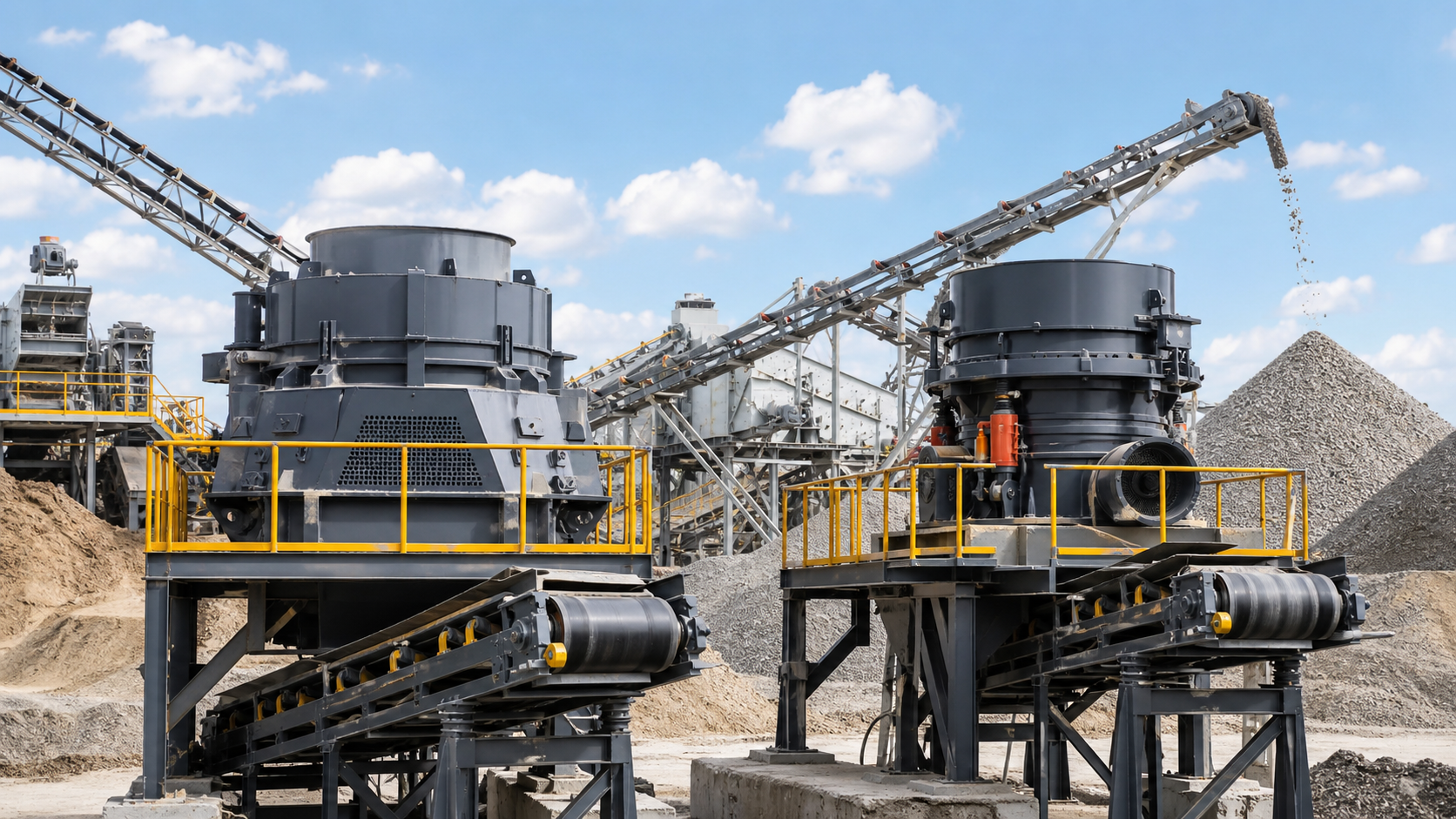
For buyers who want high-quality manufactured sand, the VSI crusher is normally the key final machine. It uses high-speed impact to break weak edges and improve cubical shape. A cone crusher uses compression crushing, so it is strong for reducing hard rock but may not produce enough well-shaped fine sand by itself.
| Factor | Cone Crusher | VSI Crusher |
|---|---|---|
| Main crushing method | Compression and bending | High-speed impact |
| Best stage | Secondary or tertiary crushing | Final sand making and shaping |
| Best use | Reducing hard rock to smaller aggregate | Producing cubical aggregate and 0-5 mm sand |
| Particle shape | Good, but may still include elongated particles | Usually better cubical shape |
| Fine sand production | Moderate | Higher, depending on rotor speed and screening |
| Feed size tolerance | Usually accepts larger feed | Requires controlled feed size |
| Wear cost driver | Mantle and concave liner life | Rotor tips, anvils, liners, and material abrasiveness |
| Typical role in sand plant | Prepare feed for VSI | Finish shaping and sand production |
What Is a Cone Crusher Best For?
A cone crusher crushes stone by squeezing it between a moving cone and a fixed liner. It is widely used after a jaw crusher because it can process hard and abrasive materials with stable capacity.
In a manufactured sand plant, the cone crusher is useful when the feed from the primary crusher is still too large for a VSI crusher. It reduces the material to a suitable size, then the vibrating screen sends qualified material to the VSI crusher for final shaping.
Cone crushers are commonly used for:
- Secondary crushing after a jaw crusher
- Tertiary crushing before a VSI crusher
- Producing 5-10 mm, 10-20 mm, and 20-30 mm aggregate
- Processing granite, basalt, quartz, river stone, and hard ore
- Building closed-circuit crushing systems with vibrating screens
The limitation is product shape and sand percentage. A cone crusher can produce some fines, but it is not usually the best final machine when the customer needs high-quality manufactured sand.
What Is a VSI Crusher Best For?
A VSI crusher, or vertical shaft impact crusher, uses a high-speed rotor to accelerate stone and throw it against a rock bed or metal anvils. This impact breaks weak edges, improves particle shape, and creates more fine material.
For manufactured sand, the VSI crusher often decides the final product quality. It helps reduce flaky and elongated particles, improve cubical shape, and produce sand suitable for concrete, asphalt, road base, and dry-mix mortar.
VSI crushers are commonly used for:
- Producing 0-5 mm manufactured sand
- Improving aggregate particle shape
- Final-stage crushing after cone or impact crushers
- Reducing flaky and needle-like particles
- Upgrading low-value aggregate into higher-value sand and shaped aggregate
The limitation is feed control. A VSI crusher should not receive oversized or unstable feed. If the feed is too large, rotor wear, vibration, and grading problems may increase.
Which Crusher Makes Better Manufactured Sand?
For final manufactured sand quality, a VSI crusher is usually better. It gives more impact and shaping action, so the final particles are often more cubical. The sand grading can also be adjusted by changing rotor speed, feed rate, cascade ratio, screening, and recirculation.
However, a VSI crusher should not do the whole job alone when the raw stone is large and hard. If the material is granite, basalt, or river stone, the plant normally needs jaw crushing and cone crushing before the VSI stage.
A practical rule is simple:
- Use a cone crusher when the main problem is reducing hard rock size.
- Use a VSI crusher when the main problem is improving shape and producing sand.
- Use both when the project requires high-quality manufactured sand from hard rock.
Recommended Equipment Configuration
The best configuration depends on raw material, output size, capacity, and product quality target.
1. Hard Rock Manufactured Sand Plant
For granite, basalt, quartz, and river stone, a common stationary layout is:
- Vibrating feeder
- Jaw crusher
- Cone crusher
- Vibrating screen
- VSI crusher
- Sand washer or air classifier
- Belt conveyors and control system
This configuration is suitable when the buyer needs both coarse aggregate and manufactured sand. The cone crusher reduces the hard rock, while the VSI crusher improves shape and increases sand output.
2. Aggregate Plant Without High Sand Requirement
If the quarry mainly sells coarse aggregate such as 10-20 mm or 20-30 mm, a jaw crusher, cone crusher, and vibrating screen may be enough.
This option can be suitable when:
- The main product is coarse aggregate, not 0-5 mm sand
- Local standards do not require very high cubical shape
- The buyer wants a simpler plant with lower initial investment
- The feed material is hard and abrasive
If the market later needs concrete sand or shaped aggregate, a VSI crusher can be added as the final stage.
3. Existing Plant Upgrade with VSI Crusher
Many quarries already have jaw and cone crushers but still struggle with poor particle shape or low sand value. In this case, adding a VSI crusher can be an efficient upgrade.
This is common when:
- The existing plant already produces enough 5-20 mm material
- The customer wants to increase 0-5 mm sand output
- The aggregate has too many flaky particles
- Concrete customers require better particle shape
- The quarry wants to sell higher-value manufactured sand
The VSI crusher receives controlled feed from the screen and works mainly as a shaping and sand making machine.
4. Mobile Cone and Mobile VSI Combination
For road construction, temporary quarry projects, and contractors who move between sites, a mobile crushing plant may be more practical.
A common mobile configuration is:
- Mobile jaw crusher for primary crushing
- Mobile cone crusher for secondary crushing
- Mobile VSI crusher and screen for final sand making
This setup requires higher investment than one single mobile crusher, but it gives more flexibility when the project needs quality sand in different locations.
Cost and Wear Considerations
The lowest machine price is not always the lowest cost per ton. Buyers should compare the full crushing system, not only the crusher model.
Important cost factors include:
- Raw material hardness and abrasiveness
- Maximum feed size
- Required capacity in tons per hour
- Target sand percentage and final grading
- Rotor tip, anvil, liner, mantle, and concave life
- Power consumption
- Screen area and conveyor capacity
- Dust control, washing, or air classification
- Automation and maintenance access
- Installation, foundation, transport, and spare parts support
A cone crusher may have lower wear cost in some hard rock reduction stages. A VSI crusher may have higher wear in abrasive applications, but it can create more saleable sand and better product shape. The key question is whether the improved product value can offset the additional wear and power cost.
Selection Criteria for Buyers
Before choosing between VSI crusher and cone crusher, prepare the technical information that affects the recommendation.
Raw Material
Granite, basalt, river stone, limestone, dolomite, and quartz behave differently in crushing. Hard and abrasive materials require stronger wear parts and careful crusher selection.
Feed Size
Cone crushers usually accept larger feed than VSI crushers. If the feed is too large for a VSI crusher, add jaw or cone crushing before the VSI stage.
Final Product Size
If the main target is 0-5 mm manufactured sand, a VSI crusher is usually important. If the target is mainly 10-20 mm aggregate, a cone crusher and screen may be enough.
Capacity
The required capacity affects crusher model, motor power, screening area, conveyor width, and closed-circuit design. A 50 TPH sand plant and a 300 TPH quarry plant need very different configurations.
Product Shape Requirement
Concrete, asphalt, and high-grade road aggregate often require better cubical shape. If particle shape is a selling point, include a VSI crusher in the final stage.
Mobile or Stationary Installation
A stationary plant is usually better for long-term quarry production. A mobile plant is better for contractors, short project timelines, and sites where quick installation is important.
Common Buyer Mistakes
Many sand making problems come from choosing one crusher without considering the full production line.
Common mistakes include:
- Using a VSI crusher as a primary crusher for oversized feed
- Expecting a cone crusher alone to produce premium manufactured sand
- Ignoring vibrating screen and return conveyor capacity
- Choosing a crusher based only on motor power or catalog capacity
- Forgetting that abrasive rock increases wear cost
- Not checking local sand standards before selecting the process
- Buying a mobile plant when a stationary plant has better long-term ROI
- Asking for a quotation without feed size, output size, and capacity details
The best crusher recommendation should be based on the entire process flow, not only the machine name.
Internal Reading
If you are still learning the basics of vertical shaft impact crushing, read What Is a VSI Crusher and How Does It Work? first. It explains the VSI working principle, typical applications, and basic selection factors.
Final Recommendation
If your project is mainly about hard rock size reduction, choose a cone crusher. If your project is mainly about manufactured sand quality, particle shape, and 0-5 mm output, choose a VSI crusher. If you are producing high-quality manufactured sand from granite, basalt, river stone, or other hard materials, the most reliable solution is often a jaw crusher plus cone crusher plus VSI crusher plus vibrating screen.
For an accurate recommendation, send your raw material, maximum feed size, required final sizes, capacity in tons per hour, site photos, local power conditions, and budget range. MVSI can help design a mobile or stationary crushing and sand making plant based on your project.
FAQ
Is a VSI crusher better than a cone crusher for sand making?
Yes. A VSI crusher is usually better for final manufactured sand production because it improves particle shape and produces more fine material. A cone crusher is better for reducing hard rock before the VSI stage.
Can a cone crusher produce manufactured sand?
A cone crusher can produce some fine material, especially in closed circuit, but it is not usually the best final machine for high-quality 0-5 mm manufactured sand. A VSI crusher is normally better for sand shape and grading control.
Do I need both cone crusher and VSI crusher?
You may need both if the raw material is hard and the project requires high-quality manufactured sand. The cone crusher reduces the stone to a suitable size, and the VSI crusher finishes shaping and sand production.
Which crusher is better for granite sand making?
For granite sand making, a jaw crusher plus cone crusher plus VSI crusher is often recommended. Granite is hard and abrasive, so it needs strong size reduction before final VSI shaping.
Which crusher has lower wear cost?
Wear cost depends on material abrasiveness, feed size, rotor speed, liner quality, and operation. A cone crusher may be more economical for hard rock reduction, while a VSI crusher may justify its wear cost by producing better-value manufactured sand.
What feed size is suitable for a VSI crusher?
The suitable feed size depends on the VSI model and rotor configuration. In most sand plants, the material should be reduced by jaw, cone, or impact crushers before entering the VSI crusher.
Is a mobile VSI crusher suitable for manufactured sand?
Yes. A mobile VSI crusher can produce manufactured sand on site, especially when combined with a mobile screen. It is useful for contractors, temporary quarries, and road construction projects.
What information should I provide before asking for a crusher quotation?
Send the raw material, maximum feed size, required output sizes, required capacity, site photos, mobile or stationary preference, local power conditions, and budget range. These details help the supplier recommend the correct crusher and plant layout.