A mobile crushing station (mobile crusher plant) is suitable for construction scenarios that require flexible deployment, fast relocation, and on-site material processing. It is widely used in mining operations, construction waste recycling, road and bridge projects, and sand & aggregate production sites. Its key advantage is the ability to crush materials directly at the source, reducing transportation costs and improving efficiency. Compared with fixed crushing lines, mobile crushing stations are especially valuable in projects with changing work locations or short construction cycles.
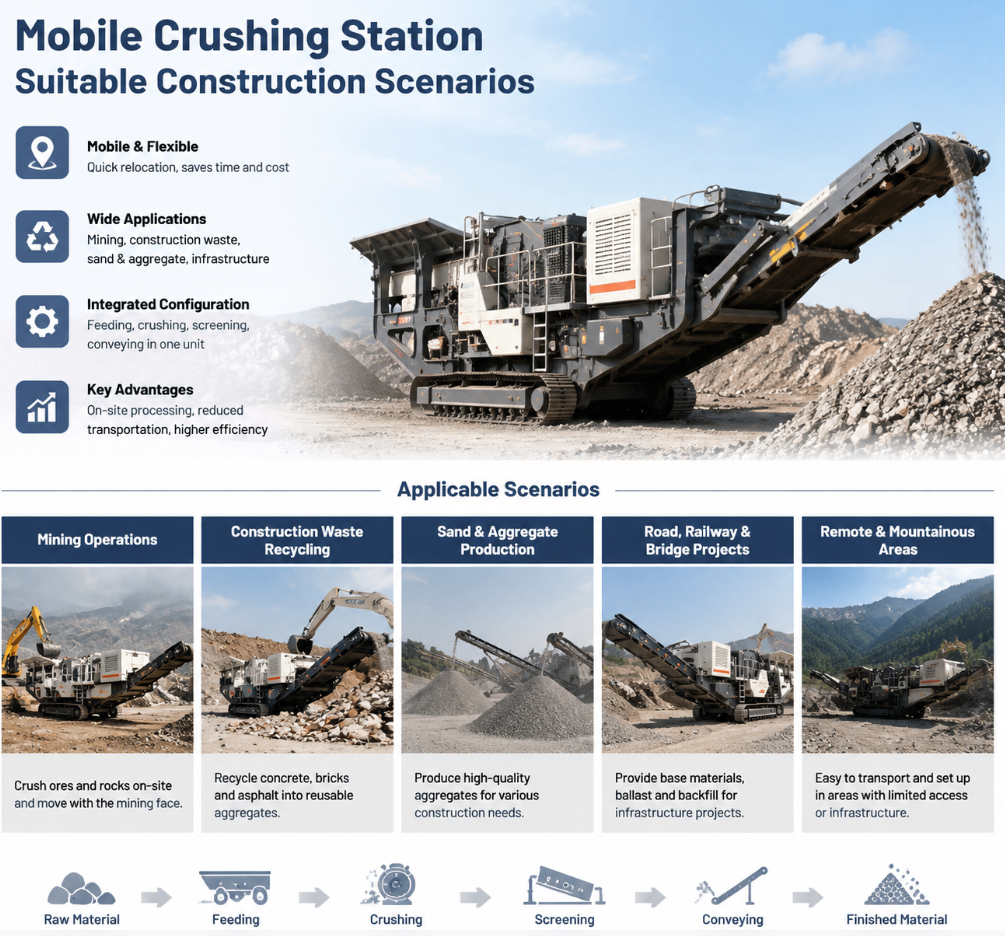
In practice, mobile crushing stations are ideal when:
- The working site frequently changes
- Raw materials are widely distributed
- On-site processing is required to reduce hauling costs
- Rapid project deployment is needed
1. Definition of Mobile Crushing Station
A mobile crushing station is a fully integrated crushing and screening system mounted on a wheeled or tracked chassis. It combines feeding, crushing, screening, and conveying into one unit.
Core components:
- Feeder system
- Crusher (jaw, cone, or impact type)
- Screening unit
- Conveyor belts
- Mobile chassis (tracked or wheeled)
- Power system (diesel or electric)
2. Main Application Scenarios
2.1 Mining Operations
Used in both open-pit and small-to-medium mines.
Typical materials:
- Granite
- Basalt
- Limestone
- Iron ore (pre-crushing stage)
Advantages:
- Moves with mining face
- Reduces haul truck dependency
- Improves ore handling efficiency
2.2 Construction Waste Recycling
One of the most common applications in urban environments.
Materials processed:
- Concrete waste
- Bricks
- Asphalt debris
Advantages:
- On-site recycling reduces landfill costs
- Produces reusable aggregates
- Supports green construction practices
2.3 Sand and Aggregate Production Plants
Used for producing building aggregates.
Workflow:
- Primary crushing → secondary crushing → screening
Advantages:
- Flexible production line configuration
- Quick relocation between quarry sites
- Suitable for small to medium aggregate demand
2.4 Road, Railway, and Bridge Projects
Ideal for linear infrastructure projects.
Examples:
- Highway base material production
- Railway ballast processing
- Bridge construction backfill
Advantages:
- Can move along project routes
- Eliminates long-distance material transport
2.5 Remote or Mountainous Construction Sites
Used in areas with difficult logistics.
Advantages:
- No need for fixed infrastructure
- Easy transport and setup
- Reduces construction downtime
3. Fixed vs Mobile Crushing Station Comparison
| Feature | Mobile Crushing Station | Fixed Crushing Plant |
|---|---|---|
| Installation time | Fast (hours–days) | Slow (weeks–months) |
| Mobility | High | None |
| Investment cost | Medium | High initial civil cost |
| Flexibility | Very high | Low |
| Output capacity | Medium | High |
| Best use case | Temporary / multi-site projects | Large long-term production |
4. Practical Application Examples
Example 1: Highway Construction Project
A contractor uses a tracked mobile crushing station to process nearby limestone. The equipment moves along the highway route, supplying aggregate for road base layers, reducing truck transport costs by over 40%.
Example 2: Urban Demolition Project
A city demolition project processes old concrete buildings on-site. The mobile crusher converts waste into recycled aggregates used for new infrastructure foundations.
Example 3: Small Quarry Operation
A quarry uses a mobile jaw crusher + cone crusher combination to produce graded aggregates without building a fixed plant, allowing relocation as mining zones shift.
5. Selection Advice (How to Choose)
When selecting a mobile crushing station, consider:
1. Material Type
- Hard rock → jaw + cone configuration
- Soft material → impact crusher
- Mixed construction waste → impact crusher with screening
2. Production Capacity
- Small projects: 50–100 TPH
- Medium projects: 100–300 TPH
- Large operations: 300+ TPH
3. Mobility Type
- Tracked: best for rough terrain and mining
- Wheeled: better for road transport and urban sites
4. Configuration Needs
- Single machine (basic crushing)
- Combined line (multi-stage crushing + screening)
5. Energy Source
- Diesel: remote areas
- Electric: fixed infrastructure sites
6. EEAT Considerations (Expertise & Trustworthiness)
This information reflects:
- Standard industrial crushing system engineering principles
- Common practices in mining and construction aggregate industries
- Widely used configurations in global quarrying and recycling operations
For real-world deployment, equipment selection should be based on:
- Geological survey data
- Material hardness (Mohs scale)
- Required product size distribution
- Local environmental regulations
7. FAQs (Frequently Asked Questions)
1. What is a mobile crushing station used for?
It is used for on-site crushing of rocks, construction waste, and aggregates in mining and construction projects.
2. Is it suitable for hard rock?
Yes, especially with jaw and cone crusher configurations.
3. Can it process construction waste?
Yes, it is widely used for concrete and brick recycling.
4. How fast can it be deployed?
Typically within a few hours to a couple of days depending on model.
5. What is the difference between tracked and wheeled types?
Tracked units are better for rough terrain; wheeled units are better for road transport.
6. Can it replace a fixed crushing plant?
In many temporary or medium-scale projects, yes. For large permanent production, fixed plants are still more efficient.
7. What industries use it most?
Mining, road construction, demolition recycling, and aggregate production.
8. Is maintenance difficult?
No, modern systems are designed for modular maintenance and quick part replacement.
Summary
Mobile crushing stations are best suited for flexible, temporary, or multi-location projects such as mining operations, construction waste recycling, and infrastructure development. Their main strengths are mobility, fast deployment, and on-site material processing, which significantly reduce logistics costs. Choosing the right configuration depends on material type, output requirements, and site conditions.