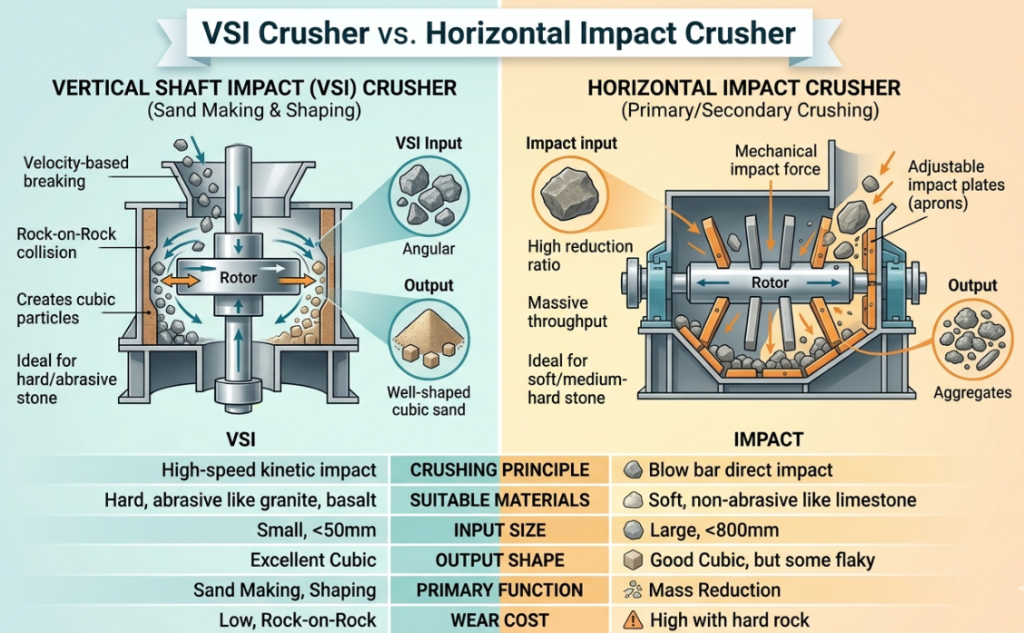
The main difference between a Vertical Shaft Impact (VSI) crusher and a horizontal Impact Crusher lies in their crushing mechanics, material suitability, and final output. VSI crushers use a vertical shaft to accelerate material against itself or an anvil, making them ideal for shaping hard, abrasive materials into high-quality cubic sand. Conversely, horizontal impact crushers utilize high-speed blow bars on a horizontal rotor to strike incoming rock, making them better suited for primary or secondary crushing of soft to medium-hard materials with higher capacities.
1. Technical Definitions
Understanding the core mechanics of each machine helps clarify their roles in aggregates production.
What is a Vertical Shaft Impact (VSI) Crusher?
A VSI crusher is a specialized machine designed for tertiary or quaternary crushing (sand making). It uses a high-speed rotor to fling rocks at velocities exceeding 60 meters per second.
The machine operates on two distinct principles:
- Rock-on-Rock (Stone-on-Stone): Rocks collide with other rocks lining the crushing chamber. This minimizes wear parts consumption and excels at shaping.
- Rock-on-Anvil (Stone-on-Iron): Rocks strike metallic alloy anvils. This offers a higher crushing ratio but increases wear when handling abrasive stone.
What is a Horizontal Impact Crusher?
A horizontal impact crusher (commonly referred to simply as an impact crusher) is a machine used for primary or secondary reduction. It features a horizontal rotor equipped with heavy blow bars. As rock enters the chamber, the spinning blow bars strike the material, throwing it against adjustable impact plates (aprons) for further reduction.
2. Core Comparison: Key Differences
| Feature | Vertical Shaft Impact (VSI) Crusher | Horizontal Impact Crusher |
|---|---|---|
| Rotor Orientation | Vertical | Horizontal |
| Primary Mechanism | Material-on-material kinetic impact | Mechanical impact from blow bars and aprons |
| Feed Size Capacity | Small (typically < 50mm) | Large (up to 300mm–800mm depending on model) |
| Primary Function | Sand making, shaping, cubical profiling | Mass reduction, primary/secondary crushing |
| Wear Cost (Hard Stone) | Extremely low (in Rock-on-Rock mode) | Very high (unsuitable for highly abrasive rock) |
| Moisture Tolerance | Low to moderate (sticky materials clog rotors) | Moderate |
3. Deep Dive into Key Performance Metrics
Crushing Principle
- VSI Crusher: Utilizes velocity and kinetic energy. The stone crushes itself in mid-air. This natural attrition breaks the rock along its natural cleavage planes.
- Impact Crusher: Utilizes mechanical force. The energy is transferred directly from the heavy power-driven rotor to the rock, forcing immediate breakage upon impact.
Output Particle Shape (Gradation and Sphericity)
- VSI Crusher: Produces an elite, highly cubical particle shape with minimal flaky or elongated needles. It is the industry standard for manufactured sand (M-sand).
- Impact Crusher: Produces good cubical shape compared to cone or jaw crushers, but the fine aggregate fraction contains more elongated particles than VSI output.
Material Suitability
- VSI Crusher: Ideal for hard, brittle, and highly abrasive materials. Examples include granite, basalt, quartzite, pebble, and cement clinker.
- Impact Crusher: Ideal for soft, medium-hard, and non-abrasive materials. Examples include limestone, gypsum, coal, and recycled concrete asphalt.
Production Capacity and Yield
- VSI Crusher: Lower total throughput capacity (typically 50–600 tons per hour), but boasts a highly concentrated yield of fine sand grains (0–5mm).
- Impact Crusher: High volume throughput (up to 2,000+ tons per hour). However, its yield of concrete-grade fine sand is low; it primarily generates structural aggregates (e.g., 10-20mm, 20-40mm).
4. Practical Application Examples
Case A: High-Speed Railway Concrete Production
- Material: Hard Basalt
- Goal: Grade-I concrete aggregates and manufactured sand.
- Solution: A VSI Crusher is mandatory here. Basalt would quickly destroy the blow bars of an impact crusher. Furthermore, high-speed rail concrete strictly limits elongated particles, a specification only achievable via VSI shaping.
Case B: Cement Plant Quarry Processing
- Material: Medium-soft Limestone
- Goal: Reduce run-of-mine boulders down to raw mill feed size (< 35mm).
- Solution: A Horizontal Impact Crusher is the correct choice. It accepts large feed sizes, offers a massive reduction ratio, and processes thousands of tons per shift efficiently.
5. Selection Advice: Which One Do You Need?
Choose a VSI Crusher if your project requires:
- Production of commercial concrete sand or asphalt top-layer aggregates.
- Processing of highly abrasive rocks like granite, river pebble, or quartz.
- Correction of poorly shaped aggregates coming from a cone crusher.
Choose a Horizontal Impact Crusher if your project requires:
- High tonnage reduction of low-abrasion rocks like limestone or recycled concrete.
- A primary or secondary crusher to feed downstream fine-crushing units.
- A machine that can handle larger feed sizes directly from a jaw crusher.
6. Frequently Asked Questions (FAQs)
1. Can a VSI crusher replace a horizontal impact crusher?
No. They serve different stages of production. An impact crusher reduces large rocks to intermediate sizes, while a VSI crusher takes those intermediate sizes and turns them into fine sand or perfectly shaped aggregates.
2. Why is a VSI crusher called a “shaper”?
Because its rock-on-rock mechanism grinds away sharp edges, corners, and flaky sections of stone, resulting in sphere-like, cubical particles that improve concrete strength.
3. Which machine has higher maintenance costs?
When processing hard stone, the horizontal impact crusher has significantly higher maintenance costs due to rapid wear on its blow bars. The VSI crusher protects itself using a lining of the rock itself, saving on wear parts.
4. What is the maximum feed size for a VSI sand maker?
Most industrial VSI crushers accept a maximum feed size between 30mm and 50mm, depending on the rotor diameter.
5. Can I use an impact crusher to make sand?
Yes, but it is inefficient. An impact crusher will generate a high percentage of coarse aggregates and excessive stone dust, rather than the controlled gradation required for quality concrete sand.
6. How does moisture content affect these crushers?
High moisture and clay content can cause sticky materials to plug the internal rotor passages of a VSI crusher. Horizontal impact crushers handle minor moisture better, though sticky materials can still clog the aprons.
7. What does “M-Sand” mean in relation to these machines?
M-Sand stands for Manufactured Sand. VSI crushers are the primary equipment used to produce M-Sand as an eco-friendly alternative to river sand.
8. Which crusher consumes more power per ton?
The VSI crusher typically consumes more power per ton of fine output because accelerating rock to extreme velocities requires high rotational energy.
7. Summary
Vertical Shaft Impact (VSI) crushers and horizontal impact crushers are complementary rather than competing technologies. The horizontal impact crusher is a high-capacity machine built for breaking down soft to medium stone early in the crushing circuit. The VSI crusher is a precision tool built for the final stage, turning hard or abrasive stone into premium, cubical manufactured sand. Selecting the right machine depends entirely on your feed material hardness, input size, and final product specifications.