Choosing a cone crusher model depends on four core factors: feed size (inlet opening), discharge size range, motor power, and required production capacity. You must also consider the type of ore, required final particle shape, and whether the crusher is used for secondary or tertiary crushing. In general, hard and abrasive materials require higher power and smaller chamber designs, while high-capacity projects need larger feed openings and stronger motors. A proper selection ensures stable operation, lower wear costs, and optimal crushing efficiency.
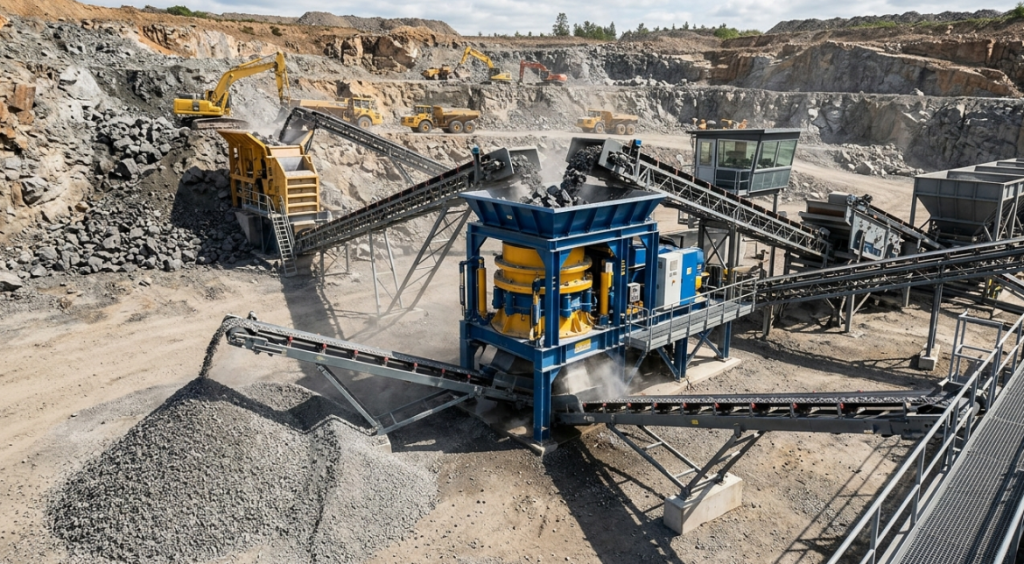
1. What Is a Cone Crusher? (Definition)
A cone crusher is a compression-type crushing machine used to reduce medium-hard to hard materials by squeezing rock between a rotating mantle and a fixed concave liner.
It is widely used in:
- Mining operations
- Aggregate production
- Construction material processing
- Mineral beneficiation plants
2. Key Parameters for Model Selection
(1) Feed Opening Size
Defines the maximum rock size the crusher can accept.
- Small models: 35–100 mm
- Medium models: 100–200 mm
- Large models: 200–350 mm+
(2) Discharge Size Range
Determines final product size.
- Fine crushing: 3–13 mm
- Medium crushing: 10–30 mm
- Coarse crushing: 20–50 mm
(3) Motor Power
Impacts crushing force and stability.
- Small: 75–160 kW
- Medium: 160–315 kW
- Large: 315–600+ kW
(4) Production Capacity
Measured in tons per hour (t/h).
- Small scale: 30–100 t/h
- Medium scale: 100–300 t/h
- Large scale: 300–1500 t/h
3. Suitable Ore Types
Cone crushers are best for hard and abrasive materials.
Common materials:
- Granite
- Basalt
- River pebbles
- Iron ore
- Copper ore
- Limestone (medium hardness)
- Quartz
Not ideal for:
- Very sticky clay materials
- High moisture feed without preprocessing
4. Selection Based on Application Stage
| Crushing Stage | Feed Size | Output Size | Recommended Model Type |
|---|---|---|---|
| Secondary | 100–300 mm | 20–60 mm | Standard cone crusher |
| Tertiary | 50–150 mm | 5–30 mm | Fine cone crusher |
| Quaternary | <50 mm | 3–10 mm | Ultra-fine cone crusher |
5. Practical Selection Examples
Example 1: Granite Aggregate Plant (200 t/h)
- Material: hard granite
- Requirement: 5–20 mm aggregates
- Recommended:
- Medium cone crusher (200–250 kW)
- Feed opening around 150–200 mm
Example 2: Iron Ore Processing Plant (500 t/h)
- Material: high hardness ore
- Requirement: stable continuous crushing
- Recommended:
- Large hydraulic cone crusher
- High power (315–500 kW)
- Multi-cylinder system preferred
Example 3: River Pebble Sand Plant (120 t/h)
- Material: medium-hard, rounded stone
- Requirement: sand-making feed preparation
- Recommended:
- Small-to-medium cone crusher
- Fine cavity type
6. Selection Checklist (Engineering Perspective)
Before choosing a model, confirm:
- Maximum feed size of raw material
- Required final product size distribution
- Daily production target (t/h)
- Hardness (Mohs scale or compressive strength)
- Moisture content of feed
- Whether continuous operation is required
- Maintenance accessibility and liner cost
7. Common Mistakes in Model Selection
- Choosing oversized models → increases cost without efficiency gain
- Ignoring feed size variation → causes blockage
- Selecting wrong cavity type → poor particle shape
- Underestimating power requirement → unstable operation
- Overlooking wear cost of liners
8. Technical Comparison of Cone Crusher Types
| Type | Structure | Best Use | Advantages | Limitations |
|---|---|---|---|---|
| Spring Cone Crusher | Mechanical spring | General crushing | Simple, low cost | Lower precision |
| Single-Cylinder Hydraulic | Hydraulic adjustment | Medium-hard ore | Stable, easy control | Limited output for large plants |
| Multi-Cylinder Hydraulic | Multiple hydraulic cylinders | High-end mining | High efficiency, precise | Higher investment |
| Compound Cone Crusher | Hybrid design | General aggregates | Balanced performance | Moderate automation |
9. EEAT-Based Engineering Advice
From an engineering standpoint, the most important selection principle is:
Match “ore hardness + feed size + required output” before selecting power or model size.
Industry experience shows that many production failures come from misalignment between:
- Feed size vs cavity design
- Capacity expectation vs real throughput
- Hardness vs liner wear resistance
Professional plants usually perform material testing (hardness + gradation analysis) before final model selection.
10. Frequently Asked Questions (FAQs)
1. What is the main function of a cone crusher?
It reduces medium-hard and hard rocks into smaller, uniform-sized aggregates using compressive force.
2. How do I know which size cone crusher I need?
Base it on feed size, output requirement, and hourly production capacity.
3. Can cone crushers produce sand?
Yes, fine cone crushers can produce sand-like material, often used as VSI feed.
4. What is the difference between standard and fine cone crushers?
Standard types handle larger feed; fine types produce smaller, more uniform output.
5. Which ore is best suited for cone crushers?
Hard and abrasive ores like granite, basalt, iron ore, and quartz.
6. How important is motor power in selection?
Very important—it determines crushing force and capacity stability.
7. What happens if I choose the wrong model?
You may face blockage, high wear costs, low efficiency, or unstable output.
8. Is hydraulic control necessary?
For medium and large plants, hydraulic systems improve safety and adjustment efficiency.
Summary
Selecting a cone crusher model requires balancing feed size, discharge requirements, motor power, production capacity, and ore hardness. The best choice is not always the largest machine, but the one that matches your material characteristics and production goals. Proper selection improves efficiency, reduces wear costs, and ensures long-term stable operation.