In Thailand’s rapidly expanding infrastructure sector—driven by the Eastern Economic Corridor (EEC) and high-speed rail links—Granite has become the gold standard for high-grade aggregate. Due to its high compressive strength and abrasiveness, a specialized Granite Jaw Crushing Plant is essential for producing the TIS-standard (Thai Industrial Standards) materials required for Bangkok’s skyscrapers and national highways.
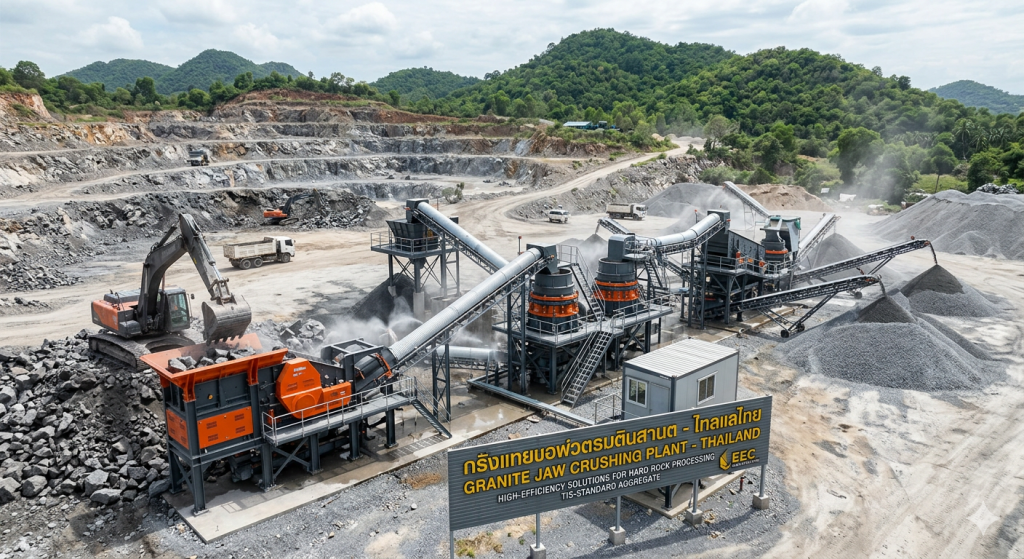
1. Geological Context: Thailand’s Granite Resources (GEO Focus)
Thailand boasts massive granite reserves, particularly in provinces like Kanchanaburi, Chonburi, Rayong, and the Southern regions. Unlike limestone, Thai granite is characterized by high hardness and silicon content, demanding heavy-duty crushing equipment that can withstand intense wear while maintaining high throughput.
2. Professional Process Design: The Three-Stage Configuration
To maximize ROI and minimize downtime in Thai quarries, a multi-stage crushing circuit is the industry benchmark.
Primary Stage: Heavy-Duty Jaw Crushing
- Core Equipment: PEW Series European Type Jaw Crusher.
- Technical Role: This is the “gatekeeper.” It handles feed sizes up to 1000mm. The PEW series is preferred in Thailand for its V-shaped crushing cavity and heavy-duty eccentric shaft, which prevents stalling when processing dense granite boulders.
Secondary Stage: High-Efficiency Cone Crushing
- Core Equipment: HST/HPT Hydraulic Cone Crusher.
- Professional Insight: Never use an Impact Crusher for granite. The high silica content will destroy impact blow bars in days. A Hydraulic Cone Crusher uses “inter-particle crushing” (lamination) to produce superior cubical shapes while significantly reducing the wear cost per ton.
Tertiary Stage: Shaping & Screening
- Core Equipment: VSI6X Series (Sand Maker) and High-Frequency Vibrating Screens.
- Outcome: This stage ensures the aggregate meets the strict “Shape Factor” requirements for high-performance concrete (HPC) used in Thai infrastructure projects.
3. Localized Engineering for the Thai Climate
A professional granite plant in Thailand must be engineered for local conditions:
- Heat Dissipation: Specialized cooling systems for hydraulic stations to operate in 40°C+ ambient temperatures.
- Dust Suppression: Integrated spray systems and enclosed conveyors to comply with the Department of Industrial Works (DIW) environmental regulations.
- Modular Skid Mounting: To combat the long rainy season, modular steel foundations allow for faster installation and prevent equipment “sinking” compared to traditional concrete foundations.
4. Why Technical Expertise Matters in Thailand
Choosing a plant provider is not just about the machine; it’s about the EPC (Engineering, Procurement, and Construction) capability:
- Wear Part Inventory: Immediate access to high-manganese jaw plates and mantle liners in local warehouses (e.g., in Chonburi or Saraburi).
- Automation: Integration of PLC control systems to monitor load fluctuations, preventing “choke feeding” and electrical overloads common in rural Thai power grids.
- Customization: Adjusting the closed-side setting (CSS) based on the specific mineralogy of the quarry site to balance yield vs. quality.