Choosing the right crusher model based on production capacity requires balancing four key factors: required output (tons per hour), raw material hardness, desired final particle size, and production configuration (primary, secondary, or tertiary crushing). In general, higher capacity plants require multi-stage crushing systems rather than a single machine. Soft materials may only need impact crushers, while hard rocks require jaw + cone combinations. Output size also determines whether fine crushing or shaping equipment is needed. A correct match ensures stable production, lower energy consumption, and reduced wear costs.
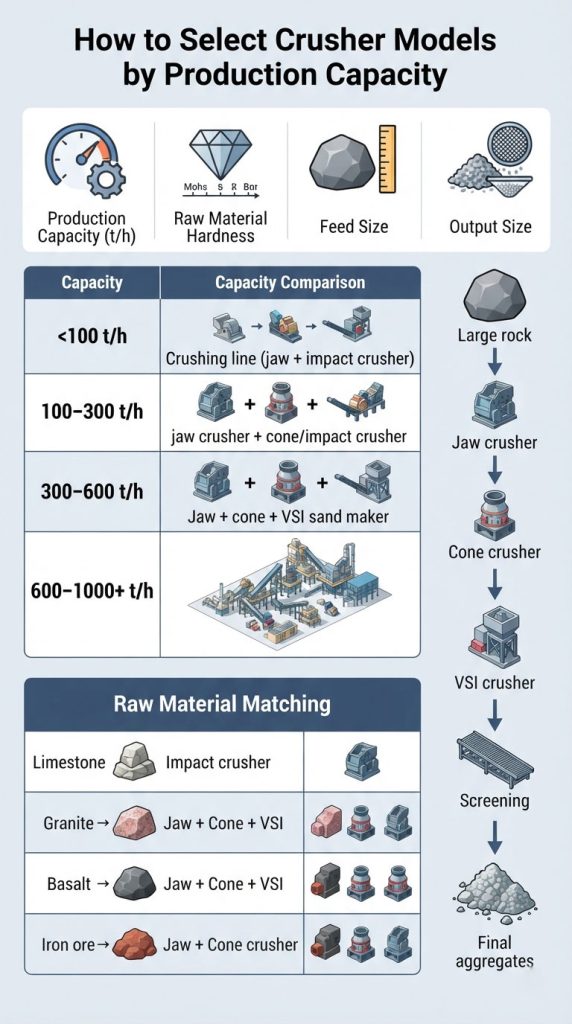
This guide explains how to select crusher models scientifically and avoid over- or under-sizing equipment.
1. Key Definition: What “Crusher Model Selection” Means
Crusher model selection refers to choosing equipment specifications based on:
- Processing capacity (t/h)
- Feed size (mm)
- Material hardness (Mohs scale or compressive strength)
- Required final product size distribution
A mismatch often leads to:
- Low efficiency
- Excessive wear
- Unstable product quality
- Higher operating cost
2. Four Core Factors That Determine Crusher Selection
1) Production Capacity (Most Important)
- Small line: <100 t/h
- Medium line: 100–300 t/h
- Large line: 300–1000+ t/h
Higher capacity usually requires:
- Larger feed opening
- Parallel machines or multi-stage systems
2) Raw Material Hardness
- Soft rock (limestone, weathered stone)
- Medium-hard (granite, basalt)
- Hard rock (quartz, high-silica ore)
Harder materials require:
- Strong compression crushers (jaw/cone)
- Higher wear resistance
3) Feed Size
- Large boulders (600–1500 mm): jaw crusher required
- Medium feed (100–300 mm): cone or impact crushers
- Fine feed (<100 mm): shaping or sand-making machines
4) Output Size Requirement
Typical output ranges:
- 0–5 mm (sand)
- 5–10 mm
- 10–20 mm
- 20–40 mm (aggregate)
Finer output = more crushing stages needed.
3. Crusher Model Selection by Capacity (Practical Table)
| Production Scale | Recommended Setup | Suitable Equipment | Application |
|---|---|---|---|
| <100 t/h | Single or simple line | Jaw crusher + impact crusher | Small quarry, building materials |
| 100–300 t/h | Two-stage line | Jaw + cone/impact crusher | Medium aggregate plants |
| 300–600 t/h | Multi-stage line | Jaw + cone + VSI | Large sand & gravel plants |
| 600–1000+ t/h | Industrial line | Multiple jaw + cone + screening system | Highway, railway projects |
4. Matching Crusher Types to Material Hardness
| Material Type | Recommended Primary | Secondary | Tertiary |
|---|---|---|---|
| Limestone | Jaw crusher | Impact crusher | Optional |
| Granite | Jaw crusher | Cone crusher | VSI sand maker |
| Basalt | Jaw crusher | Cone crusher | VSI shaping |
| Iron ore | Jaw crusher | Cone crusher | Fine crusher |
5. Selection Process (Step-by-Step)
Step 1: Define production target
Example: 200 t/h aggregate plant
Step 2: Identify raw material
Example: granite (hard rock)
Step 3: Determine feed size
Example: 800 mm boulders
Step 4: Define output size
Example: 0–31.5 mm aggregate
Step 5: Build process flow
- Jaw crusher (primary)
- Cone crusher (secondary)
- VSI crusher (shaping)
- Screening system
6. Practical Example
Case: 300 t/h Granite Crushing Plant
Requirements:
- Feed: 0–900 mm granite
- Output: 0–5 mm + 5–10 mm + 10–20 mm
Recommended configuration:
- Jaw crusher: primary crushing
- Cone crusher: secondary crushing
- VSI crusher: final shaping
Result:
- Stable output
- Better particle shape
- Reduced wear cost
7. Common Mistakes in Crusher Selection
- Choosing based only on price
- Ignoring material hardness
- Oversizing a single machine instead of using stages
- Not considering maintenance and wear parts cost
- Wrong feed size matching
8. FAQs
Q1: Can one crusher handle all production needs?
No. Most medium and large plants require multi-stage crushing.
Q2: What is the most important selection factor?
Production capacity combined with material hardness.
Q3: How do I know if I need a cone crusher?
If your material is hard rock like granite or basalt, a cone crusher is usually required.
Q4: What happens if capacity is underestimated?
The system becomes overloaded, causing downtime and wear.
Q5: Can I use an impact crusher for granite?
Not recommended for primary crushing; may be used for shaping in some cases.
Q6: How does feed size affect model selection?
Larger feed requires stronger primary crushers like jaw crushers.
Q7: Do higher capacity machines always mean better efficiency?
No. Oversized machines can waste energy and increase cost.
Q8: Should I consider future expansion?
Yes. It is recommended to design 10–20% capacity buffer.
Summary
Selecting a crusher model based on production capacity requires understanding four core factors: throughput, material hardness, feed size, and output requirements. The most efficient systems are not single machines but well-designed multi-stage crushing lines. A proper match improves productivity, reduces wear, and ensures stable product quality for long-term operation.