Crusher prices vary widely depending on type, capacity, brand, and whether the equipment is domestic or imported. In general, a small crusher can cost around $5,000–$30,000, while medium industrial crushers range from $30,000–$150,000. Large mining-grade crushing equipment or full production line crushers can exceed $150,000–$500,000+.
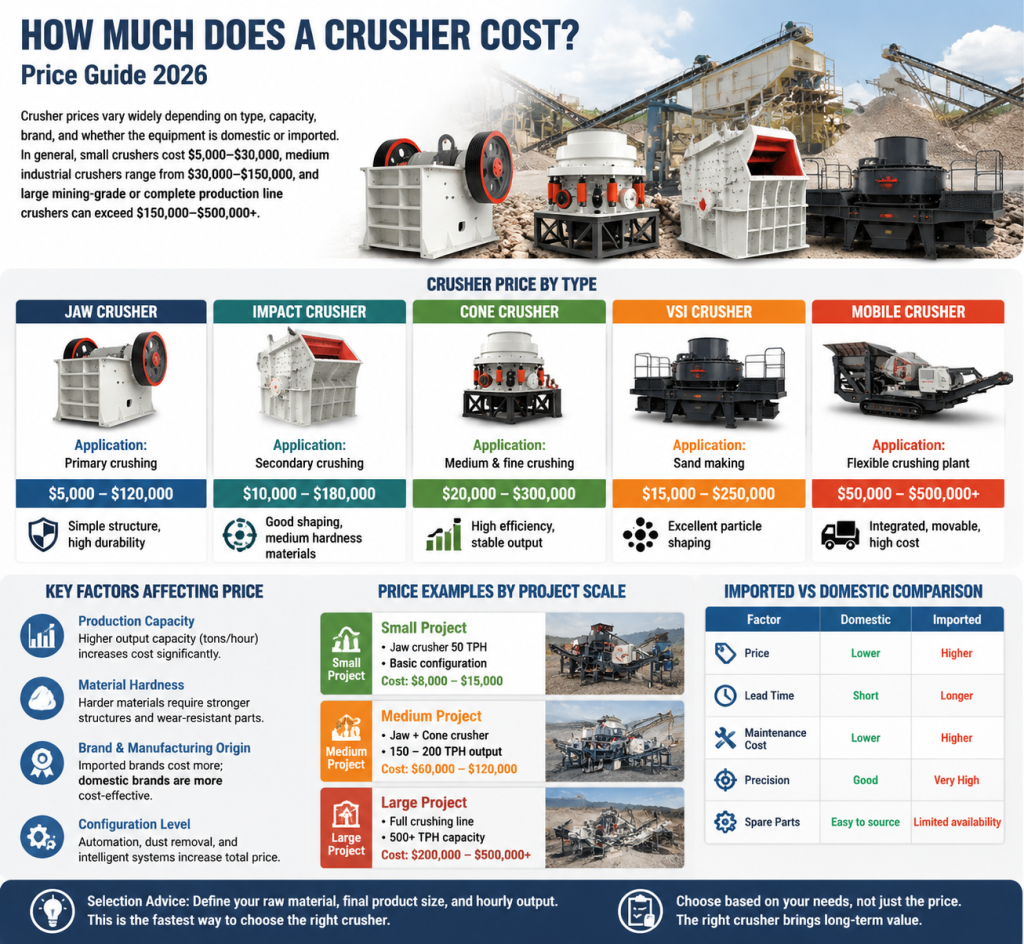
The final price depends mainly on:
- Crusher type (jaw, cone, impact, VSI)
- Processing capacity (tons per hour)
- Brand reputation
- Material hardness requirements
- Automation level and configuration
- Domestic vs imported manufacturing
What Is a Crusher? (Definition)
A crusher is a machine used in mining, construction, and aggregate industries to reduce large rocks into smaller, usable sizes. It is a core machine in sand and gravel production lines and mineral processing plants.
Common functions:
- Primary crushing (large rocks → medium size)
- Secondary crushing (medium → fine size)
- Shaping and sand making
Crusher Price by Type
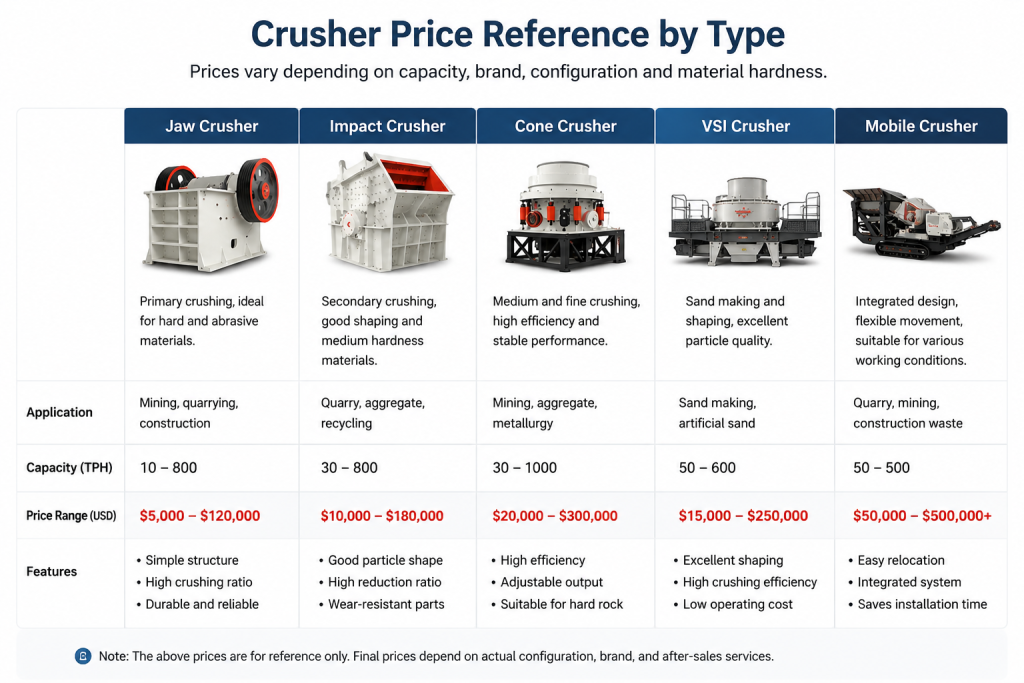
Different crusher types serve different stages of crushing, which significantly affects price.
| Crusher Type | Application | Price Range (USD) | Features |
|---|---|---|---|
| Jaw Crusher | Primary crushing | $5,000 – $120,000 | Simple structure, high durability |
| Impact Crusher | Secondary crushing | $10,000 – $180,000 | Good shaping, medium hardness materials |
| Cone Crusher | Medium & fine crushing | $20,000 – $300,000 | High efficiency, stable output |
| VSI Crusher | Sand making | $15,000 – $250,000 | Excellent particle shaping |
| Mobile Crusher | Flexible crushing plant | $50,000 – $500,000+ | Integrated, movable, high cost |
Key Factors That Affect Crusher Price
1. Production Capacity
Higher output capacity (tons/hour) increases cost significantly.
- 50–100 TPH: entry-level equipment
- 100–300 TPH: mid-range production
- 300–1000+ TPH: large mining systems
2. Material Hardness
Harder materials like granite or basalt require stronger structures and wear-resistant parts, increasing cost.
3. Brand & Manufacturing Origin
- Chinese manufacturers: more cost-effective
- European/American brands: higher precision and durability, higher price
4. Configuration Level
Add-ons such as:
- Automation systems
- Dust removal systems
- Intelligent monitoring
will increase total price.
Real-World Price Examples
Example 1: Small Construction Project
- Jaw crusher 50 TPH
- Basic configuration
👉 Cost: $8,000–$15,000
Example 2: Medium Quarry Plant
- Jaw crusher + cone crusher combination
- 150–200 TPH output
👉 Cost: $60,000–$120,000
Example 3: Large Mining Operation
- Full crushing line (jaw + cone + VSI + screening)
- 500+ TPH capacity
👉 Cost: $200,000–$500,000+
Imported vs Domestic Crusher Pricing
| Factor | Domestic (e.g., China) | Imported (Europe/US) |
|---|---|---|
| Price | Lower | Higher |
| Lead Time | Short | Longer |
| Maintenance Cost | Lower | Higher |
| Precision | Good | Very High |
| Spare Parts | Easy to source | Limited availability |
How to Choose the Right Crusher
When selecting a crusher, consider:
- Material type (limestone, granite, ore, etc.)
- Required output size
- Production capacity needs
- Budget range
- Maintenance availability
- Energy consumption
Practical selection advice:
If you are unsure, start by defining:
“What is the raw material + final product size + hourly output?”
This is the fastest way to choose the correct model.
Common Buying Mistakes
- Choosing based only on lowest price
- Ignoring wear part costs
- Overestimating required capacity
- Not considering after-sales support
- Buying without testing material suitability
8 Frequently Asked Questions (FAQs)
1. What is the cheapest type of crusher?
Jaw crushers are usually the most affordable option.
2. Why are crusher prices so different?
Because of capacity, materials, structure, and brand differences.
3. Is a more expensive crusher always better?
Not always. It depends on your material and production needs.
4. How long does a crusher last?
Typically 5–15 years depending on maintenance and usage.
5. Can I buy a full crushing line instead of one machine?
Yes, complete production lines are common in mining projects.
6. What is the maintenance cost of a crusher?
Usually 3%–10% of equipment price annually.
7. Do imported crushers perform better?
They may offer higher precision, but domestic machines often provide better cost-performance.
8. What affects wear part costs?
Material hardness, operating hours, and crusher type.
Summary
Crusher prices vary from $5,000 to over $500,000 depending on type, capacity, and configuration. Jaw crushers are the most affordable, while mobile and full crushing lines are the most expensive. The best choice depends on your material type, production needs, and long-term operating cost rather than price alone.