As Malaysia accelerates its infrastructure pipeline—driven by the East Coast Rail Link (ECRL), the Pan Borneo Highway, and rapid urban development in the Klang Valley—the demand for high-quality limestone aggregate has reached a peak.
For quarry operators in Perak (the limestone hub), Pahang, and Sarawak, transitioning from traditional setups to high-efficiency, automated production plants is no longer optional; it is a competitive necessity.
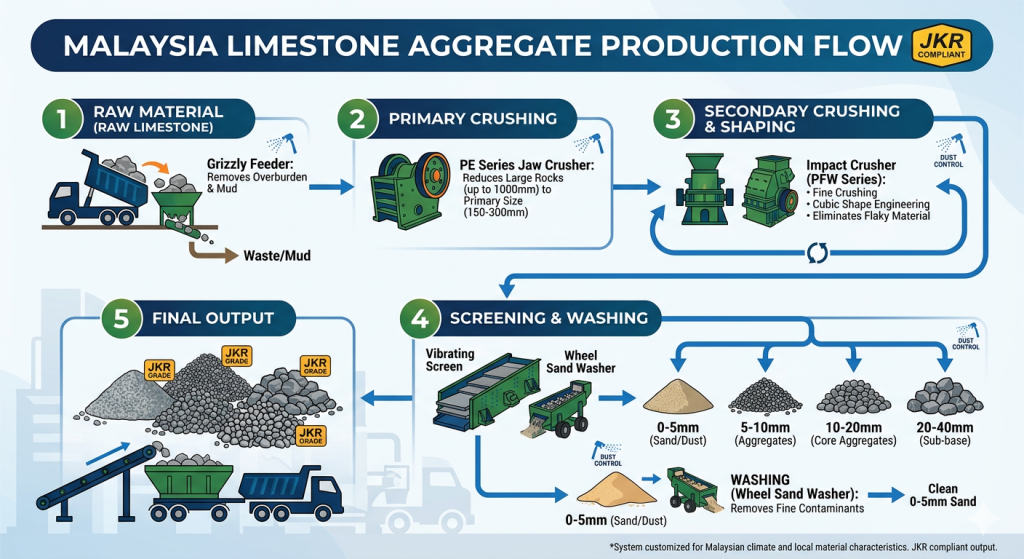
The Technical Core: Limestone Processing Stages
To meet Malaysia’s JKR (Jabatan Kerja Raya) specifications for road base and concrete aggregates, a limestone plant must balance throughput with cubicity.
1. Primary Crushing: Handling the Feed
The process begins with a heavy-duty Vibrating Grizzly Feeder (VGF). In Malaysia’s tropical climate, raw limestone often contains moisture and clay. A feeder with adjustable grizzly bars effectively pre-screens fines, preventing downstream clogging.
- Core Equipment: Jaw Crusher (e.g., PE or PEX series).
- Objective: Reduce large run-of-mine (ROM) boulders (up to 1000mm) to a manageable size (150-200mm).
2. Secondary Crushing: The Impact Advantage
Since limestone is a medium-hard, non-abrasive rock, the Impact Crusher (PFW or PF series) is the industry standard in Malaysia. Unlike cone crushers, impactors produce a superior cubical shape with fewer internal fractures, which is critical for high-strength concrete.
- Key Advantage: Higher reduction ratio and better “flakiness index” control.
3. Precision Screening: Grading for JKR Standards
Multi-deck Circular Vibrating Screens are used to separate the crushed material into marketable sizes, typically:
- 0–5mm: M-Sand/Quarry Dust (for brickmaking and asphalt).
- 5–10mm / 10–20mm: Aggregates for RMC (Ready-Mix Concrete).
- 20–40mm: Sub-base and drainage layers.
4. Environmental & Moisture Control
Given Malaysia’s stringent DOE (Department of Environment) regulations, modern plants must integrate:
- Dust Suppression Systems: High-pressure water misters at discharge points.
- Sand Washing: If the limestone has high clay content, a XSD Sand Washer is integrated to ensure the 0-5mm fraction meets clean silt-content standards.
Why Malaysia? Market Opportunities for Quarry Operators
- Abundant Resources: The Kinta Valley in Perak remains one of the world’s richest limestone regions, offering high calcium carbonate purity for both construction and industrial use.
- Infrastructure Boom: Ongoing projects in Johor (SERS) and the Sarawak Post-COVID Development Strategy 2030 are driving massive localized demand for aggregate.
- Cost-Efficiency: Modern automated plants reduce the reliance on manual labor, addressing the current labor shortages in the Malaysian industrial sector.
Choosing the Right Plant Partner
When investing in a limestone production line in Malaysia, look for providers who offer:
- Localized Support: Spare parts inventory in hubs like Shah Alam or Ipoh.
- Customizable Layouts: Ability to adapt to the specific topography of limestone hills (Karst morphology).
- Energy Efficiency: Motors compliant with Malaysian industrial standards to lower the cost-per-ton.
Conclusion
A high-performance Limestone Aggregate Production Plant is the backbone of Malaysia’s construction future. By focusing on Impact Crushing technology and advanced screening, operators can turn raw limestone into high-value JKR-grade materials with maximum ROI.
Are you planning a new quarry setup or upgrading an existing line? Contact us for a customized flow chart and quotation.